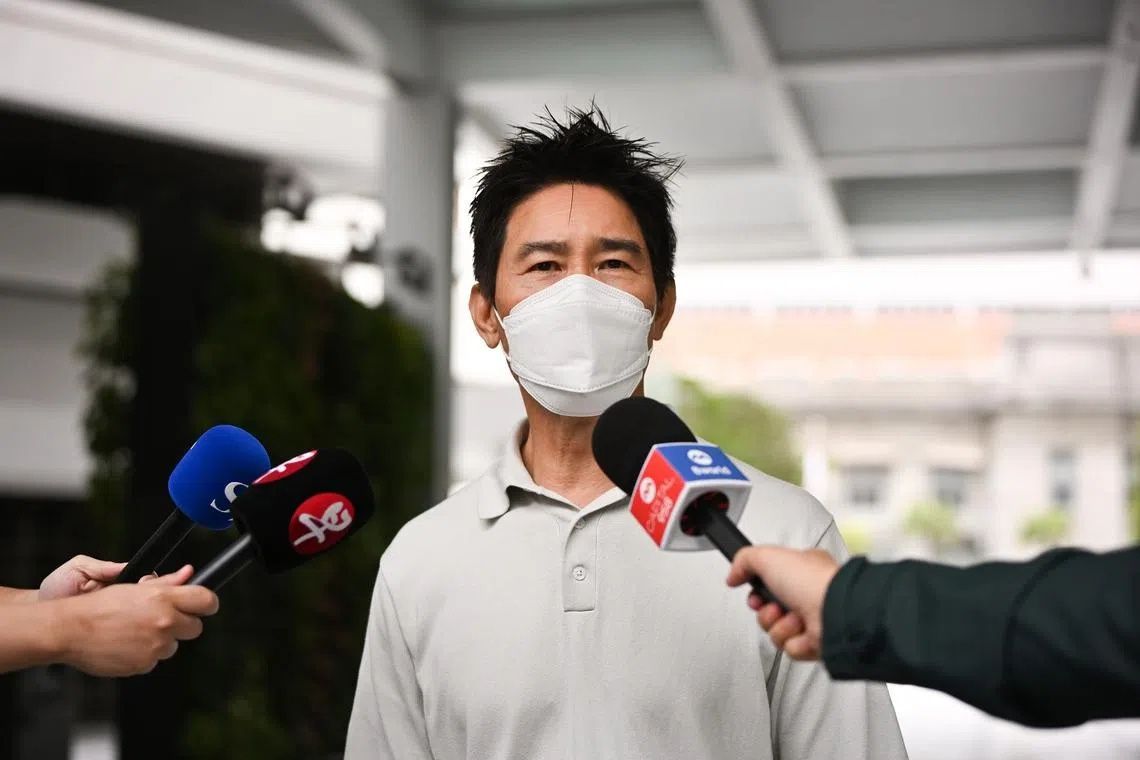
A Singapore High Court has substantially reduced the custodial sentence imposed on Edmund Chen, a 64-year-old former television actor, from five days to just one day following his appeal against a conviction for causing grievous hurt in a traffic accident. The decision, handed down on Monday (July 20), represents a significant reversal from the original sentencing handed out by the district court in January, though Justice Hri Kumar Nair stopped short of endorsing the defence argument that no jail time was warranted at all.
The incident in question occurred on the afternoon of March 4, 2025, when Chen's vehicle collided with a motorcyclist along the Ayer Rajah Expressway heading towards the Central Expressway in Singapore. The accident resulted in the motorcyclist, aged 21, sustaining multiple fractures to both wrists that required surgical intervention. The High Court's decision to slash the jail term reflects a reassessment of the proportionality of punishment in a case where the victim ultimately recovered without permanent disability despite requiring hospitalisation.
Chen, whose legal name is Tan Kai Yuan, had pleaded guilty to operating his vehicle without due consideration for other road users in contravention of Singapore's traffic laws. The circumstances surrounding the collision are significant for understanding the court's reasoning. Chen had been attempting to change lanes across multiple vehicles to access the CTE/SLE junction but had failed to position his car in the correct lane well in advance of the required turnoff. His vehicle had been moving slowly—nearly at a complete stop—as he attempted to filter from the fourth lane across the third lane to reach the expressway entrance.
The defence team, led by Senior Counsel Abraham Vergis of Providence Law Asia, mounted a comprehensive argument that challenged both the necessity and the severity of the custodial sentence. A critical element of their case involved dashcam footage from Chen's vehicle, which was played in court and demonstrated several mitigating factors. The footage showed that Chen had activated his indicator lights before changing lanes, suggesting he had taken some precaution to signal his intention. Moreover, Vergis highlighted that at the moment the motorcycle approached from behind, a passing vehicle had obscured the motorcyclist from view due to the curvature of the roadway, which could have contributed to the collision being unavoidable from Chen's perspective.
The severity of the victim's injuries and the nature of the harm became a focal point of the appellate hearing. Vergis submitted that the fractures sustained were localised to the wrists and therefore on the less severe spectrum of what constitutes grievous hurt under Singapore law. The fact that surgical repair was performed under local anaesthesia, rather than general anaesthesia, was presented as evidence that the injuries, while serious enough to warrant surgery, did not represent a catastrophic level of trauma. The victim had spent two days in Singapore General Hospital and was subsequently granted 99 days of hospitalisation leave, but crucially suffered no long-term disability or permanent impairment from the incident.
Justice Hri Kumar Nair's reasoning in allowing the appeal proved nuanced and measured. The judge acknowledged that while he could not definitively conclude the original district judge had erred in determining that the custodial threshold had been crossed—meaning some prison time was legally justified—the magnitude of the five-day sentence was plainly excessive given the totality of circumstances. This distinction is important within Singapore's sentencing framework; the judge was effectively saying that while jail time might be appropriate, the original judge had applied it too severely. The court maintained a five-year driving disqualification, underlining the seriousness with which Singapore treats dangerous driving behaviour, even when reducing the custodial component.
The prosecution's response, articulated by Deputy Public Prosecutor Ben Tan, resisted the appeal and argued for the imposition of a substantial fine up to the maximum of S$5,000 coupled with the five-year driving ban. The DPP drew attention to a particularly concerning aspect of the original incident: as Chen was executing his dangerous manoeuvre, drivers of two separate vehicles had sounded their horns in warning, yet Chen persisted with the lane change regardless. This persistence in the face of audible warnings had influenced the district judge's original decision to impose custodial time, signalling not merely momentary inattention but a failure to heed clear danger signals from other motorists.
Chen's personal circumstances surrounding the sentencing process underscored the emotional and psychological toll of the case. In an address to reporters before the appellate hearing, he revealed that he had prepared five days' worth of medication in anticipation of serving the full original sentence, and that both he and his family had been unable to sleep the night before the proceedings. This testimony painted a picture of considerable anxiety and dread about the prospect of incarceration at his age. His legal representation underwent changes following the original sentencing; after his initial conviction, Chen engaged prominent counsel Abraham Vergis, having previously been represented by Josephus Tan and Cory Wong of Invictus Law, followed by Kelvin Ong and Dickson Chew from Contigo Law.
Chen's profile as a public figure likely added another dimension to the proceedings, though the courts maintain strict impartiality regardless of a defendant's celebrity status. He remains a recognisable face in Singapore's entertainment landscape, having built a substantial television career spanning multiple decades with appearances in popular drama series including Star Maiden and Patrol. His career trajectory shifted significantly when he chose to step away from the entertainment industry around the time his daughter Chen Yixin was born in 2000, though he has continued to accept occasional acting roles, most recently appearing in the television drama Life Less Ordinary in 2017. His spouse, veteran actress Xiang Yun, is herself well-established in Singapore's television industry, known for her performances in acclaimed local dramas such as The Awakening, Double Happiness, and The Little Nyonya.
For Malaysian and broader Southeast Asian readers, this case illustrates important dimensions of traffic law enforcement and appellate judicial review across the region. Singapore's approach to penalising dangerous driving reflects a broader regional trend emphasising driver accountability and victim protection, though the flexibility demonstrated by Justice Nair's willingness to revisit the sentencing proportionality suggests courts maintain discretion even in serious traffic cases. The interplay between prosecution arguments emphasising driver culpability and defence strategies highlighting victim recovery and mitigating circumstances mirrors debates occurring in Malaysian courts regarding appropriate punishment in similar cases. The decision ultimately reinforces that while dangerous driving demands serious legal consequences, judges retain the authority to calibrate sentences to reflect the genuine harm caused and the specific circumstances, rather than applying formulaic or maximum penalties reflexively.

