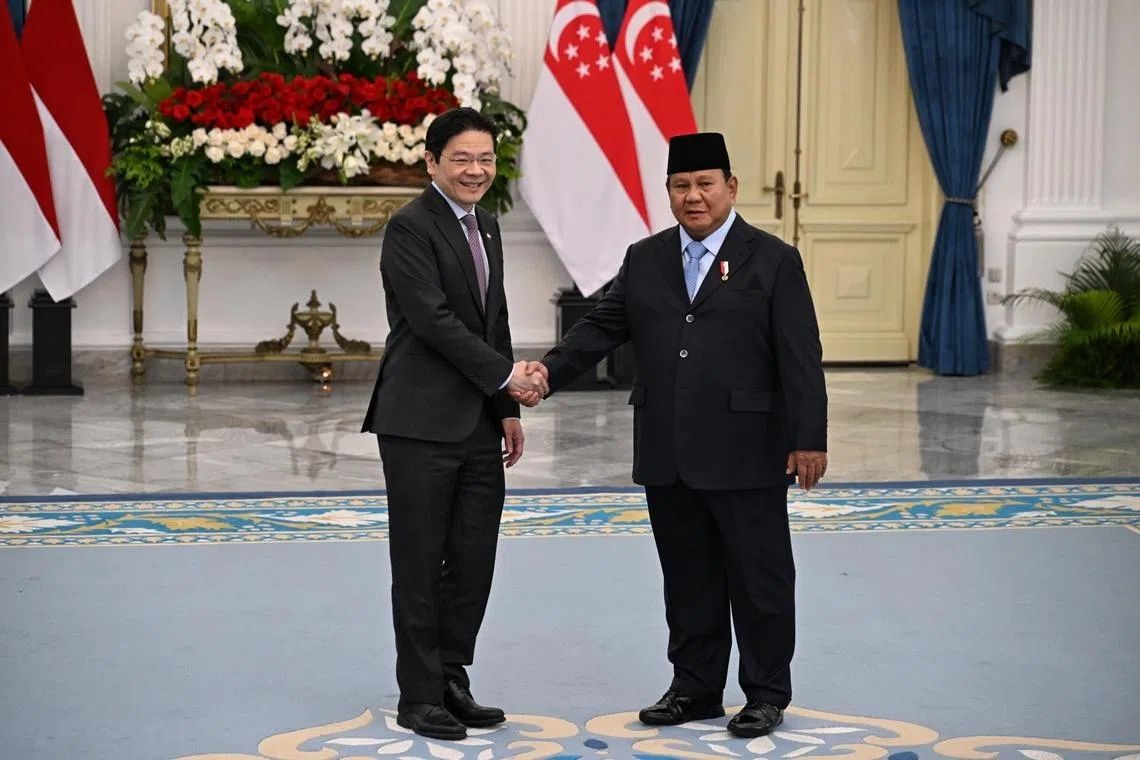
Singapore and Indonesia have jointly committed to maintaining the Strait of Malacca as an open, secure and accessible waterway for all maritime traffic, with leaders positioning maritime security as a cornerstone issue in their deepening bilateral relationship. Prime Minister Lawrence Wong and President Prabowo Subianto made the declaration during their meeting at the annual Leaders' Retreat on July 6, underscoring how both nations view the protection of this critical shipping corridor as essential to regional stability and economic prosperity.
The Strait of Malacca represents one of the world's most vital maritime chokepoints, channelling a substantial portion of global trade and energy shipments as it connects the Indian Ocean to the South China Sea. For Southeast Asia, the waterway's security carries particular weight, as disruptions would ripple through regional supply chains and international commerce. The commitment by Singapore and Indonesia, the two nations with direct interests in the strait's operations, reflects a shared understanding that maintaining its freedom of navigation serves not only their own economies but the broader international community.
President Prabowo emphasised Indonesia's position as a key stakeholder, noting that his nation and Singapore share both geographical proximity to the strait and a vested interest in its continued openness. He articulated a comprehensive vision of maritime security that extends beyond mere passage, encompassing protection from pollution, accidents, piracy and robbery. This multifaceted approach recognises that maintaining a functioning shipping route requires addressing various threats simultaneously, from environmental hazards to criminal activity that could disrupt legitimate commerce.
The Indonesian leader also highlighted his country's coordination with Malaysia and Thailand, signalling a broader regional commitment to upholding the principles enshrined in the United Nations Convention on the Law of the Sea. This tripartite cooperation framework ensures that littoral states collectively maintain standards for safety and accessibility, preventing any single nation from imposing restrictive measures that could impede international navigation rights. Such coordination is particularly significant given the geopolitical sensitivities surrounding freedom of navigation in Southeast Asian waters.
PM Wong contextualised the maritime security pledge within the broader global environment, drawing parallels to recent disruptions in the Strait of Hormuz caused by Middle Eastern conflicts. The Iranian situation has already demonstrated how regional instability can choke off vital trade routes and destabilise global energy supplies, with cascading economic consequences. By explicitly linking the Strait of Malacca's security to international commerce and energy flows, Wong underscored the stakes involved in maintaining this passage, positioning the Singapore-Indonesia commitment as essential to global economic resilience.
Beyond maritime matters, the two leaders used the retreat to expand their bilateral agenda into sectors that will shape their economies for decades ahead. Cross-border electricity trade emerged as a particularly significant development, with both nations recognising renewable energy cooperation as foundational to future regional energy security. Indonesia's sovereign investment fund Danantara was designated to lead implementation efforts, working alongside Singapore firms including Keppel Electric, Sembcorp Industries and Singapore Energy Interconnections to develop concrete proposals for electricity exports.
This electricity initiative carries implications extending well beyond the two countries, as both leaders framed it as a building block for the wider ASEAN Power Grid. Such interconnection projects could eventually allow the region to optimise energy resources across borders, with countries able to export renewable power to neighbours during peak generation periods and import during shortages. For Malaysia and other regional economies, the Singapore-Indonesia progress signals momentum toward a more integrated regional energy architecture that could eventually reduce reliance on fossil fuels and enhance energy independence.
The discussions also addressed digital infrastructure, cybersecurity and supply chain resilience—emerging domains where regional cooperation remains underdeveloped despite their strategic importance. As global supply chains face mounting pressures from geopolitical fragmentation and as cyber threats proliferate, coordinated approaches between major regional hubs like Singapore and Indonesia become increasingly valuable. Both nations acknowledged concrete progress on digital ecosystem cooperation, though detailed outcomes remain limited in public statements, suggesting ongoing behind-the-scenes negotiations on sensitive technical and governance matters.
Significantly, PM Wong used the retreat to reaffirm Singapore's confidence in Indonesia's long-term economic trajectory and to signal his nation's commitment as a sustained development partner. Rather than viewing the relationship transactionally, Wong emphasised how Singapore's investments create downstream industries, digital infrastructure and employment opportunities that benefit Indonesia's broader development. This framing contrasts with purely capital-focused investment narratives, positioning Singapore as a partner invested in Indonesia's structural economic transformation rather than simply extracting returns.
Indonesian industrial parks featuring Singapore investment received particular attention, with PM Wong highlighting developments in the Batam, Bintan and Karimun region alongside the Kendal Industrial Park in central Java. The Kendal facility's achievement of full capacity, coupled with plans for a 1,000-hectare expansion reaching its 10th anniversary in 2026, exemplifies how bilateral investment creates clustering effects that attract further regional development. These industrial zones serve as nodes in Southeast Asia's broader manufacturing networks, positioning Indonesia as an increasingly attractive destination for companies seeking to diversify away from China-dependent supply chains.
The retreat reflects a deliberate effort by both nations to deepen ties ahead of marking 60 years of diplomatic relations in 2027, using this milestone as a springboard for articulating an expanded partnership framework. By elevating maritime security while simultaneously expanding into renewable energy, digital infrastructure and supply chain cooperation, Singapore and Indonesia are signalling that their relationship transcends traditional trade mechanics. The convergence of security interests with economic development initiatives creates multiple reinforcing mechanisms that bind the two nations together across diverse domains.
For Malaysia and other Southeast Asian neighbours, the Singapore-Indonesia coordination on maritime security and economic cooperation presents both opportunities and considerations. On one hand, enhanced cooperation among major regional powers strengthens the region's overall security architecture and economic integration. On the other hand, bilateral initiatives risk creating parallel frameworks that could fragment regional decision-making if not carefully coordinated within broader ASEAN structures. The explicit mention of ongoing coordination with Malaysia and Thailand on strait security suggests awareness of this tension, though questions remain about how to scale bilateral progress into truly multilateral regional solutions.
The emphasis on cross-border electricity trade and renewable energy cooperation also carries implications for Malaysia's energy transition pathway. As Singapore and Indonesia pioneer mechanisms for regional power trade, Malaysia faces pressure to similarly decarbonise its grid and potentially participate in emerging regional electricity markets. Whether Malaysia can compete as a renewable energy exporter or faces disadvantages as coal-dependent capacity becomes less competitive in a regional market will significantly shape the country's energy economics over the coming decade.

