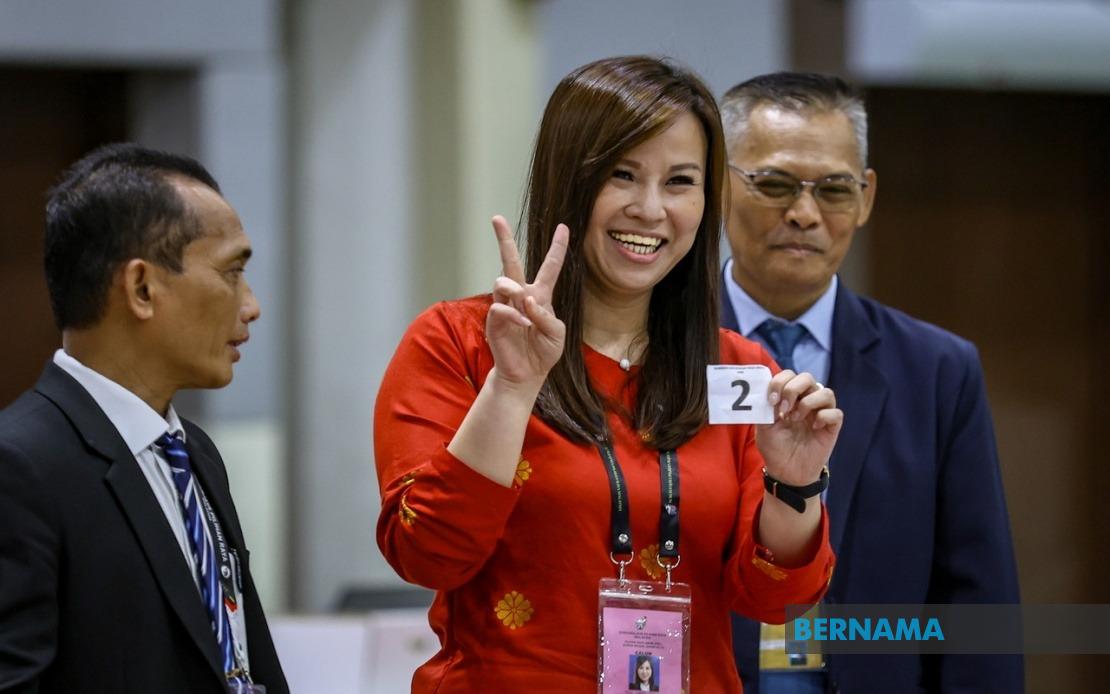
Sharon Teo, the Pakatan Harapan candidate for Permas, has centred her campaign strategy around two interconnected pillars: improving the physical infrastructure of the constituency and strengthening social welfare provisions for residents. Unveiling her platform at the nomination ceremony in Johor Bahru on June 27, Teo articulated a vision grounded in the everyday concerns she has encountered during grassroots engagement across the Permas state assembly district. Her candidacy represents PH's bid to recapture ground in this traditionally competitive area within the larger Pasir Gudang parliamentary zone, where 113,963 registered voters will determine the outcome of what promises to be a highly contested race.
The road conditions throughout Permas have emerged as a central issue in Teo's outreach efforts, and she has elevated this concern to the status of a campaign priority. Rather than treating infrastructure as merely a technical or bureaucratic matter, she frames road quality as fundamentally linked to public safety and residents' quality of life. This emphasis resonates with a widespread Malaysian preoccupation with pothole-ridden streets and deteriorating thoroughfares that affect commuters, delivery services, and emergency response times. For a state assembly district nested within an industrial corridor, dependable road networks carry economic significance beyond convenience, influencing business operations and workforce mobility across the Pasir Gudang area.
Teo brings relevant political experience to her candidacy. She previously worked as an aide within the Pulai parliamentary constituency under the late Amanah deputy president Salahuddin Ayub, providing her with exposure to state-level advocacy and constituent services. Her position as chief of the Johor Amanah Women's Youth (Warda) further positions her within party structures focused on community mobilisation, particularly among women voters—a demographic that has proven decisive in recent Malaysian elections. The delayed unveiling of her full manifesto suggests a carefully orchestrated campaign rollout intended to build momentum as voting day approaches.
Defending the Permas seat is incumbent Baharudin Mohamed Taib, who secured the constituency for Barisan Nasional in the 2022 state election. Baharudin's acknowledgment that each opponent presents distinct competitive strengths indicates a realistic assessment of the electoral environment. His declaration that he cannot underestimate his challengers reflects the volatility of Malaysian electoral dynamics, where local factors, incumbent fatigue, and voter sentiment shifts can dramatically alter outcomes even in traditionally safe seats. His decision to forgo a personalised manifesto in favour of adherence to the broader BN platform suggests a strategy centred on party loyalty and collective messaging rather than individual differentiation.
The Permas contest encompasses a four-cornered race that complicates the binary contest between PH and BN. Perikatan Nasional has fielded T. Vela as its candidate, while Parti Bersama Malaysia has nominated Dr Zamil Najwah. The presence of two additional candidates fractures the anti-incumbent vote, potentially benefiting whichever major coalition can consolidate support more effectively. In the fragmented Malaysian electoral landscape post-2020, such multi-candidate contests have frequently rewarded parties capable of mobilising core constituencies while benefiting from vote-splitting among opposition rivals. The strategic calculus for all camps involves not merely securing the largest share but ensuring that share exceeds fragmented opposition numbers.
Permas's location within Pasir Gudang carries implications beyond the state election itself. Pasir Gudang has become associated with environmental and industrial safety concerns following chemical contamination incidents that drew national attention, creating a constituency where residents possess heightened sensitivity to governance competence and responsiveness. State assembly representatives operate within this shadow, and voters may apply heightened scrutiny to candidates' capacity to address quality-of-life issues. For Teo, this context amplifies the resonance of her infrastructure and welfare messaging, as constituents possess recent experience of governance failures and consequently elevated expectations for performance.
The voter base of 113,963 eligible electors provides a defined playing field for all candidates. This figure, while substantial, remains manageable for intensive ground operations, meaning that door-to-door campaigning, community engagement, and targeted voter outreach retain significance. The six-day campaign period—spanning from the nomination process on June 27 to polling day on July 11, with early voting on July 7—compresses the available time for persuasion and mobilisation. Early voting provisions may prove particularly consequential if any candidate can effectively encourage supporter participation before standard polling day.
The 16th Johor state election unfolds amid broader uncertainty about state-level politics in Malaysia's most southern state. Johor has traditionally been regarded as BN's stronghold, yet the 2022 election demonstrated the viability of PH challenges in certain constituencies. The aggregated results from state contests provide tea leaves for national political trajectories, making Permas and other marginal seats focal points for political commentary and strategic significance beyond their immediate jurisdictions. A Teo victory would signal momentum for PH in traditionally BN terrain, whereas a Baharudin retention would reinforce narratives of BN resilience.
Teo's focus on roads and welfare reflects a bottom-up campaign philosophy rooted in constituent feedback rather than top-down thematic imposition. This approach acknowledges that voters frequently prioritise immediate, tangible improvements to their daily environment over abstract policy pronouncements. Potholed roads inconvenience residents multiple times weekly, while welfare gaps directly affect vulnerable households. By anchoring her campaign to these lived realities, Teo constructs a platform with inherent local credibility and direct relevance. This strategy contrasts with approaches that lead with grand visions or ideological positioning, instead presenting herself as attuned to authentic grassroots needs.
The campaign dynamic in Permas reflects broader patterns within Malaysian electoral politics: the persistence of multi-party competition, the vulnerability of previously secure seats, and the continued importance of local service delivery as a campaign theme. Both major contestants acknowledge competitive risk, neither claiming certainty of victory. This recognition reflects electoral maturation and realistic assessment. For observers monitoring Malaysian politics, the Permas outcome will provide granular data about voter sentiment in an industrial urban-peripheral constituency, where infrastructure and welfare remain pivotal concerns for working and lower-middle-class households navigating economic pressures and governance quality expectations.

