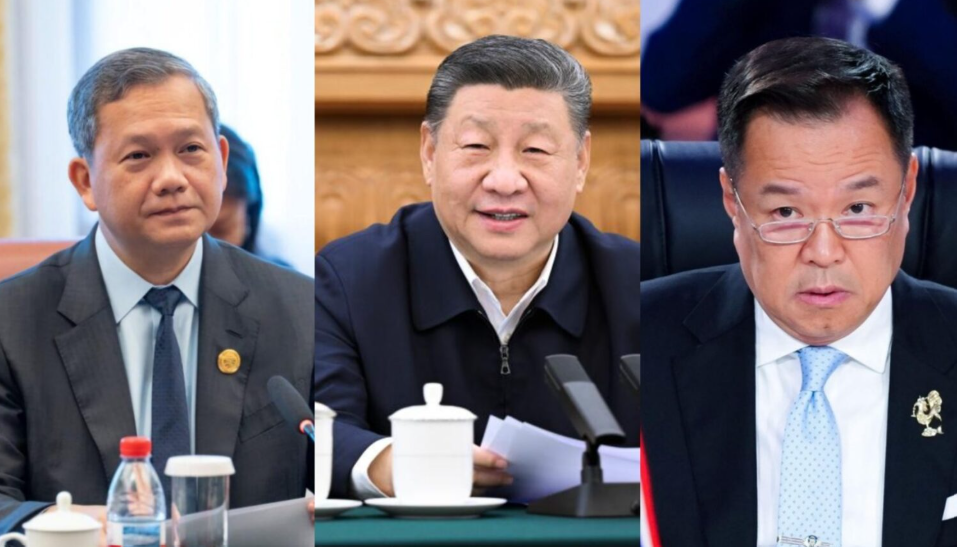
Cambodia's Prime Minister Hun Manet and Thailand's Anutin Chanvirakul are set to attend the opening session of the World AI Conference 2026 in Shanghai on July 17, both responding to invitations extended by Chinese President Xi Jinping. The high-level visit offers an unusual diplomatic opportunity, yet observers remain uncertain whether Beijing intends to use its substantial influence over both capitals to advance peace on their long-disputed frontier, or whether the gathering will amount to little more than carefully staged photo opportunities with Chinese leadership.
Manet's delegation, travelling between July 15 and 17, brings considerable institutional weight. Foreign Minister Prak Sokhonn and Defence Minister Tea Seiha will accompany him, alongside Sun Chanthol, the first vice-chairman of Cambodia's Council for the Development. Thailand's government will similarly field a senior contingent led by Foreign Minister Sihasak Phuangketkeow alongside Anutin. Both Southeast Asian leaders are scheduled for separate audiences with Xi and Premier Li Qiang, signalling the diplomatic significance Beijing attaches to the meetings.
The timing of the Shanghai summit carries particular resonance given the diplomatic stalemate that has persisted since December, when Cambodia and Thailand last engaged in serious bilateral border negotiations. The two nations maintain longstanding territorial disagreements, with Cambodia alleging that Thai forces occupy portions of its sovereign territory and prevent some 20,000 Cambodian civilians from returning to their homes. This frozen conflict has festered despite rhetorical commitments to resolution, making the Shanghai visit a potential turning point—if Beijing chooses to act as mediator rather than merely host.
Cambodia's official statements frame the Shanghai visit as an extension of existing partnership frameworks. The Phnom Penh government emphasises that the trip will deepen the Comprehensive Strategic Partnership of Cooperation with China, advance what it calls the Diamond Cooperation Framework, and reinforce the all-weather Cambodia-China Community with a Shared Future. These formulations reflect Phnom Penh's consistent positioning of China as its foremost international partner, a relationship that has only solidified since Hun Manet's assumption of the premiership.
Thailand's government similarly celebrates the visit as strengthening the Thailand-China Comprehensive Strategic Cooperative Partnership. Yet beneath these symmetric diplomatic courtesies lies an asymmetry that analysts point out: Cambodia depends far more heavily on Chinese economic and strategic backing than Thailand does. This imbalance potentially gives Beijing leverage over Phnom Penh's flexibility, though the real constraint on peace may lie elsewhere. When Hun Manet and Anutin previously encountered one another at the Asean Future Forum in Hanoi in early June, they managed only a handshake for photographers, avoiding any substantive discussion of their border grievances.
Kin Phea, director of the International Relations Institute at Cambodia's Royal Academy, offers a sobering analysis of the obstacles to settlement. He argues that the fundamental impediment is not civilian government intransigence but rather military institutions within Thailand that resist civilian authority and diplomatic constraints. Phea contends that Thailand's military has systematically failed to implement agreements that Thai civilian officials have reached with Cambodian counterparts, instead continuing what he characterises as arbitrary encroachment on Cambodian territory. This structural problem within Thailand's governance means that even if Anutin's government negotiates in good faith, enforcement remains doubtful without military compliance.
Phea invokes the Fuxian Consensus, a Chinese-brokered agreement negotiated in December 2025, as a template for what Beijing might now champion. That framework outlined principles for peaceful resolution through diplomatic consultation grounded in international law. Yet the consensus remains a dead letter, unimplemented and seemingly forgotten by both parties. Phea argues that China should assume a more assertive mediating role, explicitly leveraging its economic weight and strategic importance to both nations in order to compel them back to the negotiating table.
He articulates a specific roadmap that any serious Chinese intervention should pursue. Thailand must formally withdraw military forces from occupied Cambodian territories, resume engagement with the Joint Boundary Commission without delay, and demonstrate genuine commitment to the principles articulated at Fuxian. Cambodia, for its part, must insist on respect for the consensus and translate Thai promises into verifiable compliance measures. Without such concrete steps, Phea suggests, future meetings risk becoming mere diplomatic theatre, allowing the humanitarian dimension—the 20,000 displaced Cambodian civilians—to recede further from international attention.
For Malaysia and the broader Southeast Asian region, the Shanghai summit's outcome carries strategic implications. Cambodia-Thailand border tensions periodically threaten regional stability, occasionally drawing unwanted attention from extraregional powers. Should China succeed in brokering genuine progress, it would reinforce Beijing's positioning as a sophisticated diplomatic actor capable of resolving intra-Asean disputes. Conversely, if the Shanghai gathering produces only ceremonial outcomes, it may signal that China's influence over regional conflicts, while economically formidable, remains limited in coercing military establishments toward peace. The precedent set—whether Shanghai becomes a turning point or merely another forgotten summit—will shape how other Southeast Asian nations assess the utility of invoking Chinese mediation in their own disputes.
The convergence of Chinese economic leverage, civilian diplomatic willingness among both Bangkok and Phnom Penh, and the institutional resistance from Thai military quarters creates a moment of genuine possibility. However, that possibility will crystallise into peace only if Beijing demonstrates the political will to move beyond symbolic gestures toward substantive pressure. The coming weeks will reveal whether Xi Jinping's Shanghai conference is remembered as a breakthrough gathering or as another instance where Southeast Asia's unresolved conflicts remained politely unaddressed.

