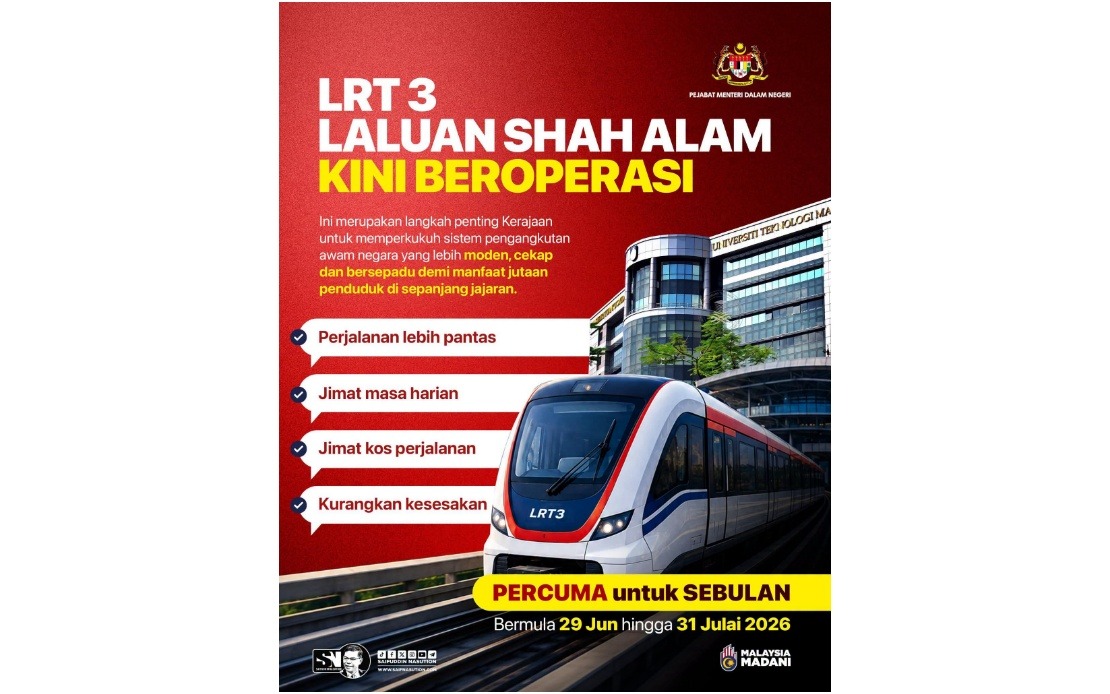
The Shah Alam Line LRT3, which commenced operations on June 29, represents a significant milestone in the MADANI Government's broader agenda to reshape urban mobility across Malaysia's most congested transport corridors. Home Minister Datuk Seri Saifuddin Nasution Ismail, speaking on the milestone, characterized the new line as concrete proof of the administration's commitment to delivering modern, efficient and comprehensively integrated public transport solutions that meaningfully enhance daily life for millions of commuters.
The development arrives at a critical juncture for the Klang Valley, one of Southeast Asia's fastest-growing metropolitan regions, where traffic congestion has become an increasingly intractable challenge for both government planners and residents alike. The LRT3 directly addresses this problem by creating an alternative transport corridor that spans key population centres including Shah Alam, Klang, and Subang—areas that have experienced explosive residential and commercial expansion over the past decade. By offering a viable mass transit option throughout this heavily trafficked zone, the line promises to alleviate pressure on road networks while simultaneously reducing commute times for workers, students and daily travellers across the region.
Beyond the immediate congestion-reduction benefits, Saifuddin emphasized that the new line embodies the government's strategic vision for strengthening Malaysia's overall public transport ecosystem. The initiative reflects a fundamental shift in policy priorities, signalling that authorities recognize mass transit investment as essential infrastructure rather than a peripheral amenity. This positioning matters considerably for how the transport sector develops in coming years, particularly as the nation grapples with urbanization pressures and environmental sustainability concerns that make car-dependent development increasingly untenable.
Prime Minister Datuk Seri Anwar Ibrahim reinforced this commitment through a symbolic gesture during the line's launch, announcing complimentary fares for all passengers traveling on the Shah Alam Line LRT3 throughout June 29 to July 31. The promotional period extends not only to the main rail line but also encompasses Prasarana Malaysia Bhd feeder bus services operating along the corridor, creating a comprehensive free-travel zone that removes financial barriers to trial usage. This approach demonstrates sophisticated understanding of user psychology: by eliminating cost considerations during the critical early adoption phase, authorities dramatically increase the likelihood that first-time passengers will experience the service and potentially transition from private vehicle dependency to regular public transport use.
Saifuddin leveraged the free-fare period as a direct appeal to residents in the affected areas, encouraging those living, working or studying along the LRT3 alignment to abandon private vehicles temporarily and experience the new service firsthand. His messaging carried an implicit assumption that positive user experience during the promotional window will generate sustained demand and ridership even after standard fares take effect in August. The strategy recognizes that public transport adoption often depends less on objective efficiency metrics than on citizens developing familiarity, confidence and habit with new systems—factors that a month of free access can substantially influence.
For Malaysian readers, the LRT3's significance extends beyond the immediate Shah Alam-Klang corridor. The project serves as a benchmark for whether the MADANI administration can execute ambitious infrastructure transformation promises at scale. Public transport development has historically confronted implementation challenges in Malaysia, ranging from construction delays to integration difficulties between different transit modes. The successful launch of LRT3 establishes a demonstration case that informs expectations for future corridors and extensions, potentially including proposed lines serving other major growth areas across Klang Valley and beyond.
The operational model employed—combining main rail infrastructure with integrated feeder bus networks—reflects international best practice in transit system design. Rather than viewing buses and rails as competing modes, the approach treats them as complementary components within a unified mobility network. For commuters, this integration means reduced wait times, simplified journey planning and genuine end-to-end connectivity. The feeder bus component proves particularly crucial for addressing the "last-mile" problem that historically limited public transport utility in Southeast Asian cities where residential sprawl extends beyond convenient walking distance from rail stations.
The free-fare initiative also carries important implications for social equity in urban transport. By temporarily removing cost barriers, the programme enables lower-income residents who might otherwise hesitate to experiment with unfamiliar transit systems to experience convenient, modern transport services. This democratization of access during the pilot phase builds political support for the project while gathering valuable ridership data that informs future pricing and service frequency decisions. The government effectively positions public transport as a public good worthy of strategic subsidy rather than a purely commercial operation that must generate surpluses.
Regional observers should note that Malaysia's investment in LRT3 reflects a broader Southeast Asian trend toward recognizing rail-based transport as essential to managing rapid urbanization and environmental challenges. Singapore, Thailand and Indonesia have all significantly expanded metro and light rail networks in recent years, creating competitive pressure for Malaysian cities to maintain transport competitiveness. The Shah Alam LRT3 partially addresses this imperative, though critics note that Kuala Lumpur's overall rail network expansion lags considerably behind comparable cities in the region.
The success metrics for LRT3 will become apparent within months of the free-fare period's conclusion. Ridership volumes, revenue collection performance and system reliability during peak periods will all indicate whether the project achieves its stated objectives of reducing congestion and attracting car users to public transport. These measurements will carry implications extending far beyond Shah Alam, potentially shaping government investment priorities and project design philosophies for subsequent transport infrastructure developments.
Saifuddin's public statements framing LRT3 as a centerpiece of MADANI governance reflect broader political messaging around the administration's delivery capacity and commitment to quality-of-life improvements. The Home Minister's direct engagement with the project signals its political importance while potentially accelerating bureaucratic processes and resource allocation for subsequent phases. Whether such high-level attention translates to sustained operational excellence and long-term ridership growth remains an open question that will ultimately determine whether LRT3 becomes merely another transport facility or a transformative catalyst for urban mobility in the Klang Valley.

