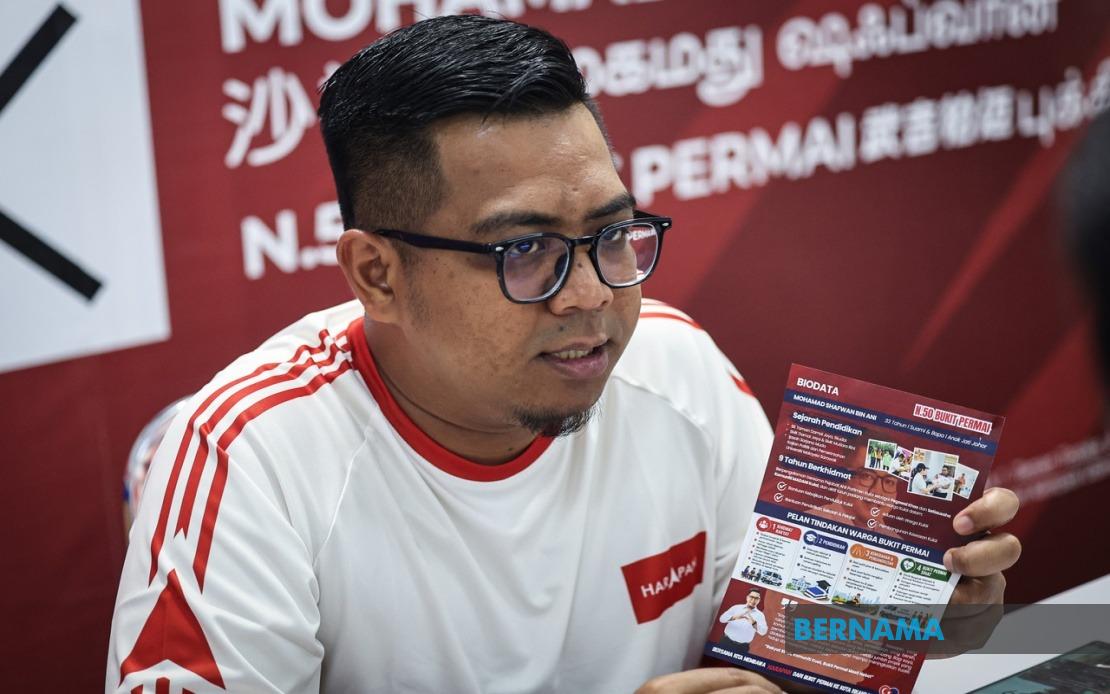
Mohamad Shafwan Ani, the Pakatan Harapan candidate for Bukit Permai in the ongoing Johor state election, is banking on an extensive track record of local involvement to persuade voters to back his candidacy, dismissing perceptions that he represents a last-minute or token appointment. The 33-year-old has spent nine years building political credibility within the constituency, work he argues positions him distinctly from opportunistic candidates. In an interview ahead of voting, Shafwan emphasised that his commitment to the community transcends electoral success, signalling a long-term investment in constituent welfare regardless of the election outcome.
Shafwan's principal credential is his tenure as a special officer in the Kulai Member of Parliament's office since 2017, a role that has furnished him with detailed knowledge of pressing local concerns and the dynamics of constituency governance. A graduate of Universiti Malaysia Sarawak with qualifications in Political Studies and Government, he brings formal academic grounding to his practical experience. The Skudai native has established residential ties to the constituency spanning nearly a decade, contrasting his profile with candidates parachuted into unfamiliar territories during campaign season. He is contesting in a four-cornered race, a scenario that typically fragments voter support and increases unpredictability in outcomes.
The Bukit Permai constituency encompasses 44,819 registered voters, and Shafwan's electoral strategy revolves around a comprehensive action plan divided into four pillars. The Mobile State Assembly Service Centre initiative represents a direct-to-constituents approach, envisioning itinerant administrative facilities that bring government services to neighbourhood locations rather than requiring residents to navigate bureaucratic headquarters. This approach acknowledges the time constraints and mobility limitations facing working families and elderly voters, demographics particularly vulnerable to cumulative administrative burdens. By eliminating travel costs and time expenditure, Shafwan frames service delivery as a tangible cost-of-living intervention.
The Bukit Permai Sihat programme forms the healthcare dimension of his proposal, offering free medical screenings at accessible community sites. This initiative addresses health equity gaps that disproportionately affect lower-income residents and senior citizens who may deprioritise preventive care due to financial pressures or access difficulties. The programme's focus on proactive screening rather than curative treatment aligns with contemporary public health thinking, potentially reducing downstream healthcare expenditure and improving population health outcomes. For residents in B40 categories, such provisions represent material relief in an inflationary environment where healthcare costs increasingly consume household budgets.
Educational support constitutes the third component, structured around needs-based allocation rather than universal provision. This targeted approach suggests scrutiny of actual educational barriers within the constituency, potentially encompassing subsidised tuition, infrastructure improvements in underperforming schools, or scholarship programmes addressing specific demographic gaps. By calibrating assistance to identified needs, Shafwan's framework avoids blanket policies that may benefit affluent households disproportionately. The Targeted Education initiative implicitly acknowledges that educational outcomes within Bukit Permai may lag state or national benchmarks, positioning educational equity as a governance priority.
Infrastructure development represents the fourth pillar, with particular attention to persistent vulnerability to flooding and drainage dysfunction. Shafwan identifies flash floods, drainage inadequacies, and road widening in village and Felda areas as critical quality-of-life issues requiring intervention. These are not abstract infrastructure concerns but tangible hazards that directly threaten household safety and economic productivity, especially for agricultural communities and informal traders. The emphasis on Felda areas signals awareness that land-scheme settlements, despite their historical significance to rural Malaysia, often experience infrastructure deficits relative to urban developments.
Shafwan's campaign has encountered sabotage involving poster destruction, an incident he characterises as motivating rather than demoralising. The occurrence is illustrative of electoral intensity within the constituency and the heightened partisanship accompanying closely contested seats. His decision to entrust investigation to authorities while maintaining campaign momentum demonstrates disciplined campaign management and avoidance of inflammatory escalation. The incident underscores the contested nature of Bukit Permai, where the 2022 result saw Datuk Mohd Jafni Md Shukor of BN-UMNO secure the seat with a majority of 4,755 votes, a margin suggesting the seat remains winnable for opposition forces.
Shafwan explicitly frames his candidacy as transcending campaign rhetoric, urging voters to evaluate him through his demonstrated service record and personal resilience rather than transient messaging. This rhetorical strategy acknowledges voter scepticism toward campaign promises, positioning integrity and consistency as differentiating factors. He identifies young voters as a demographic priority, noting they constitute between 30 and 40 per cent of the electorate. This demographic segment, often more responsive to new candidates and less bound by established partisan loyalties, represents terrain where a first-time candidate without entrenched institutional baggage may perform competitively.
The Johor state election encompasses 172 candidates competing across 56 state seats, a substantial electoral exercise reflecting the state's size and political significance within Malaysia's federation. Polling occurs under circumstances where national political dynamics continue to influence state-level contests, despite the formal separation between federal and state politics. For Pakatan Harapan, recapturing seats held by Barisan Nasional remains strategically essential for demonstrating electoral viability beyond their 2022 federal victory. Shafwan's campaign in Bukit Permai operates within this broader competitive context, where individual constituency contests aggregate into state-wide results determining governance.
Shafwan has acknowledged substantial volunteer mobilisation supporting his campaign, evidence of grassroots enthusiasm that may reflect genuine community backing or organisational discipline within PH machinery. The volunteer dimension introduces a resource advantage potentially offsetting any disadvantages stemming from candidate inexperience at electoral level. Campaign volunteers provide ground-level intelligence about voter sentiment, facilitate direct constituent engagement, and amplify message dissemination beyond paid advertising. Their willingness to invest unpaid labour suggests assessments that Shafwan represents a credible candidate worthy of intensive support.
The candidacy of Mohamad Shafwan Ani presents a substantive case for evaluating first-time candidates based on prior community engagement and policy specificity rather than electoral pedigree. His Bukit Permai Action Plan demonstrates engagement with concrete constituency challenges rather than generic platitudes. Whether these initiatives, combined with nine years of community presence, prove sufficient to overcome the 4,755-vote majority accumulated by the incumbent BN candidate in 2022 remains contingent on voter receptivity and turnout patterns. His campaign exemplifies a broader shift within opposition politics toward cultivating long-term constituency presence and targeted policy development rather than relying on periodic electoral mobilisation.

