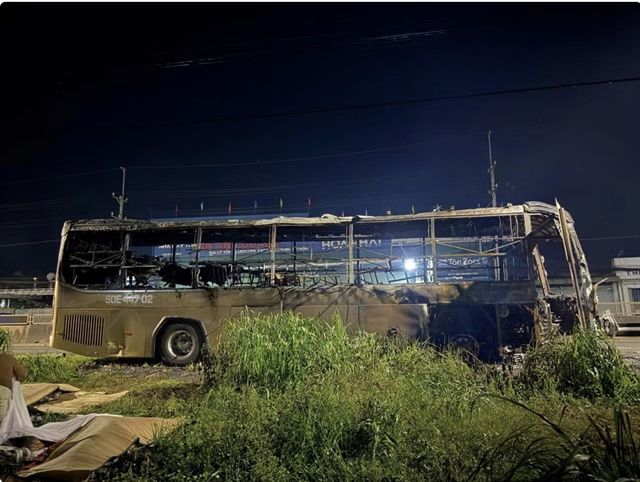
A devastating fire aboard a sleeper bus has claimed seven lives in Hung Thinh Commune, marking a sobering reminder of the persistent safety challenges facing long-distance coach travel across Vietnam. The incident occurred shortly after 2.30 am when the vehicle, carrying 33 passengers and crew, struck a roadside embankment while travelling along National Highway 1. The bus, operated under the direction of 41-year-old driver Tran Thanh Hai from Khanh Hoa Province, was en route from Dong Nai to Ho Chi Minh City when the initial collision occurred.
Following the first impact with the roadside embankment, the driver attempted to regain control of the bus but the vehicle struck another embankment before finally coming to a halt. It was during this critical moment that a fire suddenly erupted at the front of the coach, spreading with alarming speed throughout the passenger compartment. The rapid advancement of the flames caught many occupants off guard, transforming what might have been a manageable emergency into a catastrophic situation within minutes.
While some passengers managed to evacuate the vehicle as flames began to consume the interior, others became trapped inside as the fire advanced faster than they could reach the exits. Local residents in the vicinity heard calls for help and rushed to the scene with whatever firefighting equipment they had available, including portable fire extinguishers and other basic tools. Their courageous but ultimately insufficient efforts to combat the blaze demonstrated the limitations of ad-hoc emergency response in remote areas. The flames simply advanced too rapidly and too intensely for civilian intervention to make a meaningful difference, consuming the entire length of the bus within a short timeframe.
Emergency services received notification of the disaster and promptly dispatched professional firefighters, rescue personnel, and specialist equipment to Hung Thinh Commune. These coordinated emergency crews successfully extinguished the fire, extracted survivors from the wreckage, and managed traffic diversions to prevent secondary incidents on the busy highway. Despite their rapid response, the damage had already been inflicted. By the time firefighters brought the blaze under control, the bus had been reduced to a charred skeleton, almost completely destroyed by the intense heat.
The Hung Thinh Commune People's Committee confirmed through preliminary reports that seven individuals had perished in the incident. The deceased victims remained unidentified at the time of reporting, with authorities continuing their work to formally identify each person. Among the surviving passengers, several sustained injuries requiring hospitalisation, and they were transported to Thong Nhat General Hospital for medical treatment. One passenger with only minor injuries has since been discharged from care, though the condition and prognosis of other injured survivors remained unclear.
Investigators have cordoned off the scene to conduct forensic examination and gather evidence regarding the fire's origin. The enquiry's primary objectives include determining the precise cause of the fire, establishing a complete list of victims and their identities, and clarifying the exact sequence of events that led to both the initial embankment collision and the subsequent conflagration. Such investigations are critical for identifying any systemic safety deficiencies or mechanical failures that may have contributed to the tragedy.
The incident represents the second major sleeper bus accident in Vietnam within just seven days, underscoring concerning trends in coach travel safety across the country. Just a week earlier, on July 17, another sleeper bus returning from Thien Cam beach in Ha Tinh Province towards Thai Nguyen in the north veered off an expressway in Ha Noi and overturned. That collision resulted in five deaths and left dozens of passengers injured, demonstrating that serious bus accidents are occurring with troubling regularity rather than as isolated occurrences.
These successive tragedies highlight the vulnerability of sleeper bus passengers, who are often trying to rest during overnight journeys and may struggle to respond quickly to emergency situations. The combination of driver fatigue on long-distance routes, potentially ageing vehicle fleets, and the physical constraints of sleeper configurations creates a particularly hazardous travel environment. For Malaysian travellers and transport regulators, these Vietnamese incidents serve as cautionary examples of the importance of rigorous vehicle maintenance standards, driver welfare protocols, and emergency equipment provisions on long-distance coaches operating throughout Southeast Asia.

