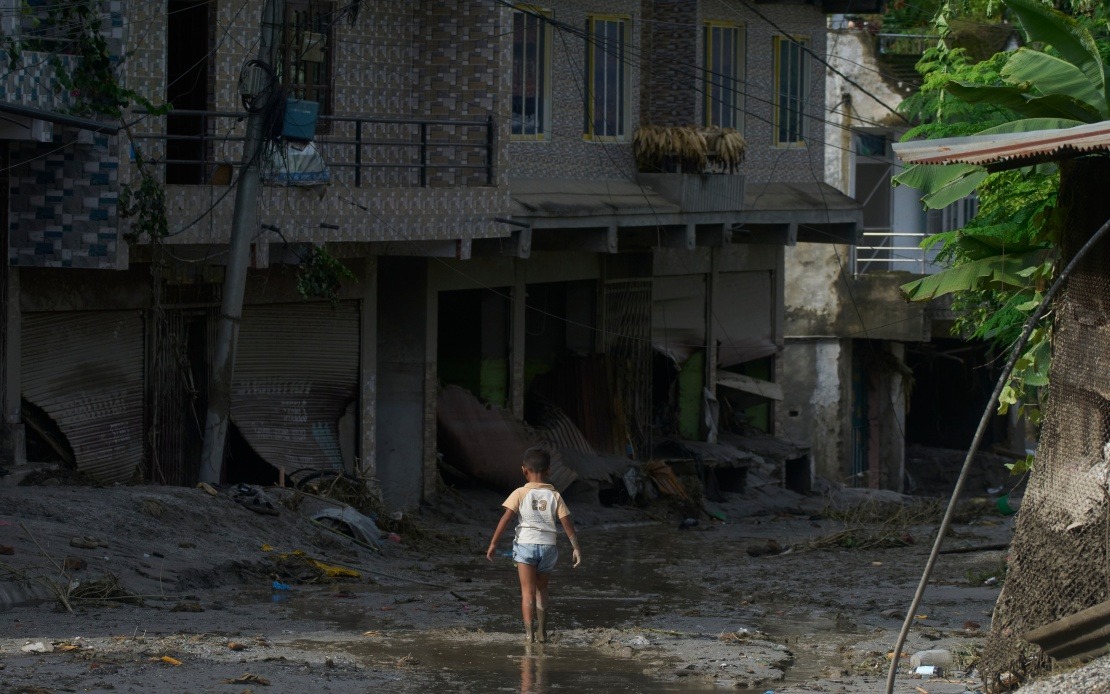
A major mudslide originating from the Nepalese side has struck Gyirong Port in Gyirong County, located in Xizang Autonomous Region along the southwestern China-Nepal border, leaving seven people confirmed dead and 554 others unaccounted for. The disaster occurred on Wednesday morning, triggering an immediate large-scale emergency response that continues to dominate rescue efforts in the mountainous frontier region. As of early Saturday morning, just two local villagers had been successfully extracted from the affected area, highlighting the scale and complexity of the ongoing recovery operation.
The geographical location of this incident carries significant strategic importance, as Gyirong Port serves as a vital commercial crossing between China and Nepal. Positioned in one of Asia's most challenging mountain environments, the port facilitates bilateral trade and people movement between the two nations. The mudslide's timing and location have thus created not only a humanitarian crisis but also disrupted cross-border commerce and transportation links that connect the broader Himalayan region. The Xizang Autonomous Region's emergency management department has mobilised resources on an unprecedented scale to address both the immediate rescue requirements and the potential for cascading secondary disasters.
Recognising the magnitude of the challenge, authorities have deployed a total of 2,141 rescue workers to the disaster zone, supplemented by 86 specialists with expertise in natural resources assessment and related fields. This integrated approach reflects an understanding that mudslide disasters in high-altitude border regions demand not only aggressive search-and-rescue operations but also geological analysis to prevent further collapses. The deployment represents a coordinated mobilisation across multiple provincial and national agencies working in tandem to manage what has rapidly become one of the most significant natural disasters in the region this year.
Beyond immediate rescue efforts, authorities have implemented a comprehensive hazard mitigation strategy targeting the surrounding terrain. Rescue teams equipped with specialised machinery have undertaken systematic inspections across adjacent slopes, roads, and infrastructure zones classified as critical or at-risk. This preventive approach stems from the sobering reality that mountainous regions experiencing major mudslides frequently face follow-up collapses as destabilised earth and rock continue to settle and shift in the days following an initial disaster. Each subsequent slide could potentially reach trapped survivors or hamper rescue accessibility, making these pre-emptive geological surveys essential to operational safety.
A particular concern has emerged regarding a barrier lake that formed as a consequence of the mudslide's massive volume of displaced earth and debris. Such natural dams, while sometimes providing temporary water resources, pose acute dangers if they rupture unexpectedly. To address this threat, authorities have established a dedicated five-person monitoring post stationed to maintain constant surveillance of the barrier lake's integrity and water levels. This specialised team watches for signs of structural weakness or sudden drainage that could trigger devastating flash flooding downstream, representing a secondary disaster scenario that could multiply casualties and worsen the overall humanitarian impact.
Logistical infrastructure has been progressively restored to support ongoing rescue and relief operations. Approximately 1.02 kilometres of road, damaged or blocked by mudslide debris and geological instability, has been cleared and reopened to traffic. Road access proves critical for transporting rescue personnel, specialised equipment, medical supplies, and evacuated survivors. In mountainous frontier regions like Gyirong, where alternative transport routes are limited and weather conditions remain unpredictable, maintaining even modest road connectivity can determine the difference between successful rescue outcomes and prolonged isolation for affected communities.
The incident underscores the vulnerability of border communities in the Himalayan zone to natural disasters, a concern that resonates across Southeast Asia and the broader Hindu Kush-Himalayan region. Climate change-induced glacial melt, increasingly intense rainfall patterns, and terrain destabilisation from infrastructure development have collectively elevated mudslide and avalanche risks across high-mountain border areas. Malaysia and other ASEAN nations, while geographically distant from this particular disaster, confront similar geological hazards in their own mountainous and hilly regions, making the response strategies employed here relevant to regional disaster preparedness frameworks.
For Malaysian readers and policymakers, this incident highlights critical lessons regarding disaster response coordination across international boundaries. Gyirong Port's status as a shared border facility means that Nepal and China must coordinate not only search-and-rescue efforts but also information sharing, medical response capacity, and reconstruction planning. Southeast Asian nations managing shared river systems, maritime boundaries, and terrestrial crossings with neighbours can extract valuable insights from how Beijing and Kathmandu are managing this crisis's international dimensions.
The investigation into the mudslide's underlying causes—whether triggered primarily by rainfall, seismic activity, glacial melt, or some combination thereof—will inform future infrastructure planning and early warning systems throughout the region. Gyirong Port's critical role in China-Nepal connectivity means that comprehensive analysis of this disaster will likely influence engineering standards and natural hazard assessment protocols not only within Xizang but across comparable border zones throughout Asia. For a region as geologically active and climatically volatile as the Himalayan-Hindu Kush zone, understanding and learning from such catastrophes represents an investment in collective safety.

