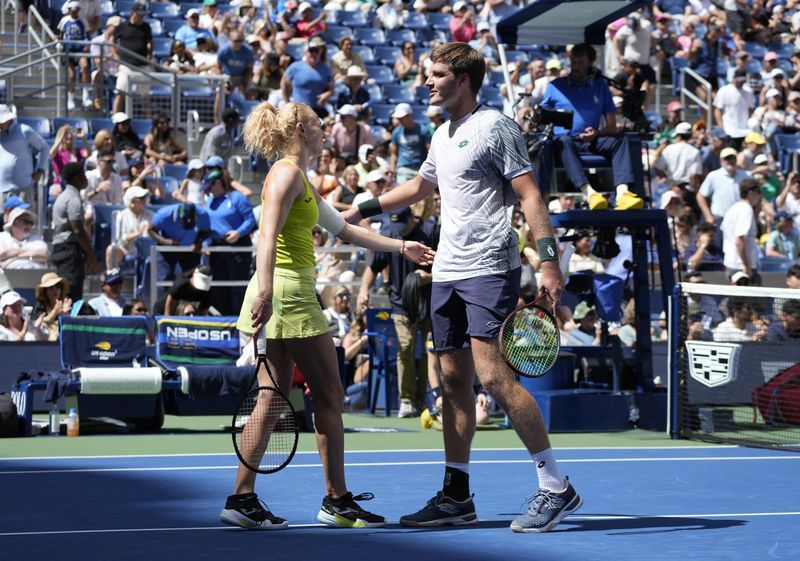
Serena Williams delivered a masterclass in her highly anticipated comeback to professional tennis, joining forces with 21-year-old Carlos Alcaraz to capture a decisive victory over Erin Routliffe and Lloyd Glasspool 5-3, 4-1 in the first round of mixed doubles at the US Open on Tuesday. The emotional homecoming of the 23-time Grand Slam champion, who had not set foot on Arthur Ashe Stadium since her tearful farewell in 2022, sent shockwaves of jubilation through the packed arena as she stepped back into the competitive arena more than two months after announcing her remarkable return to the sport.
The reception that greeted Williams upon her arrival at court transcended ordinary sporting spectacle, with the stadium erupting in thunderous applause that underscored her enduring status as one of tennis's most captivating figures. This triumphant return carries profound significance for Malaysian and Southeast Asian tennis enthusiasts, who have witnessed the sport's evolution over decades and watched Williams inspire generations of players across the region. Her comeback at an age when most athletes have long retired speaks to broader themes of longevity, resilience, and the magnetic appeal of elite athletic competition that resonates deeply within the regional sporting consciousness.
What proved particularly striking was the evident chemistry between Williams and her considerably younger partner, with the pair displaying infectious enthusiasm throughout their contest. The comfortable rapport transcended the typical professional courtesies of competitive pairing, as both athletes grinned and exchanged knowing glances while navigating their opponents' challenge. This intergenerational partnership carries implicit symbolism—Williams passing the torch while remaining competitive at the highest level, mentoring through action rather than commentary. Alcaraz, who had endured enforced absence from competitive play since April due to injury concerns, appeared to shake off his inactivity with remarkable efficiency as the match progressed, ultimately closing the opening set with a flourishing forehand winner.
The second set proved almost anticlimactic in its decisiveness, with Williams and Alcaraz dismantling their opponents' resistance with commanding strokes and tactical acuity. Advancing into the quarter-finals, they will face the formidable pairing of Belinda Bencic and Flavio Cobolli later in the same day. Despite her extended absence from competition, Williams demonstrated the technical precision and court awareness that defined her illustrious career, including unleashing a 120 mph ace that drew audible gasps from spectators—a reminder of the raw power she retains even after years away from professional play.
Meanwhile, the tournament witnessed a stunning upset that reverberated through the competitive landscape. Top-seeded Novak Djokovic and Aryna Sabalenka, formidable singles competitors whose individual brilliance had suggested a formidable mixed doubles partnership, fell to the experienced doubles specialists Henry Patten and Katerina Siniakova with a lopsided 1-4, 4-2, 10-2 scoreline. This emphatic elimination challenged assumptions about the transferability of singles excellence to doubles competition, where specialised tactical knowledge, positioning instincts, and partnership coordination function according to different calculus than individual play. Siniakova's clinical ace on the final point epitomised the clinical execution that distinguished the victors' performance.
The format itself merits examination within the broader context of professional tennis administration and audience engagement strategies. This second year of the revamped mixed doubles structure deliberately positioned singles megastars as the centrepiece attraction, scheduling matches as a standalone event preceding the main singles draw. The rationale centred on commercial viability—organizers believed that prominent singles players would magnetise casual spectators and media attention, thereby elevating mixed doubles from its historical status as an undercard attraction. The strategy has demonstrably succeeded in drawing capacity crowds and sustaining television interest, though not without controversy among established doubles professionals who contend that prioritizing singles luminaries marginalises dedicated doubles specialists whose technical mastery in the format remains unmatched.
For Malaysian readers observing these developments, the format's success carries implications for how professional tennis distributes opportunities and recognition. The debate between inclusivity for established doubles players versus commercial imperatives that champion crossover appeal reflects broader tensions in sports governance between competitive merit and market forces. Southeast Asian players aspiring to doubles careers face an environment where traditional pathways increasingly compete with novel structures that privilege singles pedigree, potentially reshaping career trajectories and investment priorities within regional tennis development programmes.
The defending champions, Italian pairing Sara Errani and Andrea Vavassori, could not replicate their title-winning form, succumbing to the Russian combination of Mirra Andreeva and Andrey Rublev in a hard-fought encounter that went 1-4, 4-1, 11-9. Their elimination opened the draw considerably, distributing advancement opportunities among multiple competing partnerships. The results across multiple matches suggested that the mixed doubles format, despite its emphasis on marquee names, ultimately rewards tactical sophistication and specialised doubles acumen rather than merely importing singles excellence.
Other notable progressions included the advancement of husband-and-wife pairing Gael Monfils and Elina Svitolina into the semi-finals, alongside the Czech-American combination of Karolina Muchova and Jakub Mensik. These results indicate that the mixed doubles draw encompasses considerable competitive depth, with established doubles competencies proving decisive in determining progression. The tournament structure continues generating compelling narratives that transcend conventional singles-focused narratives, offering dimensions of partnership dynamics and gender-integrated competition that appeal to evolving audience preferences.
The broader significance of this tournament phase extends beyond immediate match results into questions about professional tennis's evolving identity. Williams's participation symbolises the sport's capacity to reinvent itself and retain compelling figures within the competitive arena, regardless of conventional retirement conventions. Her presence alongside Alcaraz, representing youth and established greatness in collaborative harmony, encapsulates tennis's enduring appeal across generational divides. For regional audiences, the tournament underscores that even within rigidly hierarchical individual sports, innovative formats and strategic repositioning can generate fresh enthusiasm while maintaining competitive integrity. The mixed doubles narrative arc will ultimately determine whether this format becomes permanent fixture within Grand Slam architecture or represents transitional experiment in the sport's ongoing evolution.

