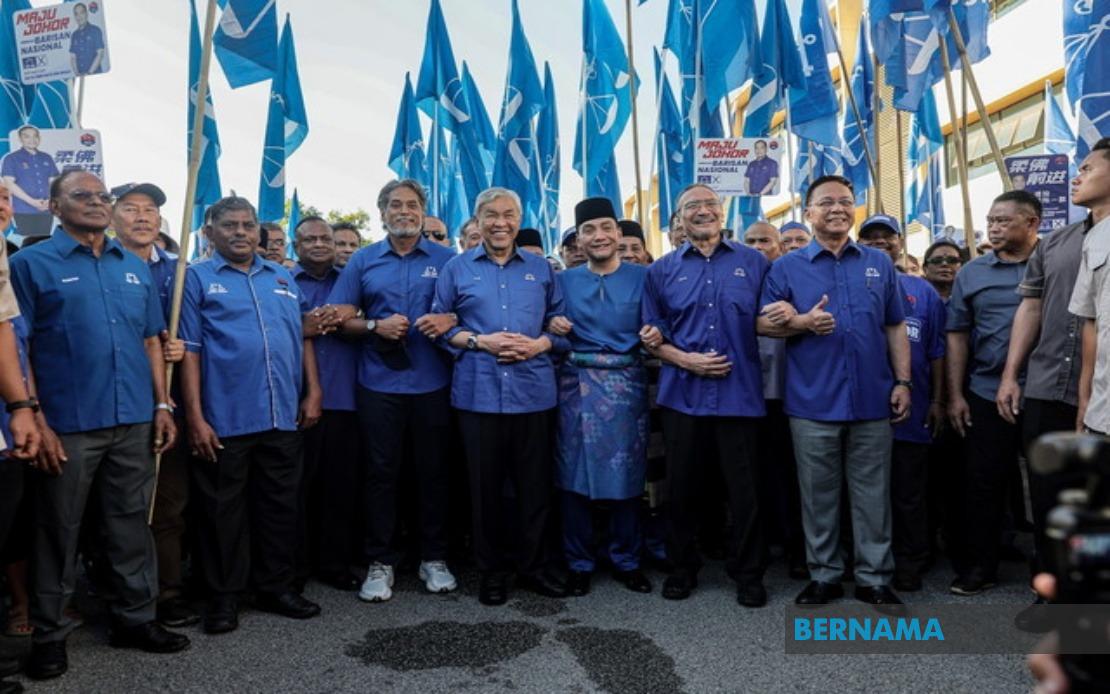
Johor's political landscape intensified on June 27 when Datuk Onn Hafiz Ghazi, the Barisan Nasional chairman for the state, formally entered the electoral race by submitting his nomination documents for the upcoming state election. The submission took place at 9.10 am at the Muafakat Hall within the Simpang Renggam District Council, marking an official milestone in the campaign season. As the sitting representative for the Machap state assembly constituency, Onn Hafiz's move represented the formal commencement of his re-election bid under the BN banner.
The significance of the occasion was underscored by the calibre of political heavyweights who appeared alongside the Johor BN chairman. UMNO president Datuk Seri Dr Ahmad Zahid Hamidi travelled to Simpang Renggam to witness the submission, lending his party's organisational weight to the proceedings. His presence signalled the national leadership's commitment to the Johor campaign, a state that remains crucial to UMNO's political fortunes in Malaysia. The symbolism was further reinforced by the attendance of Datuk Seri Hishammuddin Tun Hussein, the MP for Sembrong, who brought constituency-level campaign machinery to the event.
Khairy Jamaluddin, the former minister whose political relevance has undergone significant fluctuations in recent years, also graced the nomination centre. His participation demonstrated attempts by the BN machinery to consolidate support across different segments within the coalition. The gathering also included Datuk Seri Hasni Mohammad, a former Johor Menteri Besar whose experience and institutional knowledge within state politics provided additional legitimacy to the proceedings. The convergence of these figures suggested careful orchestration to project an image of party unity and organisational readiness heading into the electoral contest.
The nomination centre at Simpang Renggam witnessed considerable mobilisation by party supporters, who had gathered in significant numbers throughout the surrounding precinct. Visible displays of party affiliation permeated the scene, with supporters sporting colours corresponding to their respective political organisations and carrying banners and flags emblazoned with candidate names and party symbols. This grassroots energy reflected the competitive intensity of the electoral period and demonstrated the logistical capacity of BN machinery to turn out supporters for high-profile party events.
Onn Hafiz's nomination came within the broader framework of the 16th Johor state election, a major electoral contest that carries implications extending beyond the state's immediate political configuration. Control of Johor has historically been contested territory between BN and opposition coalitions, and electoral performance in Malaysia's largest southern state frequently reverberates across the broader peninsula. The nomination of established figures like Onn Hafiz, supported by senior national leadership, indicated BN's commitment to maintaining dominance in constituencies they currently hold.
The deployment of such senior party figures to a state-level nomination event reflected the high stakes surrounding the Johor contest. In Malaysian politics, the presence of national party presidents and federal ministers at constituency-level events serves multiple purposes: it signals party commitment, energises local party machinery, generates media coverage, and provides candidates with enhanced visibility and perceived legitimacy. The early mobilisation of these resources suggested expectations of a competitive election where demonstrating organisational superiority would matter significantly.
Machap, Onn Hafiz's constituency, occupies an important position within Johor's electoral geography. The assemblyman's re-nomination indicated the BN's intention to retain the seat, and the high-profile support demonstrated confidence in his electoral prospects. However, the need to deploy multiple senior figures also suggested acknowledgment that no seat could be taken for granted, a calculation that has become increasingly relevant in Malaysian politics following the realignment of forces across recent election cycles.
The broader context of BN's positioning in Johor cannot be separated from the coalition's need to demonstrate strength and cohesion heading into any electoral contest. In an era when political coalitions have become more fluid and voter behaviour more volatile, visual displays of party unity and leader support become crucial components of campaign strategy. The gathering at Simpang Renggam effectively communicated that BN leadership was fully engaged with the Johor campaign and that incumbent representatives enjoyed backing from both state and national party echelons.
The nomination process marked a formal transition from organisational preparation to active campaigning. With nomination papers submitted, candidates could intensify public outreach, and party machinery could shift focus toward voter mobilisation. For observers monitoring the Johor political scene, the calibre and composition of supporters accompanying Onn Hafiz provided early indicators regarding BN's confidence levels and strategic priorities across different electoral zones within the state. The event thus functioned simultaneously as a legal requirement, a symbolic statement of party commitment, and a practical tool for energising campaign operations heading into the election proper.

