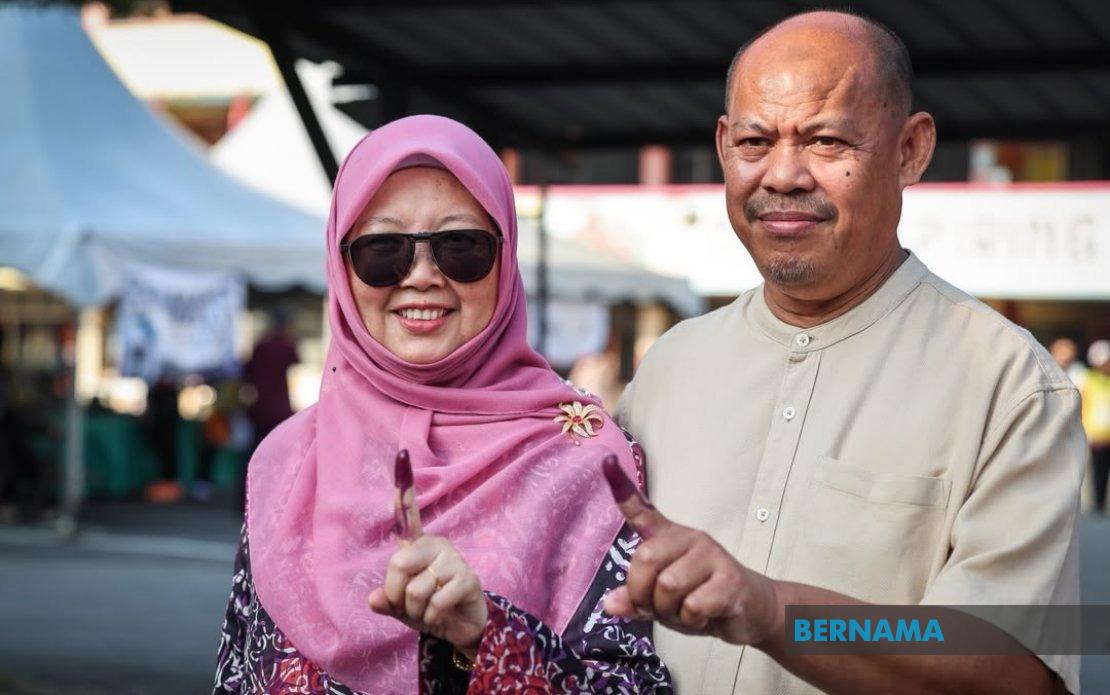
Political leaders in Johor set the tone for civic participation on July 11 as several high-ranking party figures joined queues at polling stations across the state for the 16th Johor state election. Their early appearance at voting centres underscored the importance of public engagement and helped galvanise electoral momentum during the crucial first hours of polling day.
Johor PKR chairman Datuk Seri Dr Zaliha Mustafa was among the first to exercise her franchise, arriving at Sekolah Menengah Kebangsaan Bandar Baru Uda in Johor Bahru at 9 am. The former Minister in the Prime Minister's Department, responsible for Federal Territories during her previous tenure, brought her husband Dr Ahmad Adzlan Musa to the polling centre. Both cast their votes in the Larkin constituency, fulfilling their democratic duty at the state level while maintaining their connection to their local electoral division.
Stressing the importance of voter turnout, Dr Zaliha appealed directly to Johor residents to abandon complacency and arrive at polling stations without delay. She specifically highlighted meteorological concerns, noting that weather forecasts predicted rain would intensify from midday onwards through the afternoon hours. Her plea reflected awareness that climatic conditions could discourage participation, particularly among voters who might otherwise have postponed their ballots to later in the day. By casting her own vote early, she provided a visible example of the civic behaviour she was advocating.
Departing from PKR's example, the Democratic Action Party also fielded prominent representation at the polls. Johor DAP chairman Teo Nie Ching arrived at Sekolah Jenis Kebangsaan Cina Kulai Besar in the Kulai area shortly before 9.30 am, demonstrating that the early-voting trend transcended party lines. The participation of DAP leadership reflected the multiethnic and multi-party nature of Johor's electoral dynamics, where different coalitions compete for voter support across diverse demographic segments.
The strategic decision by party leaders to vote early carries practical and symbolic dimensions. Practically, their presence at polling stations during opening hours helps reduce congestion and demonstrates that the voting process operates smoothly from the outset, reassuring ordinary voters about accessibility and efficiency. Symbolically, when senior figures queue alongside constituents rather than delegating their civic duty or voting through special arrangements, it reinforces the principle that electoral participation ranks as a fundamental responsibility binding all citizens equally, regardless of status or position.
For Malaysian observers following Johor politics, the behaviour of these leaders reflected broader campaign strategies. Early voting by prominent figures generates media coverage that extends messaging beyond traditional advertising, allowing parties to frame narratives about civic duty, democratic engagement, and confidence in their own electoral prospects. The implicit message that leaders are voting for their own candidates projects conviction and familiarity with their parties' platforms.
The weather forecast Dr Zaliha referenced would prove significant for overall turnout patterns. Rain during afternoon hours typically depresses voter participation in tropical climates where many residents lack reliable transport or choose to remain indoors during heavy downpours. By encouraging citizens to vote in the morning window, leadership appeals like hers aimed to counteract this tendency, potentially maximizing the total electorate that would determine the election outcome. This weather-conscious civic messaging represents a distinctly Malaysian political communication strategy adapted to local conditions.
The Johor state election itself carried significance within Malaysia's broader political context. As one of the country's largest and most electorally influential states, with substantial population and economic resources, the result would reverberate beyond Johor itself. Coalition performance in the state election could influence calculations about federal-level politics, particularly given Malaysia's complex system of state and national governance where outcomes in major states affect national coalition stability and configuration.
Both PKR and DAP represented components of broader political coalitions competing for Johor's mandate. The appearance of their respective chairpersons at early polling stations signalled organisational readiness and confidence in their respective electoral organisations. For PKR, with its historical focus on Selangor and federal politics, Johor representation through Dr Zaliha's leadership position indicated ambitions to expand influence in the southern peninsula. For DAP, maintaining strong performance in diverse constituencies remained crucial to justifying its position within any governing coalition and demonstrating its capacity to mobilise voters beyond traditional strongholds in Penang and Selangor.
The early voting by party leaders also reflected lessons from previous elections where voter fatigue or unfavourable late-day conditions suppressed participation. Malaysian political strategists recognise that electoral outcomes frequently turn on marginal variations in turnout across different constituencies and demographic groups. Party leadership that visibly models early voting behaviour hopes to cascade this preference through their grassroots organisations and party networks, creating multiplicative effects that could prove decisive in marginal contests.
For Southeast Asian context, Johor's election illustrated how established democracies operate routine electoral cycles even amid broader regional political currents. Unlike some neighbouring jurisdictions where electoral timing and conduct remain contestable or opaque, Malaysia's state elections proceed according to constitutional schedules with international observation and domestic media scrutiny. The ordinary sight of party leaders queuing at ordinary schools reflects institutional maturity that practitioners of Malaysian politics sometimes take for granted but which distinguishes the country's democratic systems from more fragile regional counterparts.

