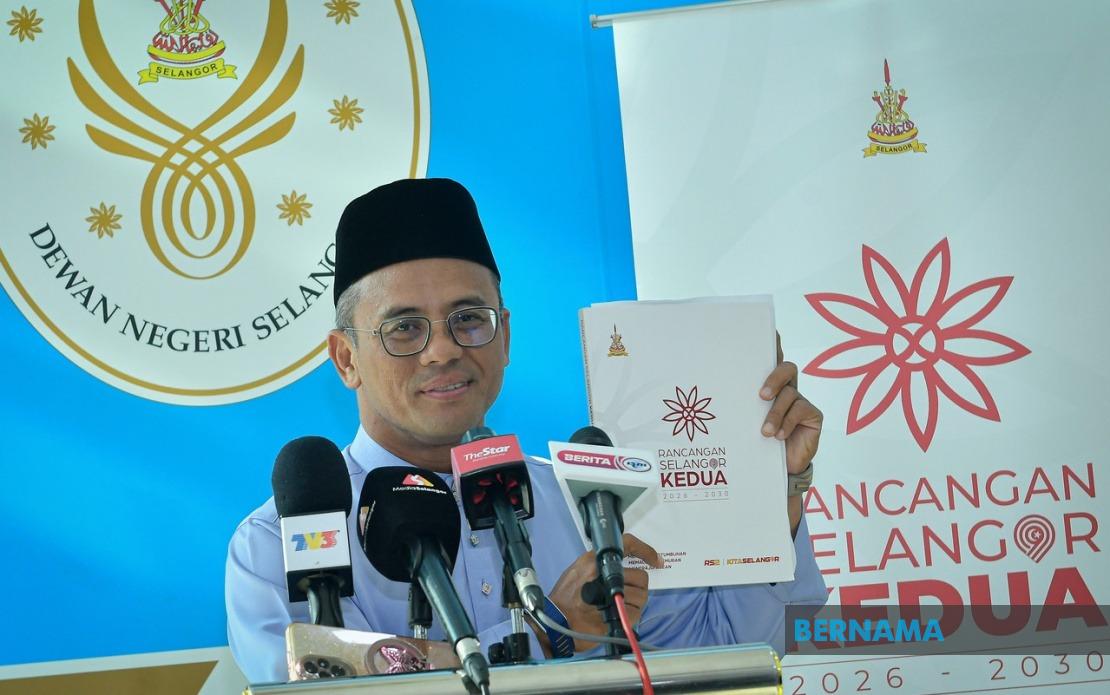
Selangor's Menteri Besar Datuk Seri Amirudin Shari has set an ambitious performance benchmark requiring every local authority in the state to reach and sustain a 95 per cent rating under the PBT Star Rating System (SPB-PBT) by the end of the decade. Unveiling the target while tabling the Second Selangor Plan (RS-2) in the state assembly, Amirudin framed the initiative as a fundamental shift toward equalising service quality across the state's municipalities, moving beyond a system where only select areas enjoy premium public administration.
The mandate embedded in RS-2 represents a philosophical reorientation within Selangor's governance architecture. Rather than accepting disparate service standards across different municipal zones—a reality that typically afflicts rapidly urbanising states where wealthy enclaves receive disproportionate resources—the state government is committing to a baseline of excellence that extends uniformly to all residents. This approach carries particular significance for a state that encompasses sprawling urban centres, semi-developed townships, and rural peripheries with vastly different administrative capacities and revenue bases.
Centrally, Amirudin emphasised that achieving these ratings hinges on transforming how local authorities interact with residents and manage complaints. He underscored that grievances lodged through social media platforms, traditional channels, or direct citizen contact must receive systematic attention and resolution. This emphasis reflects a broader evolution in municipal governance across Southeast Asia, where digital connectivity has created heightened public expectations for responsive, transparent administration. For Selangor, where tech-savvy urban populations coexist with communities in developing areas, institutionalising complaint responsiveness becomes a critical equaliser.
Parallel to the service delivery ambition, the state government is pursuing aggressive digitalisation targets, aiming for 85 per cent End-to-End Digital Government Service Sharing by 2030. This pathway would substantially modernise how Selangor residents interact with local authorities, reducing bureaucratic friction and enabling data sharing across municipal systems. The digital infrastructure underpinning this vision carries implications beyond mere convenience; it establishes foundations for data-driven governance where local authorities can identify service gaps, anticipate resident needs, and allocate resources more efficiently. For Malaysian readers accustomed to dealing with fragmented, paper-dependent municipal systems, the target signals a deliberate move toward Asian-standard digital governance.
Amirudin's narrative incorporated a critical financial sustainability dimension often absent from public service announcements. The state currently derives approximately 75 per cent of its revenue from land premiums and rental income—a structural vulnerability that creates cyclical dependence on property development cycles and exposes budgets to market volatility. RS-2 accordingly prioritises revenue diversification through innovative financing mechanisms and enhanced private sector participation, seeking to insulate the state from land-market shocks that could undermine the municipal service targets.
The government-linked company (GLC) alignment strategy emerges as the operational mechanism for achieving these ambitions. Amirudin outlined plans to establish a fully integrated State Investment Holding company that would consolidate fragmented corporate entities, eliminate duplicative functions, and generate superior returns for the state treasury. This restructuring reflects lessons from other high-performing Asian economies where state-owned enterprises operate as coherent investment vehicles rather than scattered fiefdoms. For Selangor, whose GLCs historically operated with limited coordination, integration promises both cost efficiency and strategic clarity.
The repositioning of GLCs toward technology and service-based economic sectors signals a deliberate departure from traditional infrastructure-heavy development models. Rather than perpetually constructing physical infrastructure, Selangor's state entities would increasingly compete in digital services, professional services, and technology domains—sectors offering higher margins and greater resilience against commodity price fluctuations. This transition carries implications for employment patterns, skills requirements, and the types of economic opportunities available to Selangor residents over the next decade.
From a regional perspective, Selangor's commitment to uniform service standards and digitalisation benchmarks positions Malaysia's largest state as a laboratory for governance modernisation within Southeast Asia. The specific 95 per cent rating target and 85 per cent digital sharing objective provide measurable, time-bound metrics that enable comparative analysis with peer jurisdictions and create accountability mechanisms. In a region where governance quality often varies dramatically across and within states, Selangor's embrace of explicit, uniform standards represents a significant institutional evolution.
The implementation challenge, however, remains substantial. Achieving uniform excellence across dozens of municipalities with varying fiscal capacities, administrative expertise, and demographic pressures demands sustained political will, adequate resource allocation, and sophisticated performance management. The disparity between wealthy urban councils and resource-constrained rural municipalities could perpetuate gaps despite aspirational targets. Amirudin's framing suggests awareness of these dynamics, emphasising that PBTs must collectively "work harder" to bridge capability gaps rather than expecting improvement to materialise spontaneously.
The RS-2 announcements also reflect evolving resident expectations within fast-urbanising Malaysia. Selangor's population, increasingly digitally connected and mobile, demands service responsiveness comparable to private-sector consumer experiences. The state government's commitment to addressing complaints through multiple channels and delivering integrated digital services responds to these demographic realities. For residents across Selangor—from Petaling Jaya office workers to Sabak Bernam agricultural communities—the targets ostensibly promise equivalent access to responsive, efficient municipal administration.
Looking forward, RS-2's success will depend substantially on resource mobilisation and institutional capacity-building within local authorities. The revenue diversification agenda becomes crucial here; sustainable improvement in service ratings requires adequate funding, not merely administrative exhortation. Similarly, the digital infrastructure investments must occur alongside human capital development, ensuring municipal staff possess skills to operate integrated systems and interpret data-driven insights. Without simultaneous investment in these enabling factors, the 95 per cent rating target risks becoming aspirational rhetoric rather than operational reality.
The strategic alignment between state government priorities and GLC objectives also introduces new accountability vectors. If state-owned enterprises are explicitly tasked with advancing RS-2 objectives through technology-based service delivery and revenue innovation, their performance becomes measurable against specific benchmarks. This represents a departure from the more diffuse, unstated expectations that historically governed GLC-state government relationships. For Selangor residents, this clarity potentially translates into more responsive state institutions, though realisation ultimately depends on consistent implementation and resource commitment over an extended timeframe.

