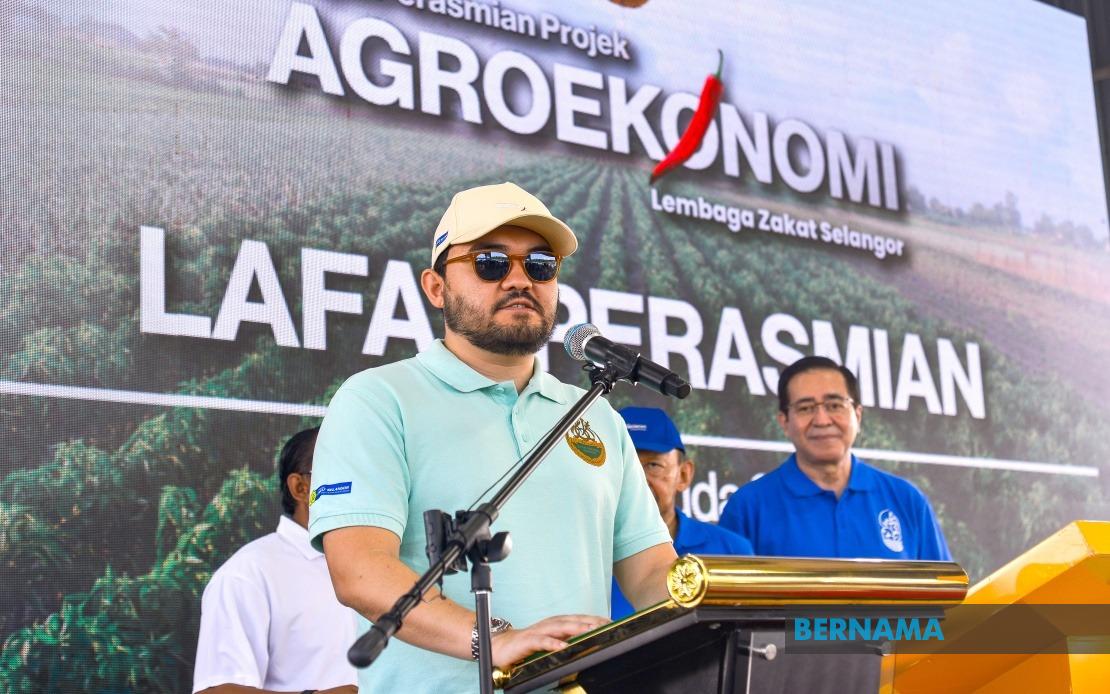
The Selangor Zakat Board has taken a strategic step beyond traditional welfare assistance by launching an ambitious agricultural venture designed to equip disadvantaged community members with the skills and resources needed for long-term financial independence. Unveiled on July 1 at Laman Agro Ehsan in Bukit Beruntung by the Raja Muda of Selangor, Tengku Amir Shah Sultan Sharafuddin Idris Shah, the Agroeconomic Project represents a RM26 million investment spanning 110 acres, with 76 acres allocated specifically for agro-development activities centred on high-value chilli cultivation using modern fertigation techniques.
The initiative reflects a broader shift in how Islamic charitable institutions across Malaysia are approaching poverty alleviation and economic empowerment. Rather than limiting assistance to one-time cash handouts, Zakat Selangor has constructed a comprehensive ecosystem combining technical training, supervised crop management, hands-on agricultural guidance, and secured residential accommodation to remove barriers to participation. This holistic model addresses not just immediate financial needs but builds human capital and entrepreneurial confidence among beneficiaries, a concern increasingly central to development discourse in Southeast Asia where sustainable livelihoods have become critical to reducing wealth inequality.
Forty-eight carefully selected participants drawn from the asnaf category—those deemed eligible for zakat assistance under Islamic law—will undergo an intensive three-year development programme that balances classroom instruction with practical field experience. Each participant receives a 0.5-acre cultivation plot containing approximately 2,000 chilli plant bags, collectively generating 96,000 planting bags per production cycle across all 48 plots. This scale of operation allows Zakat Selangor to demonstrate commercial viability while maintaining individual learning and management responsibility, a critical balance for building participant confidence and practical competence.
The financial projections underlying the scheme are deliberately conservative yet compelling. Once participants achieve stable crop management and establish consistent production patterns, programme officials estimate monthly incomes reaching RM4,000 per participant, a figure substantially exceeding Malaysia's official poverty line and providing genuine pathway to middle-income stability for families currently struggling financially. For context, this represents annual income potential of RM48,000, sufficient to sustain a household of five to six persons in Selangor with reasonable quality of life, assuming participants maintain consistency and market access remains reliable.
Accommodation emerges as a particularly innovative component addressing a fundamental constraint faced by rural development programmes across Malaysia and the region. Participants are housed at Prima Beruntung residential facilities with rental costs fully absorbed by Zakat Selangor throughout the programme duration, eliminating transport challenges and daily logistical barriers that have historically undermined participation in agricultural initiatives. This residential structure also facilitates peer learning, collective problem-solving, and the social cohesion necessary for sustaining commitment through seasonal cycles and market fluctuations typical of agricultural enterprise.
Participant selection methodology reflects careful attention to programme sustainability and social equity. Collaboration with the Kuala Langat Area Farmers' Organisation ensured candidates possessed appropriate baseline capabilities, realistic motivations, and genuine commitment to agricultural pursuits rather than passive welfare dependence. This targeted recruitment approach, tested against local agricultural expertise, substantially increases likelihood of successful programme completion and income realisation compared to open-access models that often falter when participants lack foundational agricultural knowledge or psychological readiness for self-employment disciplines.
The financial architecture underlying the project demonstrates sophisticated collaboration between Malaysia's Islamic finance ecosystem and social development objectives. Beyond Zakat Selangor's primary RM26 million commitment, strategic partners including the Pilgrims Fund Board, RHB Islamic Bank Berhad, and Cagamas Berhad contributed RM2.07 million through wakalah arrangements, aligning profit-seeking institutions with social welfare missions. This financing model offers instructive lessons for other Southeast Asian economies seeking to mobilise religious charitable institutions and Islamic financial institutions toward development goals without government budget strain.
Participant testimonies reveal the psychological and practical dimensions of the initiative beyond income statistics. Norfhadilah Mohd Shafiin, a 45-year-old mother of five, described the programme as fundamentally transformative—not merely providing income opportunities but imparting agricultural knowledge, operational confidence, and psychological reorientation toward self-reliance rather than welfare dependency. Similarly, father-of-two Raimi Rusydi Rodi emphasised the skill acquisition and peer learning dimensions, suggesting the programme functions simultaneously as vocational training, community-building exercise, and confidence-restoration mechanism for individuals whose circumstances previously offered limited pathway to dignified economic participation.
The chilli cultivation focus reflects deliberate market strategy aligned with Malaysian agricultural demand and regional consumption patterns. Chilli represents a high-value crop suitable for small-scale intensive cultivation, generating superior returns compared to commoditised staple crops, whilst remains central to Southeast Asian cuisine and therefore maintains stable demand. The fertigation technology employed—automated drip irrigation with integrated nutrient delivery—optimises water efficiency and yield consistency, particularly valuable in Malaysia's humid tropical climate where water abundance masks irrigation management requirements critical for commercial viability.
Implications for Malaysia's broader social welfare architecture warrant consideration. Zakat Selangor's model demonstrates that Islamic charitable institutions possess unique positioning—enjoying both religious legitimacy and financial resources—to pioneer development interventions exceeding conventional government welfare's scope and flexibility. As Malaysia navigates challenges of post-pandemic economic inequality and structural unemployment particularly affecting lower-income communities, replicating this comprehensive asnaf empowerment model across other states could establish scalable template for transforming passive welfare into active economic participation. The Selangor initiative suggests that sustainable poverty reduction increasingly requires integrated interventions combining financial resources, technical training, market linkage facilitation, and psychological transformation—components rarely assembled through traditional government welfare bureaucracies or conventional microfinance approaches.
Longer-term programme success will ultimately depend on downstream factors extending beyond Zakat Selangor's direct control, particularly securing reliable agricultural input supply chains, establishing stable buyer relationships for participant output, and enabling participants to transition from supervised cultivation toward independent commercial enterprise following programme completion. Whether Laman Agro Ehsan evolves into self-sustaining cooperative marketing structure or whether participants successfully integrate into broader agricultural value chains remains critical unanswered question determining whether temporary income generation transforms into permanent livelihood upgrading. Regardless, the initiative's comprehensive design and genuine commitment to participant empowerment through skill development rather than passive aid distribution establishes encouraging precedent for rethinking how Malaysia's institutions can mobilise available resources toward meaningful poverty alleviation across Southeast Asia's most vulnerable populations.

