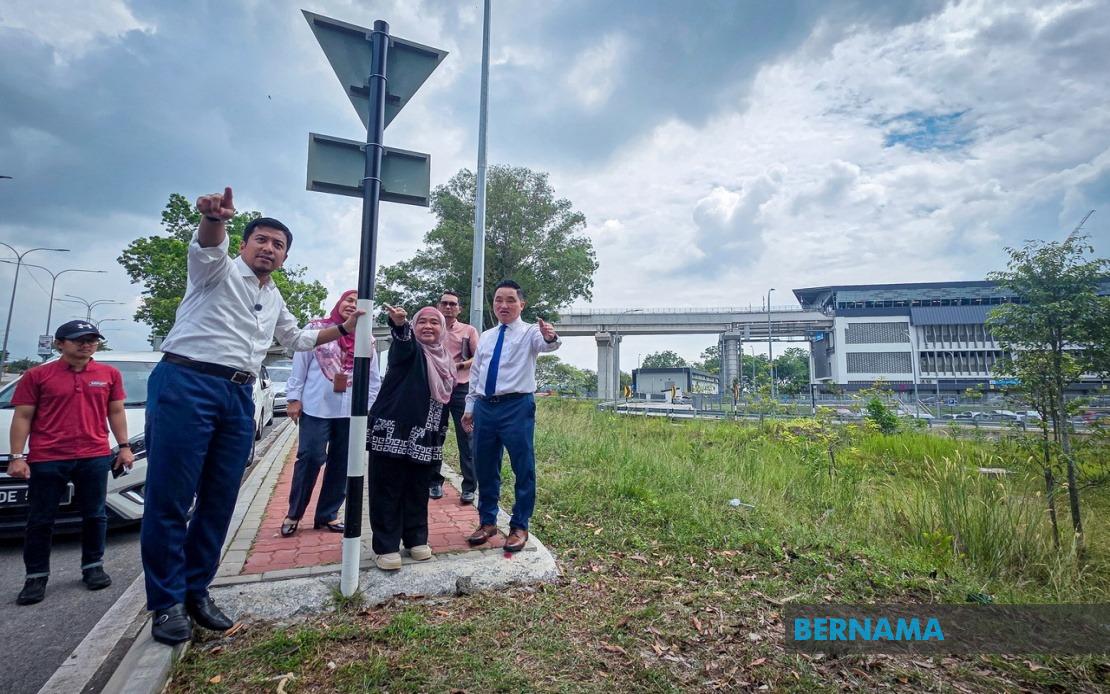
The Selangor State Government has committed to expediting work on pedestrian and connectivity facilities at Shah Alam Line LRT3 stations, recognising that infrastructure gaps around transit hubs directly impact the commuting experience of daily users. State Local Government and Tourism Exco Datuk Ng Suee Lim announced the acceleration during an inspection of public infrastructure, emphasising that the state administration takes responsibility for resolving deficiencies that have emerged since the rail line's operational launch.
Two stations have emerged as focal points for immediate attention: Dato' Menteri Station and Shah Alam Stadium Station. At Dato' Menteri Station, the primary obstacles relate to administrative procedures and formal approvals. Ng disclosed that Prasarana, the operator responsible for urban rail infrastructure across Kuala Lumpur and Selangor, has received a directive to complete the necessary connectivity features within a two-month window. This compressed timeline reflects the state government's determination to remove bureaucratic bottlenecks that might otherwise delay improvements.
The situation at Shah Alam Stadium Station presents a more complex timeline. The responsible authorities acknowledge that completion will require an extended period because third-party property developers adjacent to the station must undertake tender processes and coordinate development activities. Nevertheless, Ng indicated that the state government intends to maintain oversight of these parallel projects and will press for acceleration wherever possible. This approach underscores a fundamental reality of urban infrastructure development in Malaysia: public transport stations often sit amid private development zones, requiring careful coordination between multiple stakeholders with differing timelines and priorities.
Datuk Ng's remarks reveal a pragmatic understanding of infrastructure delivery. While acknowledging that newly completed projects inevitably contain weaknesses that only become apparent during actual operational use, he framed this reality not as an excuse but as a catalyst for systematic improvement. The identification of issues through real-world usage patterns represents valuable field data that should trigger prompt remedial action. By publicly committing to addressing these shortcomings, the Selangor administration signals accountability to commuters who depend on these transit nodes.
The Shah Alam City Council (MBSA) will assume a monitoring role in tracking progress on connectivity improvements. Simultaneously, the state government plans to convene coordination meetings with nearby developers to synchronise timelines and ensure that infrastructure work proceeds efficiently. This multi-stakeholder approach recognises that solutions often require negotiation and buy-in from entities beyond direct government control. Private developers, property owners, and transit operators all influence whether pedestrian walkways, zebra crossings, and related safety features are delivered promptly.
Beyond these two priority stations, the state government has instructed all Local Authorities (PBT) operating in districts containing LRT3 stations to conduct comprehensive reviews of their respective areas. This system-wide audit aims to identify shortcomings in connectivity infrastructure across the entire Shah Alam Line. By extending scrutiny beyond the two flagged stations, the Selangor administration acknowledges that deficiencies are likely present elsewhere and that proactive identification serves the public interest more effectively than reactive complaints.
Datuk Ng specifically named the Royal Klang City Council (MBDK) and other relevant local authorities, tasking them with enlisting their appointed council members and state assemblymen as additional eyes on infrastructure quality. This distributed monitoring mechanism leverages elected representatives' relationships with constituents to surface emerging problems. When residents encounter accessibility issues or safety concerns around transit facilities, their elected representatives become natural conduits for raising these matters. By formalising this feedback loop, the state government essentially crowdsources infrastructure monitoring.
For Malaysian commuters in the Klang Valley, this announcement carries practical significance. The LRT3 Shah Alam Line represents a major investment in urban mobility, easing congestion on established routes and providing new transport options. However, a rail line's effectiveness depends not merely on train frequency and route design but on the pedestrian environment surrounding stations. A commuter who struggles to access a station safely or conveniently may abandon the service despite its operational merits. Ensuring that connectivity infrastructure matches the quality of the rail service itself represents an important prerequisite for ridership growth.
The commitment also reflects broader Southeast Asian trends in urban transport development. Across the region, cities have invested heavily in rapid transit systems, yet many struggle with the "last mile" problem—moving passengers from their origins to transit stations and from stations to final destinations. Singapore and Bangkok have generally managed this challenge more systematically through integrated planning from inception, whereas Malaysian cities frequently find themselves retrofitting solutions after construction. The Selangor government's approach acknowledges this reality and pledges to close gaps that emerged during initial operations.
The two-month deadline for Prasarana at Dato' Menteri Station provides a measurable commitment against which public accountability can be assessed. If the deadline passes without completion, the undertaking becomes a political vulnerability for the state administration. This creates constructive pressure on the operator to prioritise the work. However, the more ambiguous timeframe for Shah Alam Stadium Station—contingent on private developer tender processes—presents a greater challenge to implementation. Should developers move slowly or encounter complications, the state government faces the difficult choice of absorbing delays that lie partly beyond its direct control or escalating pressure that might damage relationships with private sector partners essential to broader urban development.
The participation of Exco Youth, Sports and Entrepreneurship Mohd Najwan Halimi in the inspection signals that connectivity infrastructure warrants attention across multiple portfolio areas within state government. Youth and sports constituencies particularly depend on accessible transit networks, as younger Malaysians and sports venue visitors rely more heavily on public transport than private vehicles. This multi-portfolio engagement suggests that infrastructure improvement is viewed as a cross-government priority rather than a narrowly technical issue.
Looking forward, the success of these initiatives will depend on whether announced timelines hold and whether local authorities genuinely activate their monitoring responsibilities. The Selangor government has created mechanisms for accountability and coordination. The translation of these mechanisms into visible improvements on the ground will determine whether this initiative meaningfully enhances the commuting experience or remains primarily a public relations exercise. For residents in areas served by LRT3, the coming months will reveal whether the state's commitment to infrastructure excellence extends beyond press conferences to sustained action.

