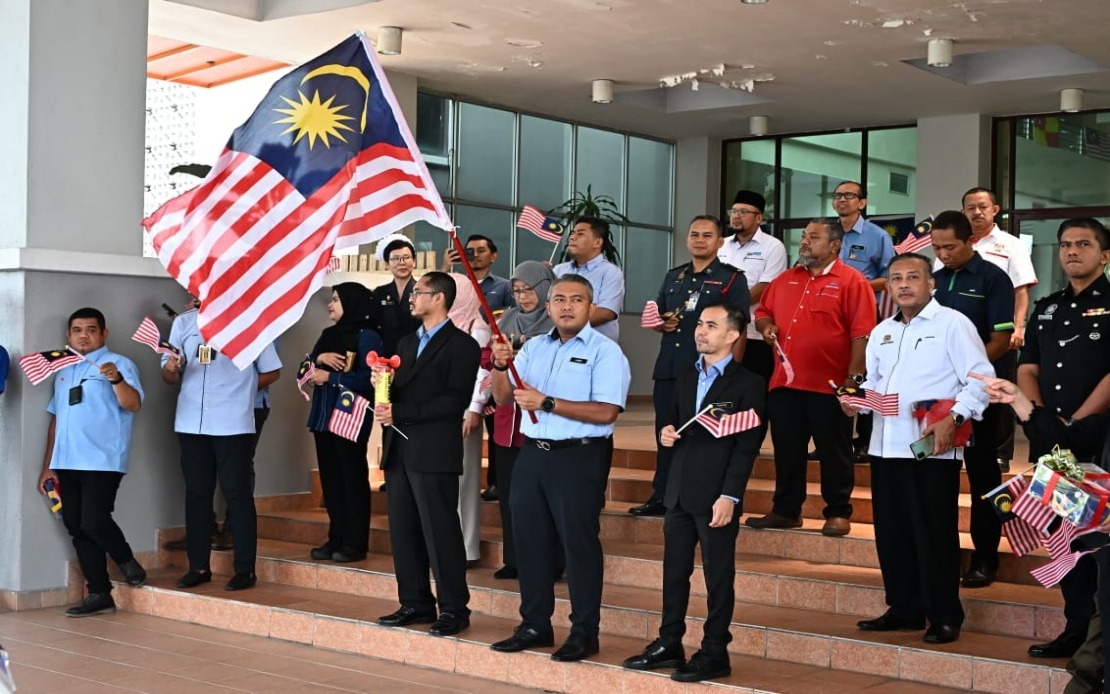
The Selangor Information Department has orchestrated an ambitious collaborative effort to deepen patriotic sentiment among the state's residents by bringing together governmental bodies and private enterprises under a unified banner. The Kembara Merdeka Jalur Gemilang X Arena Penggerak Komuniti (KMJG X JAGO) 2026 initiative signals a deliberate pivot towards demonstrating that building national consciousness transcends institutional silos and sectoral boundaries. By enlisting participation across multiple layers of society, the campaign addresses a fundamental challenge facing contemporary Malaysia: sustaining collective pride in national identity amid the fragmentation of modern life.
According to Herlina Ainizawati Zakaria, Assistant Director of the Selangor Information Department's Cyber Media Branch, this convergence of institutional actors reflects a strategic recognition that fostering patriotism demands coordinated messaging and authentic grassroots engagement. The department has committed to developing communication strategies that prioritize inclusivity, creativity, and measurable community impact when disseminating national narratives. This approach acknowledges that top-down proclamations of patriotism often fall flat; instead, when various agencies—from police to municipal councils to shopping centres—collectively champion the same message, the sentiment gains credibility and resonance. The stated aspiration is to cultivate a populace that deeply understands Malaysian history, consistently articulates pride in citizenship, and translates those sentiments into tangible expressions of national solidarity.
The KMJG X JAGO 2026 programme perpetuates an established tradition while expanding its remit considerably. The core ritual of hand-delivering the Jalur Gemilang from one designated location to another has become synonymous with the Selangor Information Department's National Day and Malaysia Day (HKHM) mobilization efforts. However, this iteration substantially broadens the thematic scope, weaving together programming that emphasizes patriotism, national unity, and love for country into a coherent narrative arc. By anchoring these themes explicitly within the initiative's structure, organizers are signalling that patriotism is not merely ceremonial but foundational to governance priorities and community life.
Central to this campaign is the One House One Jalur Gemilang (1R1JG) initiative, which seeks to fundamentally shift how ordinary Malaysians relate to national symbols. Rather than treating the flag as something reserved for official occasions or government buildings, the 1R1JG campaign encourages household-level adoption and display of the Jalur Gemilang throughout National Month. This democratization of the flag's presence transforms it from an elite or institutional symbol into a ubiquitous marker of civic identity. When neighbours see flags adorning homes up and down their streets, the psychological effect is multiplicative—national pride becomes visible, normalized, and collectively affirmed. For Malaysian society, where diversity of background and belief can sometimes obscure common ground, such symbolic unification serves a pragmatic binding function.
The Klang area was selected as the central zone for activating KMJG X JAGO Selangor 2026, with three distinct pit-stops designated to maximize geographic reach and institutional engagement. Wisma Persekutuan Klang, the Klang District and Land Office, and AEON Bukit Tinggi Shopping Centre collectively represent the institutional, bureaucratic, and commercial nodes through which ordinary residents conduct their lives. By positioning these venues as activation points, the campaign recognizes that patriotic messaging achieves optimal penetration when it intersects with spaces where citizens already gather for administrative or consumer purposes. The shopping centre placement particularly reflects contemporary understanding that civic engagement must occur not merely in formal civic institutions but in the quotidian spaces where Malaysians spend significant time.
The operational scale of the initiative demonstrates serious institutional commitment. Approximately 50 participants representing 10 distinct government agencies and private sector organizations mobilized for the Klang phase. This roster included the Klang Selatan District Police Headquarters, Klang Utara Police District, the Klang Royal City Council, and the Klang District Civil Defence Force, among others. The participation of security forces and disaster management authorities particularly underscores how patriotism is being framed as fundamentally intertwined with public safety, emergency preparedness, and institutional stability. When police and civil defence personnel actively champion flag ceremonies and national pride campaigns, they are effectively signalling that patriotism is integral to their institutional missions and public service mandates.
For Malaysian and broader Southeast Asian contexts, this initiative carries particular significance. The region has long grappled with balancing national identity formation with ethnic, religious, and subnational identifications. Malaysia's constitutional framework explicitly recognizes Islam's special position alongside protections for minority faiths and customary rights, creating inherent tensions that demand sophisticated governance approaches. Patriotism campaigns that explicitly encompass diverse institutional actors—secular government bodies, police forces, private commerce—implicitly affirm that national pride can accommodate and integrate these various components rather than requiring suppression of particular identities. By anchoring the campaign in visible, decentralized activity across multiple venues and institutions, the Selangor initiative sidesteps the pitfall of appearing to impose patriotism from a singular point of authority.
The Cyber Media Branch's explicit focus on communication strategy indicates sophisticated awareness that messaging mechanisms matter as much as substantive content. In Malaysia's fragmented media landscape, where citizens consume news through diverse platforms ranging from traditional print to social media to community channels, ensuring consistent patriotic messaging requires strategic coordination. The department's commitment to developing "creative and high-impact" communication approaches recognizes that younger Malaysians particularly may be alienated by conventional patriotic discourse. By channelling the campaign through diverse institutional actors and physical venues, including commercial spaces like shopping centres, the initiative attempts to make patriotism culturally contemporary rather than antiquated.
Looking toward 2026, this campaign establishes institutional infrastructure and community expectations that will likely persist beyond the immediate initiative. When government agencies, police, councils, and private businesses jointly champion flag display and national pride, they are collectively signalling that these values constitute normative rather than exceptional priorities. For Malaysia, where national unity has historically required continuous and deliberate cultivation, such persistent, multi-institutional messaging serves an important reinforcement function. The expansion of programming around patriotic themes beyond traditional National Day ceremonies suggests recognition that modern citizenship requires year-round engagement with national narrative and pride, not merely episodic mobilization.

