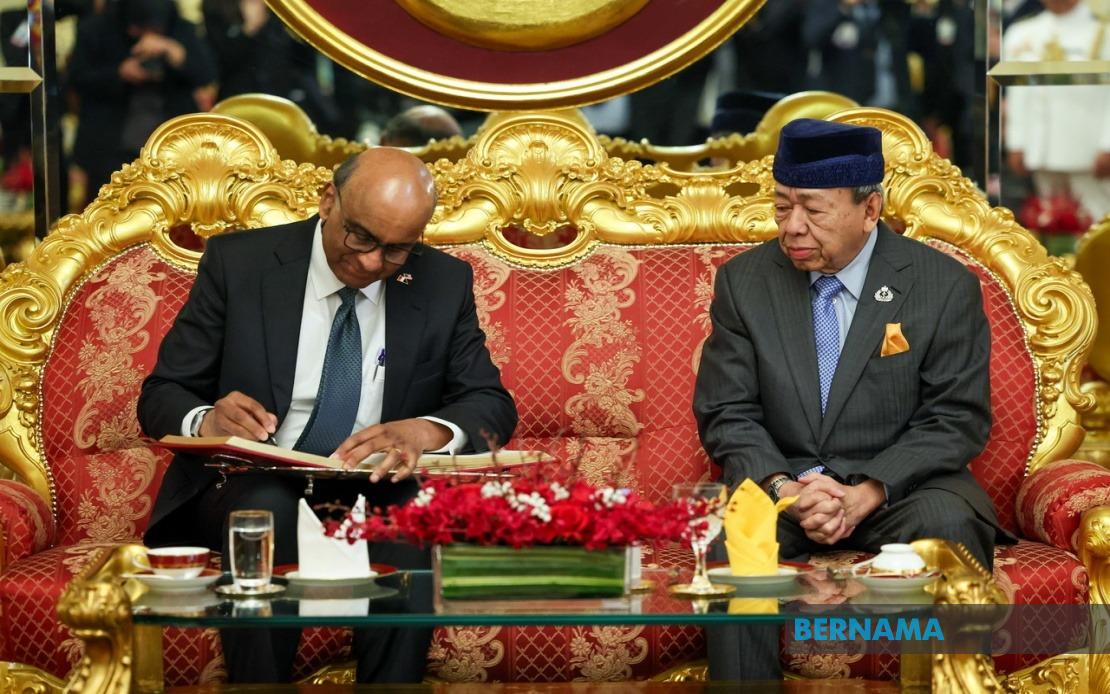
The Sultan of Selangor, Sultan Sharafuddin Idris Shah, hosted Singapore President Tharman Shanmugaratnam at Istana Alam Shah in Klang on July 14, underscoring the close ties between the two neighbouring nations and the ceremonial importance of such high-level engagements. The president's arrival at the royal residence occurred at 11 am, where he was formally received by the Raja Muda of Selangor, Tengku Amir Shah, reflecting the protocol observed in Malaysian state functions involving visiting heads of state.
The duration of the meeting, which extended for approximately ninety minutes and concluded at 12.40 pm, suggests substantive discussions took place during the audience. The presence of Entrepreneur Development and Cooperatives Minister Steven Sim, serving as minister-in-attendance, indicated the Malaysian government's attention to the visit and its desire to facilitate dialogue on matters of bilateral interest beyond the ceremonial aspects of the encounter.
Tharman's presence in Malaysia forms part of a three-day state visit spanning July 13 to 15, conducted at the formal invitation of His Majesty Sultan Ibrahim, King of Malaysia. This diplomatic engagement carries considerable symbolic weight in the context of Malaysia-Singapore relations, which remain foundational to regional stability and prosperity in Southeast Asia. The visit demonstrates the commitment of both nations to maintaining high-level political engagement and reinforcing institutional relationships.
The Malaysian Foreign Ministry characterised this state visit as a reciprocal gesture, noting that it responds to Sultan Ibrahim's own state visit to Singapore in May 2024. Such mutual exchanges between heads of state serve multiple purposes: they strengthen personal relationships between leaders, facilitate dialogue on pressing bilateral and regional matters, and publicly reaffirm the strategic partnership between the two countries. The pattern of regular high-level visits underscores the institutionalised nature of Malaysia-Singapore relations.
From an economic perspective, the bilateral relationship holds tremendous significance for both nations and the broader Southeast Asian region. Singapore functions as Malaysia's second-largest trading partner globally, a position that reflects the depth of commercial integration between the two economies. More strikingly, Singapore ranks as Malaysia's largest trading partner among the ten members of the Association of Southeast Asian Nations, a distinction that highlights the asymmetry in ASEAN trade flows and Singapore's role as a global financial and commercial hub.
The trading relationship encompasses diverse sectors including finance, petrochemicals, electronics, and services, with billions of dollars in annual bilateral commerce flowing across the shared maritime boundary. This economic interdependence creates structural incentives for maintaining stable and cordial political relations, as disruptions in bilateral ties could have cascading effects on business operations and investment flows between the two countries.
For Malaysian observers, the significance of such high-level visits extends beyond immediate bilateral concerns. As ASEAN navigates complex regional dynamics involving great power competition and evolving security challenges, the Singapore-Malaysia relationship serves as a cornerstone of ASEAN cohesion. Singapore's strategic location, advanced economic capabilities, and diplomatic networks mean that strong Malaysia-Singapore ties contribute to regional equilibrium and ASEAN's ability to manage external pressures while pursuing collective interests.
The involvement of the Raja Muda in receiving the Singapore president also carries symbolic importance within the Malaysian constitutional framework. The Raja Muda's participation in state functions emphasises the role of the sultanate in representing regional interests and maintaining ceremonial and diplomatic traditions that have long characterised Malaysian governance.
These state visits, while sometimes appearing routine in media coverage, perform crucial functions in contemporary international relations. They provide opportunities for leaders to discuss matters not always suitable for public discourse, allow for relationship-building among senior officials from both governments, and signal to domestic and international audiences the priority each nation places on the bilateral relationship. In the case of Malaysia and Singapore, where historical grievances and geographical proximity have occasionally strained relations, the regularity and formality of such engagements serve as stabilising mechanisms.
Looking ahead, observers will likely monitor outcomes from Tharman's visit through official statements and any concrete agreements reached during the three-day engagement. Such visits often culminate in joint communiqués detailing shared positions on regional issues, agreements on trade or investment facilitation, or cultural and educational exchange initiatives. The broader context of Southeast Asian politics, including questions surrounding the South China Sea, regional security architecture, and economic cooperation, may feature prominently in behind-the-scenes discussions.

