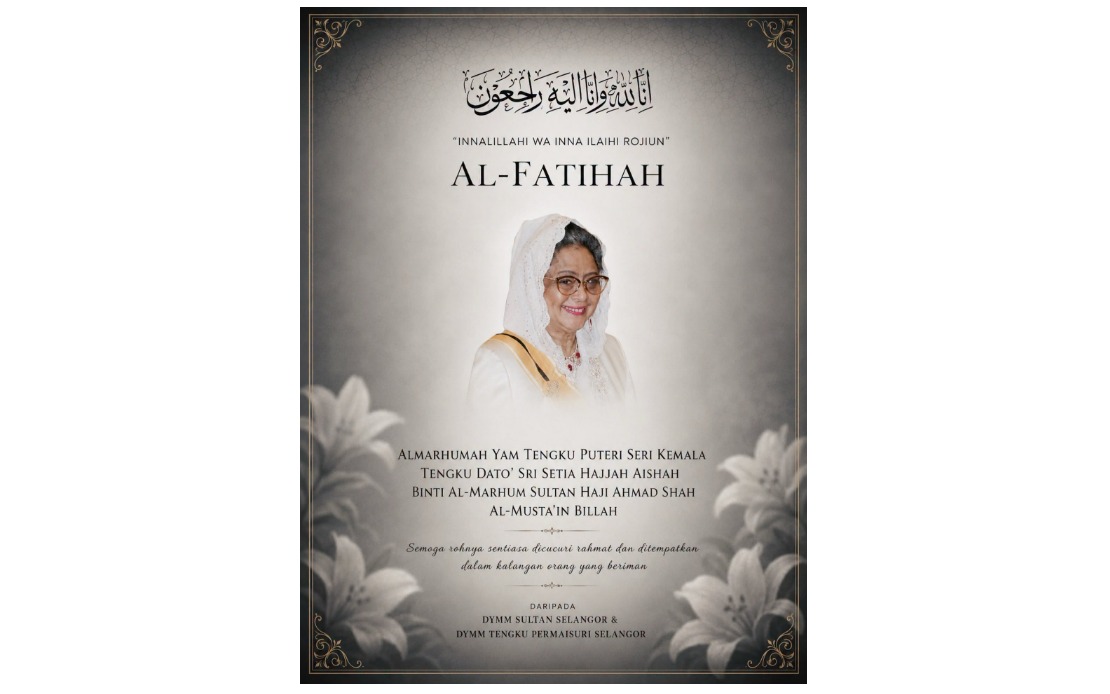
The royal households of Selangor have extended formal condolences to the Pahang royal family following the death of a prominent member of the sultanate. Sultan Sharafuddin Idris Shah and Tengku Permaisuri Selangor Tengku Permaisuri Norashikin issued expressions of sympathy regarding the passing of Tengku Puteri Seri Kemala Tengku Datuk Seri Aishah Almarhum Sultan Ahmad Shah, who was the elder sister of the reigning Sultan of Pahang, Al-Sultan Abdullah Ri'ayatuddin Al-Mustafa Billah Shah.
The announcement came through official channels from the Selangor Royal Office, underscoring the protocol of interroyalty communication that characterises Malaysia's federal system of constitutional monarchies. Such gestures of condolence between state rulers reflect the institutional bonds that connect the various sultanates across the peninsula, creating a unified framework for royal observance during periods of mourning.
Tengku Datuk Seri Aishah's death occurred at a medical facility in Kuala Lumpur, with her passing recorded at 9.15 pm. The timing of the announcement and the formal nature of the condolences indicate the significance of her position within the Pahang royal lineage. As the sister of the incumbent Sultan, she held considerable standing within one of Malaysia's most historically prominent sultanates.
The Selangor royal statement conveyed profound sorrow, with Sultan Sharafuddin and Tengku Permaisuri Norashikin expressing their grief and offering prayers for the deceased. The customary invocation "Al-Fatihah" accompanied their message, representing a spiritual acknowledgement consistent with Islamic mourning practices observed within Malaysia's royal circles. This formulaic expression serves both a religious and cultural purpose, signifying respect and solidarity during bereavement.
Arrangements for the funeral proceeded according to royal protocols, with Tengku Datuk Seri Aishah's remains transferred to the Pahang Royal Mausoleum located in Pekan. The decision to conduct interment at this site underscores the family's commitment to maintaining continuity with dynastic burial traditions. The funeral was to be conducted with full honours, reflecting both her status as a member of the ruling house and the dignity afforded to senior members of Pahang's royal establishment.
The observance of such customs demonstrates how Malaysia's constitutional monarchy system operates beyond legislative functions. State rulers maintain social and ceremonial responsibilities that extend to representing their populations during significant events, including matters affecting fellow royal families. These interactions, though formal in nature, reinforce the interconnectedness of Malaysia's nine hereditary sultanates and the broader institution of constitutional monarchy.
For observers of Malaysian royal affairs, such condolences carry symbolic weight. They underscore the cooperative nature of the sultanate system, wherein rulers acknowledge each other's joys and sorrows through established protocols. These gestures, while seemingly routine, contribute to the stability and cohesion of Malaysia's unique governance structure, which balances federal authority with state-level monarchical traditions.
The death of Tengku Datuk Seri Aishah represents a generational moment within the Pahang royal family. As the sibling of the current Sultan, she would have witnessed significant periods of the state's modern history and possessed intimate knowledge of its dynastic evolution. Her passing thus marks the transition of institutional memory within the sultanate, a reality acknowledged through the careful observation of mourning protocols.
The incident illustrates how Malaysia's royal institutions function as integrated networks rather than isolated entities. News of significant events within one sultanate's family rapidly circulates through official channels to other state palaces, enabling prompt expressions of sympathy and solidarity. This interconnected approach to royal protocol ensures that major life events—births, deaths, installations—receive acknowledgement across the entire system of hereditary rule.

