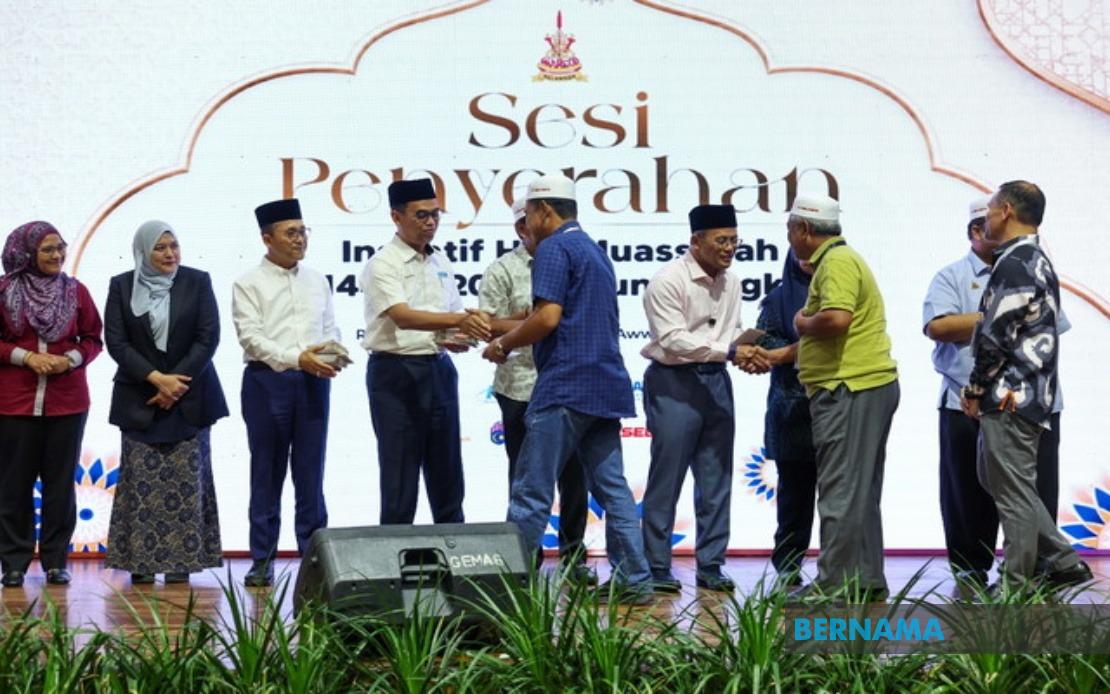
Selangor is approaching the final stages of its ambitious financial assistance programme for pilgrims preparing for the 2026 Haj journey, with authorities confirming that nearly 80 per cent of beneficiaries have already received their support payments. According to Menteri Besar Datuk Seri Amirudin Shari, 4,800 recipients out of the targeted 6,000 have been disbursed funds through the Muassasah Haj Incentive initiative, with the remaining pool of over 1,000 pilgrims set to receive their payments within weeks rather than months.
The completion timeline signals an acceleration in administrative processing following the public ceremony held at Putra Perdana Community Hall in Puchong for Dengkil constituency residents. The gathering, which featured Deputy Housing and Local Government Minister Datuk Aiman Athirah Sabu alongside Amirudin, represented one of several staged handover events orchestrated across the state to distribute assistance to eligible Muassasah pilgrims. This phased approach reflects the scale of coordination required to manage disbursements to thousands of beneficiaries across Selangor's diverse constituencies and demographic regions.
The state government, operating through its dedicated implementing agency the Selangor Menteri Besar Incorporated Foundation (Yayasan MBI), committed RM9 million to underpin the entire 2026 programme. This substantial financial commitment translates to RM1,500 per eligible pilgrim, an amount carefully structured to address the practical realities of Haj preparation rather than abstract charity. The assistance covers concrete needs including religious attire and equipment specific to pilgrimage requirements, pharmaceutical preparations essential for the demanding physical undertaking of Haj, appropriate clothing suitable for Saudi Arabia's climate conditions, and sundry items that enhance pilgrims' comfort and dignity during their spiritual journey.
For Malaysian pilgrims, particularly those from modest economic circumstances, the RM1,500 allocation represents meaningful support that bridges the gap between aspiration and feasibility. The Haj represents not merely a religious obligation for Muslims but also a significant financial burden that many ordinary Malaysians struggle to shoulder when combined with other living expenses and family commitments. By targeting assistance specifically toward pilgrimage-related expenditures rather than general subsidy, the Selangor initiative demonstrates policy precision that acknowledges both the sacred importance of the journey and the material constraints facing working and lower-income pilgrims.
Looking beyond the current cycle, Amirudin articulated an aspiration to elevate the per-capita assistance to RM2,000, potentially within the 2027 or 2028 timeframe depending on fiscal developments and budgetary availability. This upward trajectory reflects state government confidence in programme sustainability while demonstrating realistic acknowledgment of financial variability in government operations. The proposed increase of RM500 per recipient, though seemingly modest in absolute terms, would represent a 33 per cent enhancement that could substantially improve pilgrims' preparation capacity and reduce financial stress during the pre-departure period.
The cautious framing of future commitments—emphasizing that increases remain subject to financial circumstances rather than guaranteed—reflects prudent fiscal communication in an era of economic uncertainty. Regional governments across Malaysia and Southeast Asia frequently encounter pressures to expand social programmes without corresponding revenue growth, creating sustainability challenges. Amirudin's transparent articulation that unforeseen financial constraints could emerge demonstrates political maturity in managing public expectations while maintaining programme credibility through honest acknowledgment of budget realities.
The Muassasah Haj Incentive programme carries broader significance within Malaysia's federal structure and Selangor's particular political context. As the nation's most economically dynamic and populous state, Selangor's capacity to implement sophisticated social assistance programmes influences expectations and policy discourse across other Malaysian states. The initiative demonstrates how state governments can leverage their constitutional fiscal autonomy to design targeted interventions addressing constituent needs, particularly for religious obligations that carry deep cultural significance in Malaysian society.
The logistics of identifying, contacting, and disbursing payments to over 6,000 individuals scattered across Selangor's municipalities presents substantial administrative coordination challenges. The current status of completing approximately 80 per cent of disbursements ahead of the September deadline suggests competent programme management and effective communication channels with beneficiaries. Such operational capacity, often under-appreciated in policy discourse, proves essential for maintaining public confidence in government assistance mechanisms and ensuring that intended beneficiaries actually receive allocated resources.
For pilgrims themselves, the RM1,500 assistance provides tangible relief from the financial pressure that sometimes deters Muslims from fulfilling the Haj obligation despite possessing the spiritual commitment. When combined with other support mechanisms pilgrims may access through employers, religious organizations, or personal savings, the state assistance becomes one component within a broader ecosystem of enablement. The psychological dimension—knowing that government acknowledges and materially supports the pilgrimage endeavour—carries significance beyond the numerical assistance amount.
Regionally, Selangor's approach offers insights for other Muslim-majority jurisdictions and diverse societies where religious minorities similarly undertake significant faith-based travels. The model of state-facilitated financial assistance for pilgrimage preparation, calibrated to practical needs and implemented through accountable institutional frameworks, represents transferable policy design applicable across Southeast Asian contexts where pluralism and religious accommodation feature prominently in governance.
The completion of disbursements by September establishes a clear administrative benchmark against which the programme's success can be measured. Beyond timely payment, the true evaluation criterion encompasses whether recipients feel genuinely supported in their pilgrimage preparations and whether the assistance demonstrably enhances their Haj experience. Subsequent programme cycles will likely benefit from beneficiary feedback and operational lessons learned during the current 2026 implementation phase, creating opportunities for continuous refinement of assistance delivery mechanisms.

