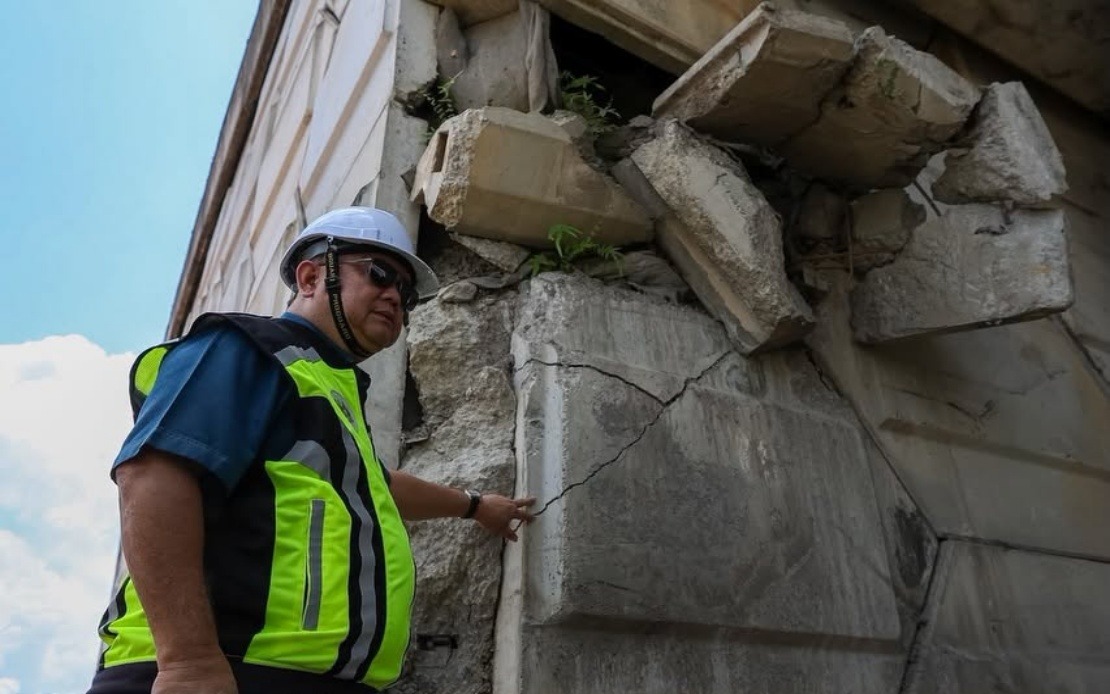
Works Minister Datuk Seri Alexander Nanta Linggi has committed to a carefully staged reopening of the Selangau-Mukah Interchange Flyover on the Pan Borneo Highway, but only after comprehensive safety assessments confirm the route is secure for public use. The announcement follows a damaging collision involving a palm oil tanker that compromised the structural integrity of Ramp 1, prompting authorities to close the critical transport corridor to prevent further risk to commuters.
The incident, which struck the retaining wall structure and raised concerns about the flyover's stability, triggered an immediate shutdown that has since created considerable disruption across Sarawak's interior regions. The closure particularly affects the vital Bintulu-Mukah-Sibu corridor, a key commercial and social artery serving thousands of daily travellers and commercial operators dependent on efficient regional connectivity. Nanta acknowledged during his visit to the site that the temporary closure represents a significant inconvenience to residents, businesses, and regular users who previously relied on this route for commerce and essential travel.
The minister outlined a carefully structured approach to restoration, emphasising that structural repairs to Ramp 1 will proceed under rigorous safety protocols rather than expedited timelines. Technical assessments conducted on-site identified specific damage to the retaining wall that requires controlled, methodical repair work to restore the flyover's structural stability. Rather than reopening all lanes simultaneously once repairs begin, authorities will implement a staged reopening strategy, allowing undamaged sections to return to service while sections still undergoing remediation remain closed to traffic.
Nanta identified three core priorities guiding the reconstruction effort. First, maintaining absolute safety standards for all road users represents the non-negotiable foundation for any reopening decision, with no compromise on structural integrity or ongoing monitoring. Second, the ministry will oversee the repair schedule to prevent unnecessary delays that would extend the disruption beyond what is technically required. Third, authorities commit to providing clear, timely public communication regarding alternative routes, current closure zones, and the progress of ongoing work—a recognition that transparency helps commuters plan journeys and manage expectations.
The minister's statement reflects growing awareness among policymakers of public sentiment regarding infrastructure safety, particularly in an era where concerns about road conditions circulate rapidly through both traditional news channels and social media platforms. Nanta specifically cited the importance of taking community feedback seriously, acknowledging that residents and regular users possess valuable insights into the impact and urgency of resolving the situation. This inclusive approach signals a shift toward integrating public input into infrastructure decision-making, especially when safety rather than purely commercial timelines drives policy.
The Pan Borneo Highway, a major development corridor serving Sarawak's interior regions, has become central to the state's economic integration and social connectivity. The Selangau-Mukah section represents a crucial link in this network, connecting agricultural and resource-extraction zones to coastal population and commercial centres. The closure thus carries broader economic implications beyond immediate commuter inconvenience, affecting supply chains for agricultural products, reducing efficiency in commerce-dependent transport networks, and potentially constraining economic activity in surrounding districts.
Nanta's personal visit to the scene and his direct involvement in oversight signal that the federal government recognises the strategic importance of swift yet safe resolution. Rather than delegating the matter entirely to technical contractors, the minister's hands-on approach suggests a commitment to maintaining momentum while preventing corner-cutting on safety measures. This balance between urgency and caution reflects lessons learned from previous infrastructure incidents where delays in addressing safety concerns created compounding problems and erosion of public confidence.
The phased reopening strategy represents a pragmatic compromise between competing demands. Sections of the flyover that structural assessments confirm as undamaged or already-repaired can serve traffic immediately, restoring partial connectivity and reducing overall disruption even while other sections continue work. This approach allows commerce and travel to resume partially while maintaining closure zones where hazards persist, demonstrating an understanding that binary on-off solutions often prove inefficient in managing complex infrastructure challenges.
For Malaysian road users and particularly for Sarawak residents accustomed to the challenges of interior connectivity, the commitment to staged reopening offers measured reassurance. The explicit prioritisation of safety over calendar-driven deadlines contrasts with past incidents where infrastructure was reopened prematurely only to require subsequent closures when problems emerged. Nanta's statement that the lane will reopen only once safety is fully restored provides the assurance that structures will not return to service until genuinely secure.
The broader lesson extends beyond this single incident. As Malaysia's highway network expands and heavy commercial traffic intensifies, ensuring that oversight agencies conduct thorough safety assessments and repairs represents an investment in long-term system reliability. The Pan Borneo Highway, designed as a transformational project connecting Sarawak's remote regions to modern transport infrastructure, can only fulfil that mission if users maintain confidence in its safety standards. Any compromise on safety protocols undermines the entire development objective and erodes public trust in government infrastructure management more broadly.
Authorities have committed to providing regular updates on repair progress and reopening timelines, allowing commuters and businesses to adjust operations accordingly. This communication commitment matters particularly in Sarawak's interior, where limited route alternatives mean closures create more acute disruption than equivalent closures in more densely connected regions. By maintaining transparency throughout the repair process, officials can help affected communities and commercial operators develop contingency plans rather than facing unexpected announcement of reopening or extended closures.
As repairs proceed, the incident should prompt broader examination of maintenance protocols and safety oversight mechanisms across the Pan Borneo Highway and other major Malaysian transport corridors. Regular structural inspections, impact response procedures, and emergency protocols all warrant review in light of this collision's consequences. Infrastructure that serves regional development aspirations must be maintained with the rigour and attention to safety that those aspirations demand.

