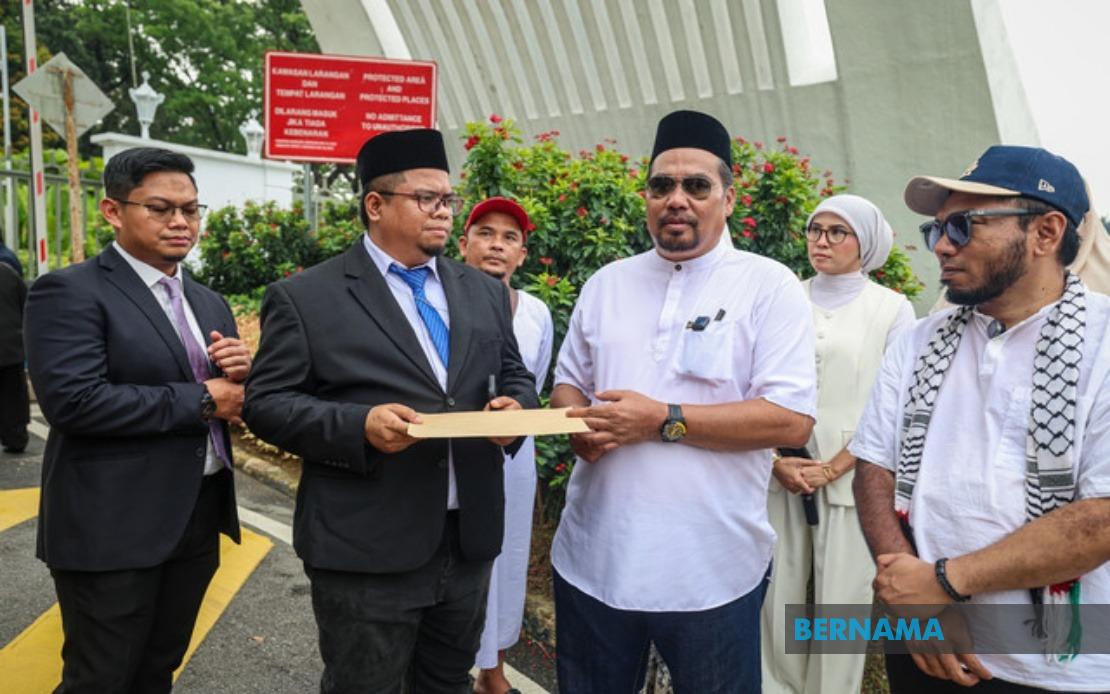
Pressure is mounting on the Malaysian government to take decisive action against officials implicated in the mismanagement of Tabung Haji (TH), as the social media activist group Sekretariat Gerak Gempur Media Sosial Rakyat Malaysia (SEKPUR) formally escalated demands for accountability. The group staged a peaceful gathering at Parliament's main entrance on August 11, presenting a memorandum that calls for the prosecution of wrongdoers regardless of political affiliation, emphasising that the institution's stewardship cannot be compromised by partisan considerations.
The memorandum, delivered to Zairudin Hashim, press secretary to the Minister in the Prime Minister's Department (Religious Affairs), is intended for Minister Senator Dr Zulkifli Hasan. SEKPUR's submission comes directly in the wake of Parliament's special sitting to brief lawmakers on findings from the Royal Commission of Inquiry, which had concluded its investigation into the Islamic pilgrimage fund's operational shortcomings. The timing reflects widespread concern that momentum for reform and justice may dissipate if the government delays concrete responses to the RCI's recommendations.
The underlying trigger for SEKPUR's intervention is the 211-page RCI report released publicly on July 29, which documented systematic weaknesses in Tabung Haji's governance and management spanning 2014 to 2020. This six-year window coincides with a period of significant institutional strain, during which the fund faced mounting financial pressures and questioned the efficacy of its operational frameworks. The report's findings have exposed vulnerabilities that extend beyond simple administrative oversights, touching on strategic decision-making and oversight failures at senior levels.
SEKPUR secretary Mohd Yani Alias articulated a principled stance during the parliamentary submission, declaring that accountability must transcend political loyalty. His statement that "we do not care who is responsible or which party they belong to" underscores the civil society expectation that partisan considerations should not shelter officials from consequences. This framing is particularly significant in Malaysia's current political environment, where questions of institutional accountability have occasionally become entangled with coalition politics and factional interests within government.
The activist group's concerns extend beyond narrow questions of prosecution to encompass structural financial sustainability. SEKPUR has raised alarms about Tabung Haji's capacity to maintain competitive hibah distributions—the profit payouts that depositors depend upon as returns on their pilgrimage savings. The fund's financial position directly affects millions of Malaysian Muslims who treat Tabung Haji accounts as vehicles for disciplined saving toward fulfilling the hajj obligation. Diminished returns represent a tangible cost borne by ordinary depositors whose life savings are at stake.
Escalating haj costs present an additional burden that SEKPUR identifies as worthy of government intervention. The increasing expense of performing the pilgrimage compounds the financial strain on devotees, particularly those from lower-income households for whom the hajj represents a significant lifetime expenditure. SEKPUR's memorandum frames this cost inflation within the context of institutional mismanagement, implying that better governance might have protected depositors from absorbing losses that subsequently necessitate higher pilgrimage fees to offset institutional shortfalls.
The memorandum also presses for greater transparency in haj quota allocation, a procedurally sensitive matter with historical significance in Malaysian Islamic administration. Quota management involves balancing religious equity with operational capacity, and accusations of non-transparent distribution can undermine public confidence in the system. SEKPUR's intervention suggests that civil society stakeholders perceive opaqueness as a governance deficit requiring remediation through institutional reform and public disclosure.
The RCI report included 25 specific recommendations for institutional improvement, and as of July 30, Tabung Haji had already implemented approximately 75 percent of these measures. While this compliance rate demonstrates responsiveness, SEKPUR's mobilisation suggests that implementing procedural reforms is insufficient without parallel accountability for past failings. The activist group appears to be signalling that the government must pursue a dual approach: technical improvements to prevent future mismanagement alongside meaningful consequences for historical wrongdoing.
The Yang di-Pertuan Agong's earlier decree, referenced in SEKPUR's memorandum, explicitly directed that those responsible for Tabung Haji's difficulties must be "brought to justice and pursued to the fullest extent." SEKPUR is essentially operationalising this royal directive by converting it from institutional guidance into concrete political pressure. The group's invocation of the Agong's authority lends legitimacy to its demands while positioning enforcement as a constitutional obligation rather than merely a policy preference.
For Malaysian readers and observers across Southeast Asia, this episode illustrates broader tensions within Islamic institutional governance in the region. Tabung Haji represents a sophisticated attempt to blend religious obligation with modern financial management, serving as a model that other Muslim-majority countries have studied. The institution's stumbles thus carry implications beyond Malaysia, as failures in governance undermine confidence in whether religious financial institutions can function effectively within contemporary regulatory frameworks.
The submission to Parliament also reflects evolving civil society activism in Malaysia, where social media-based movements increasingly translate online mobilisation into formal institutional engagement. SEKPUR's transition from digital agitation to parliamentary advocacy demonstrates how contemporary activism operates across multiple registers, combining grassroots pressure with strategic intervention at key decision-making nodes. This approach amplifies the group's influence beyond what purely digital campaigns might achieve.
Government responsiveness to SEKPUR's memorandum will likely become a barometer of the administration's commitment to the accountability agenda. Inaction could be interpreted as tacit permission for mismanagers to escape consequences, potentially eroding public trust not only in Tabung Haji but in broader institutional governance. Conversely, decisive action could establish precedent that institutional mismanagement carries real costs, irrespective of political connections or factional alignment within government structures.
The coming weeks will reveal whether the government treats SEKPUR's intervention as a routine civil society submission or as a significant political signal requiring substantive response. The millions of Tabung Haji depositors—mostly ordinary Malaysian Muslims saving systematically for their pilgrimage—have a profound stake in the outcome of these deliberations. Their expectations for accountability, combined with broader concerns about institutional integrity, ensure that this matter will remain salient in Malaysia's governance discourse regardless of official pronouncements.

