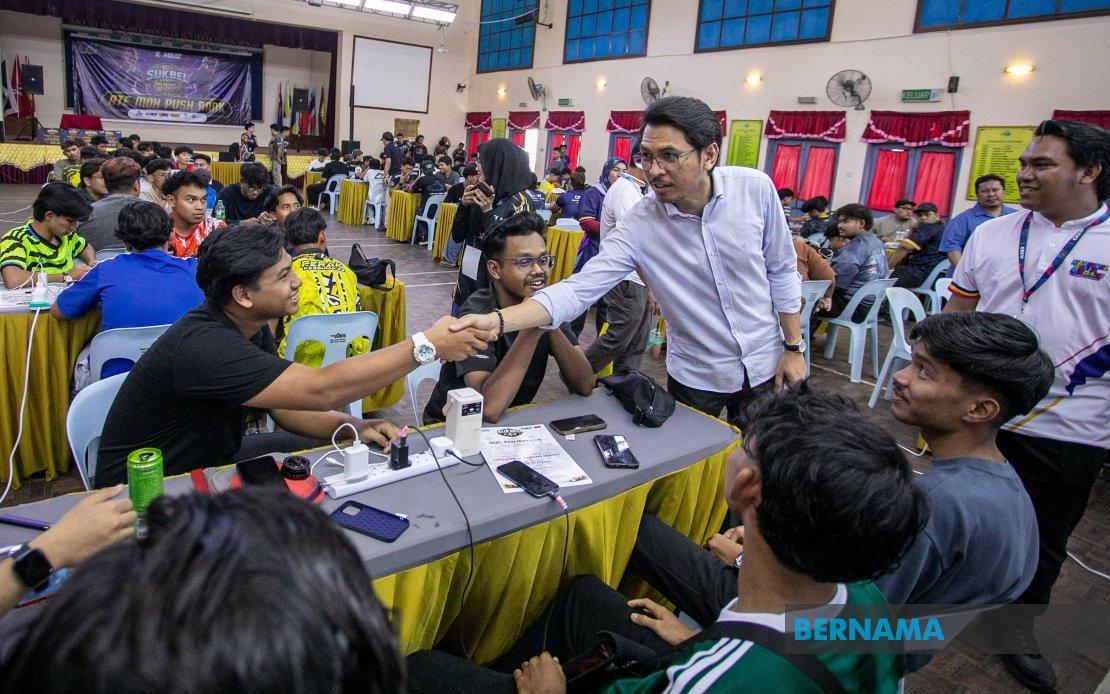
The Sejahtera MADANI initiative operating in Perak has reached a significant milestone, directing RM2.3 million in financial assistance to approximately 2,000 residents across the state. Building on this initial success, the programme has now secured an additional RM3 million allocation to broaden its scope and deepen its impact across more communities. The expansion reflects government confidence in the scheme's ability to address economic hardship and support vulnerable populations in one of Malaysia's key states.
Muhammad Kamil Abdul Munim, the Finance Minister's political secretary, unveiled the funding boost while officiating a Sejahtera MADANI roadshow in the Padang Rengas parliamentary constituency at Millennium Hall in Lubok Merbau. The fresh capital injection signals the government's determination to sustain momentum in delivering targeted welfare assistance to those most in need of financial and social support. The expansion comes at a time when economic pressures continue to affect households across the nation, making such interventions increasingly vital for maintaining social stability.
The programme's beneficiary categories are deliberately varied to address multiple dimensions of poverty and economic disadvantage. Micro-entrepreneurs struggling to scale their operations, workers earning at the lower end of the income spectrum, and academically gifted students pursuing higher education all qualify for assistance. This diversified approach recognises that poverty manifests differently across society, requiring differentiated solutions rather than one-size-fits-all interventions. By targeting specific groups, the scheme aims to generate multiplier effects that benefit not only direct recipients but also their families and wider communities.
Beyond monetary handouts, the initiative distinguishes itself through its provision of productive assets and incentive mechanisms. During the Padang Rengas roadshow, thirteen high-achieving SPM students received laptops to support their tertiary studies, while five small-scale entrepreneurs were given business equipment to enhance productivity and revenue generation. This asset-based approach acknowledges that financial constraints often prevent entrepreneurial individuals and talented students from fully realising their potential. By removing these practical barriers, the programme creates pathways for economic mobility and social advancement that transcend simple income support.
Muhammad Kamil emphasised that the Sejahtera MADANI framework reflects the government's broader philosophy of delivering welfare assistance with precision and accountability. Rather than dispersing funds indiscriminately, the scheme identifies genuine need and channels support to maximise real-world impact. This targeting mechanism represents a deliberate shift from earlier welfare approaches that sometimes suffered from inefficiency or limited effectiveness. The government's messaging suggests a commitment to ensuring public funds generate tangible improvements in recipients' living standards and educational outcomes.
However, the announcement also flagged significant governance challenges that had undermined earlier implementation efforts. Muhammad Kamil acknowledged that the original SejaTi MADANI grant scheme, which empowered local communities to identify and prioritise their own projects, experienced notable implementation failures. Several projects failed to materialise as planned or suffered from management problems that eroded public confidence in the initiative. These setbacks prompted a fundamental rethink of the programme's operational structure and oversight mechanisms.
The government's response involves substantially tightening supervision and monitoring throughout project lifecycles. Muhammad Kamil stated that enhanced vigilance would be implemented to prevent future project collapses, misappropriation of public funds, and fraudulent practices. This represents an implicit acknowledgment that decentralisation, while theoretically appealing for fostering community ownership, created vulnerabilities when combined with insufficient oversight. The balance between community empowerment and rigorous accountability remains challenging, but the revised approach prioritises safeguarding public resources against leakage and misuse.
The governance lesson here has broader relevance for Malaysian development programmes beyond Sejahtera MADANI. Many initiatives have foundered not through lack of funding or poor initial design, but through inadequate monitoring, weak implementation capacity at the ground level, and insufficient mechanisms to detect and deter corruption or negligence. The government's stated commitment to stepped-up oversight suggests learning from past failures, though translating this commitment into consistent practice across sprawling programmes remains challenging. Perak's experience provides a case study in the necessity of matching ambition in programme scope with commensurate investment in administrative capacity and accountability infrastructure.
For Malaysian recipients and communities relying on government assistance, the expansion of Sejahtera MADANI funding carries both promise and caution. The promise lies in expanded reach—more entrepreneurs will access equipment, more students will receive educational support, and more households will receive immediate financial relief. The caution reflects the acknowledged history of implementation difficulties that previously plagued the scheme. Success ultimately depends not just on funding availability, but on the government's ability to execute enhanced oversight in practice, resist political patronage in beneficiary selection, and maintain momentum across multiple implementation cycles.
The Sejahtera MADANI initiative's trajectory illustrates a broader pattern in Malaysian governance, where good intentions and adequate resources have sometimes been undermined by weak institutional capacity and monitoring gaps. The government's willingness to expand funding while simultaneously implementing corrective governance measures suggests recognition of these historical lessons. For other Southeast Asian nations grappling with similar welfare and development challenges, Malaysia's experience—both the initial successes and subsequent difficulties—offers instructive examples of what works and where systems require strengthening. The real test will come as the programme enters its expansion phase, demonstrating whether enhanced oversight can genuinely deliver the broader impact the additional funding promises.

