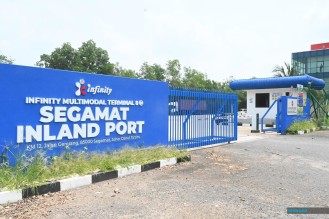
After lying dormant for more than a decade, the Segamat Inland Port (SIP) is positioning itself as a critical node in Malaysia's freight logistics network, with management targeting container volumes exceeding 6,000 twenty-foot equivalent units (TEUs) before the calendar year concludes. The facility, which resumed operations in late June following its official launch by Transport Minister Anthony Loke Siew Fook, represents a significant step in the government's broader strategy to transition cargo movement from roads to railways, a shift embodied in the Road to Rail initiative developed in partnership with Keretapi Tanah Melayu Bhd.
The performance metrics during SIP's initial weeks of operation demonstrate the pent-up demand for rail-based cargo handling across a vast industrial region. In its first operational month through July, the port managed approximately 1,000 TEUs of containerised and bulk cargo, according to Samuel Ho, the facility's manager. While this throughput may appear modest in isolation, it provides a foundation for scaling operations significantly. The annual target of 6,000 TEUs would represent a meaningful volume for an inland facility competing against established port infrastructure, particularly given the facility's current operational constraints and the time required for supply chains to adjust to rail logistics.
SIP's geographic positioning makes it strategically valuable for manufacturers and distributors across a four-state region spanning northern Johor, southern Pahang, southern Negeri Sembilan, and Melaka. This inland location offers proximity to established industrial clusters and development zones without the congestion and higher handling costs associated with maritime ports. For manufacturers in districts such as Batu Pahat and Kluang, the inland port provides a direct railway connection to major sea ports including Port Klang, Port of Tanjung Pelepas, and Johor Port in Pasir Gudang. This connectivity advantage has traditionally been underutilised, creating what Ho describes as an opportunity for the facility to emerge as a catalyst for regional economic growth and industrial investment.
The revival of SIP is inseparable from recent infrastructure improvements that fundamentally altered the economics of rail freight in Malaysia. Previously, the facility operated under severe scheduling constraints because the railway network in Johor relied on single-track infrastructure that prioritised passenger train services, with freight trains accommodated only during secondary time slots. This limitation meant SIP could accommodate approximately one cargo trip weekly, rendering rail logistics impractical for time-sensitive shipments. The completion of double-tracking to Johor has transformed operational flexibility dramatically. SIP can now accommodate up to four cargo receiving and dispatch trips weekly, multiplying available capacity and making rail-based logistics competitive with road transport for many commodities and supply chain scenarios.
The environmental and efficiency arguments supporting the inland port's expansion carry particular weight in Malaysia's transport and logistics sector. Rail freight transport consumes substantially less fuel than road transport while handling equivalent volumes; according to SIP management, a single cargo train journey displaces approximately 80 container trucks from the road network. This substitution effect extends beyond direct fuel savings to encompass reduced emissions, lower accident rates, and decreased contribution to road congestion. On a broader scale, SIP operations could eliminate roughly 18,000 lorry movements monthly from Malaysian highways—a significant intervention in traffic flows and road safety profiles for an inland facility still in its infancy.
Safety considerations have emerged as a central justification for the port's reactivation, reflecting both regulatory priorities and operational realities. Road transport exposes freight to elevated accident risks and unpredictable delays stemming from congestion, weather conditions, and mechanical failures. Rail transport offers more predictable transit times and substantially reduced accident exposure, advantages that become increasingly valuable as supply chains demand reliability and just-in-time delivery becomes standard practice. For automotive suppliers, electronics manufacturers, and food producers operating across the four-state service region, these reliability improvements can justify incorporating rail logistics into their transport strategies, even if rail costs per unit are slightly higher than the most economical trucking options.
Operationally, SIP is developing on a substantial land footprint that provides room for significant expansion. The facility currently occupies 20.23 hectares in its inaugural phase, positioned directly adjacent to Segamat Railway Station. Crucially, management has conceived the overall development as a three-phase programme, implying that the current footprint represents only an initial manifestation of the facility's intended scale. This phased approach allows SIP to expand capacity incrementally while demonstrating demand and refining operational procedures. Upon completion of all planned phases, the facility could accommodate substantially greater throughput and support a more diverse range of cargo types and handling services.
Employment generation has featured prominently in communications surrounding SIP's reactivation, reflecting both genuine labour market impacts and the political importance of job creation in industrial development narratives. Management reports that the initial phase has already created over 200 positions for local residents, spanning roles in cargo handling, security, logistics coordination, and operational management. Projected job creation upon completion of subsequent phases suggests this employment base will expand substantially as the facility scales. For a region where manufacturing provides primary employment but logistics opportunities have historically been concentrated in major port cities, the inland port offers diversified career pathways and income-generating opportunities distributed across smaller urban centres.
SIP's integration into Malaysian vocational and higher education represents an additional dimension of its development strategy with long-term implications for sectoral workforce quality. Management has established a collaborative relationship with Universiti Tun Hussein Onn Malaysia (UTHM) focused on knowledge transfer regarding rail-based inland port operations. This partnership includes providing students and researchers with fieldwork exposure and supporting applied studies on logistics efficiency, transport systems optimisation, and supply chain management. These educational linkages help develop specialised expertise in rail freight handling—a competency that has atrophied across Malaysia during decades when road transport dominated freight corridors. Rebuilding this expertise foundation is essential for the sector's long-term development and competitive positioning.
The trajectory of container volumes during SIP's ramp-up phase will provide crucial insights into demand for rail-based inland logistics across Southeast Asia's broader market context. Regional supply chains are increasingly diversifying away from concentration on major port cities, reflecting the emergence of industrial clusters inland and the growing logistical sophistication of mid-sized manufacturers. SIP's performance offers a natural experiment in whether Malaysian industrial operators will adopt rail logistics when reliable alternatives become available. Success in meeting and exceeding the 6,000 TEU target by year-end would demonstrate genuine market demand and could stimulate similar inland port developments elsewhere in the region. Conversely, challenges in reaching targets would reveal persistent logistical, regulatory, or cultural barriers to rail freight adoption that require more fundamental intervention.
Transport Minister Loke's official endorsement of SIP reflects the facility's alignment with broader government objectives concerning transport system efficiency and supply chain resilience. The ministerial framing emphasises SIP's role in strengthening Malaysia's logistics network and enhancing the competitiveness of domestic industrial operations by reducing transport costs and improving service reliability. These positioning statements indicate that SIP is conceived not merely as a port facility but as an element within an integrated transport strategy addressing congestion, environmental sustainability, and economic productivity simultaneously. This systemic conception suggests that government support for inland port development may extend beyond initial capital provision to encompass ongoing operational assistance, regulatory adjustments, and coordination with port authorities and railway operators.
The inland port sector represents an emerging frontier in Malaysian logistics, with SIP positioned as a pioneer establishment establishing operational models and business practices that could be replicated across the peninsula. The facility's success will depend on continued railway infrastructure investment, coordination between multiple government and private sector entities, and the willingness of shippers to integrate rail logistics into established supply chain practices. For Malaysian readers following regional logistics developments, SIP's performance trajectory offers a bellwether indicator of whether Malaysian transport policy can successfully transition freight movement away from over-reliance on road networks toward more balanced, sustainable, and efficient multimodal systems.

