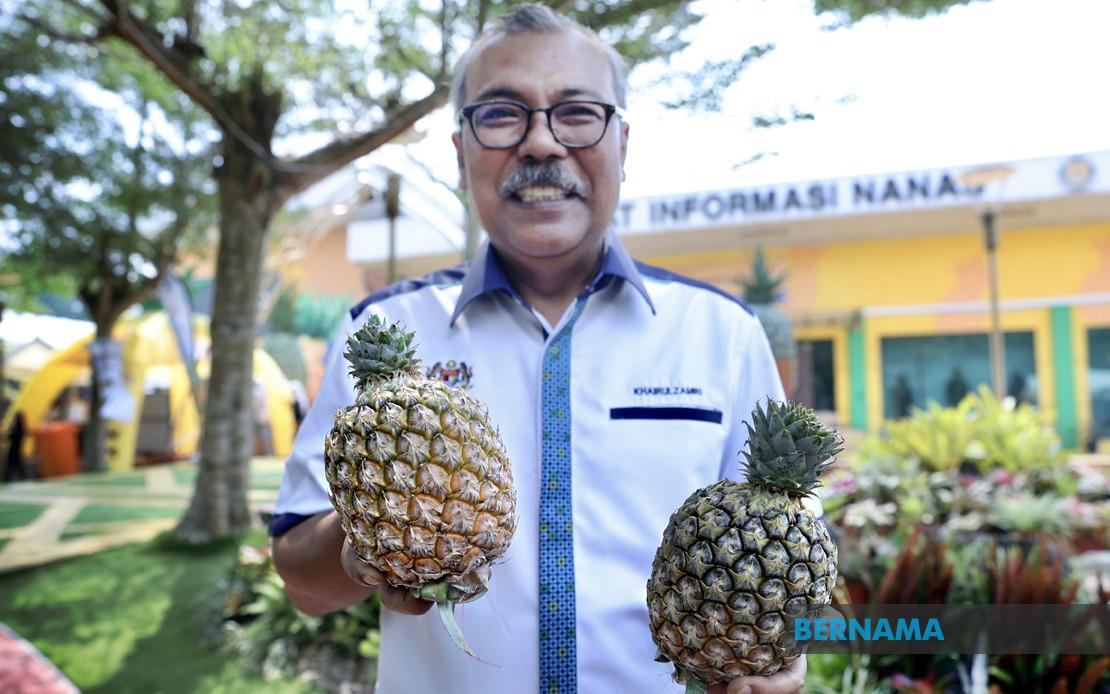
A premium pineapple variety developed in Sarawak is commanding attention at this year's Malaysia Agriculture Expo, marking a potential milestone for the nation's fruit industry. The Sarawak Gold (SG1) has arrived at Laman Nanas during MAHA 2026, currently underway at the Malaysia Agriculture Expo Park (MAEPS) in Serdang, with seven tonnes shipped from the state to showcase the fruit's commercial qualities to the visiting public.
According to Mohd Khairuzamri M. Salleh, director-general of the Malaysian Pineapple Industry Board (LPNM), the SG1 represents a genuine breakthrough for producers navigating increasingly competitive global markets. The variety was first identified and cultivated in Miri and has been identified as a crop with substantial economic viability. What distinguishes the SG1 from established competitors centres on multiple agronomic and organoleptic advantages that address longstanding challenges within the sector.
The fruit's flavour profile rivals the widely planted MD2 variety, recognised as an industry benchmark for sweetness and consumer appeal. Yet the SG1 offers distinctive visual characteristics, particularly its crown formation which resembles a rose in shape and creates distinctive market differentiation. Quality consistency throughout the fruit—from crown to base—addresses a persistent concern among international buyers regarding variable organoleptic profiles in tropical fruits. These attributes combine to position SG1 as a premium product commanding higher retail prices.
Perhaps most significantly for smallholder farmers and large-scale operators alike, the SG1 achieves harvestable maturity in approximately nine months, substantially compressing the production cycle compared to MD2's fourteen-month timeline. This acceleration translates directly into improved capital turnover, reduced carrying costs, and greater operational flexibility for producers managing seasonal demand fluctuations across export markets. The cumulative financial impact over multiple crop cycles can substantially improve farm profitability.
The variety's agronomic efficiency extends further to planting density, a critical variable determining yield per hectare and land utilisation rates. The SG1 tolerates remarkably high densities ranging between 25,000 and 30,000 plants per acre—substantially above conventional spacing practices. This density tolerance permits intensification of production without proportional increases in land requirements, a particular advantage within Malaysia's constrained agricultural geography and competing land demands. For a nation seeking to maximise agricultural output while preserving forest reserves and environmental integrity, this development carries strategic implications.
The Malaysian Pineapple Industry Board is actively pursuing geographical expansion of SG1 cultivation beyond Sarawak into Peninsular Malaysia, recognising the variety's potential to revitalise production areas and attract grower participation. Distribution of SG1 seedlings to commercial producers across wider regions is projected to commence within the coming year, signalling institutional confidence in the variety's scalability and market reception. This rollout strategy suggests that LPNM anticipates sufficient domestic demand and export opportunity to justify investment in expansion infrastructure.
International market penetration has already commenced through preliminary channels. Trial shipments dispatched from Sarawak to Singapore have achieved successful reception, validating export protocols and demonstrating that the SG1 meets stringent international quality specifications. The variety's pronounced resilience—noted across growing conditions encountered during Sarawak cultivation—suggests capacity to perform across diverse climatic and soil conditions within target export destinations. Strategic markets including China and New Zealand have been identified as expansion targets, reflecting confidence that SG1 possesses competitive advantages within these sophisticated consumer segments.
Beyond fresh fruit marketing, MAHA 2026's Laman Nanas exhibition articulates a broader industry narrative centred on maximising value extraction across the entire pineapple production system. The exhibition theme, "Value Creation for Food Security," seeks to reposition public understanding of pineapple cultivation beyond conventional fresh-fruit commerce. The "one planting, three harvests" framework conceptualises the pineapple as a multi-output agricultural system, wherein seeds constitute a harvested commodity distinct from the primary fruit, whilst vegetative material traditionally discarded as waste undergoes transformation into high-value secondary products.
These secondary applications encompass feeds for ruminant livestock derived from plant residues, fibrous textiles derived from leaf material, and paper products manufactured from processed biomass. This systemic valorisation approach addresses sustainability concerns regarding agricultural waste whilst generating additional revenue streams for producers. For Malaysian agriculture seeking to enhance overall sectoral profitability and environmental performance simultaneously, this integrated production philosophy offers a template applicable beyond pineapples to broader horticultural systems.
MAHA 2026, operating through September 6 at MAEPS, aggregates approximately 2,000 exhibitors and expects to attract over four million visitors throughout its run. The exhibition functions as a significant platform for showcasing domestic agricultural innovation and facilitating stakeholder engagement across the value chain, from production through marketing. The SG1 debut at this scale provides unprecedented visibility to growers, agricultural technology providers, exporters, and government policymakers examining opportunities within tropical fruit production.
The implications for Malaysia's agricultural competitiveness extend beyond individual farmer profitability into broader strategic considerations. Global pineapple production remains concentrated within relatively few producing nations, with the Philippines, Costa Rica, and Brazil commanding substantial market share. Development and commercialisation of superior varieties with shortened production cycles and superior yield characteristics per hectare enables Malaysia to capture market segments defined by premium pricing and differentiation. Success in establishing SG1 across Malaysian geography could catalyse broader investment in domestically developed crop varieties, reducing dependence upon externally developed genetic material and enhancing national agricultural autonomy.

