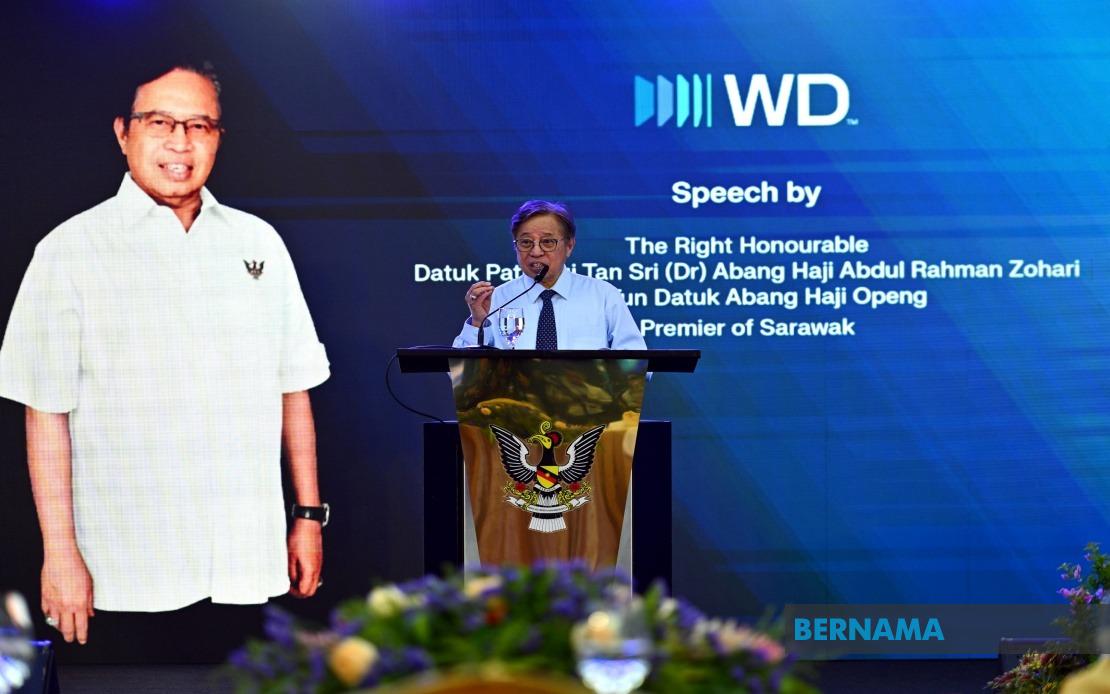
Sarawak's leadership has signalled pragmatic acceptance of a potential increase to its special constitutional grant, though the state remains mindful of the federal government's budgetary constraints. Premier Tan Sri Abang Johari Tun Openg outlined this position while observing that any enhancement to the payment structure under Article 112D would require sufficient federal capacity to deliver. Speaking after attending the New Horizon initiative for Western Digital operations in Kuching on July 2, he acknowledged that discussions on this sensitive constitutional matter have remained largely preliminary, despite its elevation during recent talks with Prime Minister Datuk Seri Anwar Ibrahim in Bintulu.
The Article 112D special grant represents a longstanding mechanism within Malaysia's federal architecture, specifically designed to support Sarawak's development and governance. Abang Johari's measured tone reflects the delicate balance required when negotiating financial arrangements between a resource-rich state and the central government, particularly when national finances face competing pressures. His statement that the state would welcome an increase "if the Federal Government can afford it" while extending understanding should circumstances prove otherwise demonstrates both appetite for improved fiscal allocation and realistic recognition of broader economic constraints.
Prime Minister Anwar Ibrahim confirmed during parliamentary question time on June 30 that active negotiations remain underway regarding Sarawak's special grant allocation. His public commitment to honouring the Malaysia Agreement 1963 principles signals that the federal administration views this matter as integral to maintaining the constitutional compact underpinning Malaysia's federation. The MA63 framework remains politically and legally significant for Sarawak, having established particular safeguards and financial provisions when the state joined the federation six decades ago.
The absence of detailed technical discussions at this stage suggests negotiations are still in their exploratory phase, with both parties likely taking time to assess fiscal priorities and establish parameters for any meaningful adjustment. For Sarawak, which has consistently emphasised its constitutional rights under MA63, pressing the case for enhanced grant allocation aligns with longer-standing assertions regarding federal resource distribution. The state has historically argued that its contributions to national wealth—particularly through oil and gas revenues—warrant corresponding federal investment and fiscal support.
Beyond the immediate grant discussion, Abang Johari's remarks underscore Sarawak's strategic economic pivot toward high-technology sectors and renewable energy industries. His emphasis on the three-decade partnership with Western Digital highlights how the state has positioned itself as an attractive destination for capital-intensive technology investment. The focus on glass substrate data storage technology reflects Sarawak's efforts to move beyond extractive industries toward advanced manufacturing and digital infrastructure.
The Premier articulated a forward-looking vision in which data assets would eventually surpass petroleum in economic value, positioning Sarawak to capitalise on this transition through investments in data centre infrastructure and related technologies. This narrative carries implications for federal-state fiscal discussions, as Sarawak constructs a case for viewing enhanced grant allocation as investment in future competitiveness rather than subsidy. The availability of renewable energy and abundant water resources—critical inputs for data centre operations—provides legitimate competitive advantages that Sarawak can leverage in attracting multinational technology enterprises.
Western Digital's continued commitment to Sarawak, expressed through its glass substrate technology development, demonstrates investor confidence in the state's operational environment and resource advantages. The technology itself represents a significant advancement, enabling considerably higher data storage capacity compared to conventional systems and directly supporting the infrastructure requirements of artificial intelligence-driven digital economies. This convergence of state advantages, investor presence, and emerging technological demand creates a compelling platform for Sarawak's economic repositioning.
For Malaysian observers, the ongoing grant negotiations carry broader implications regarding federal-state fiscal relations and constitutional implementation. How the federal government responds to Sarawak's positioning will set precedents affecting other states and potentially influencing political dynamics within the ruling coalition. The matter also reflects growing awareness across Malaysia that economic futures depend increasingly on attracting technology investment and developing digital infrastructure, making Sarawak's resource-based advantages strategically valuable to national competitiveness.
Abang Johari's pragmatic framing—acknowledging federal constraints while maintaining Sarawak's interest in improved fiscal arrangements—suggests a negotiating approach emphasising shared prosperity and long-term stability rather than confrontational demands. This measured stance may facilitate progress by avoiding the appearance of zero-sum competition between federal and state interests. By linking the grant discussion to broader economic transformation narratives, Sarawak frames enhanced federal support as contributing to national development objectives rather than representing merely parochial state interests.

