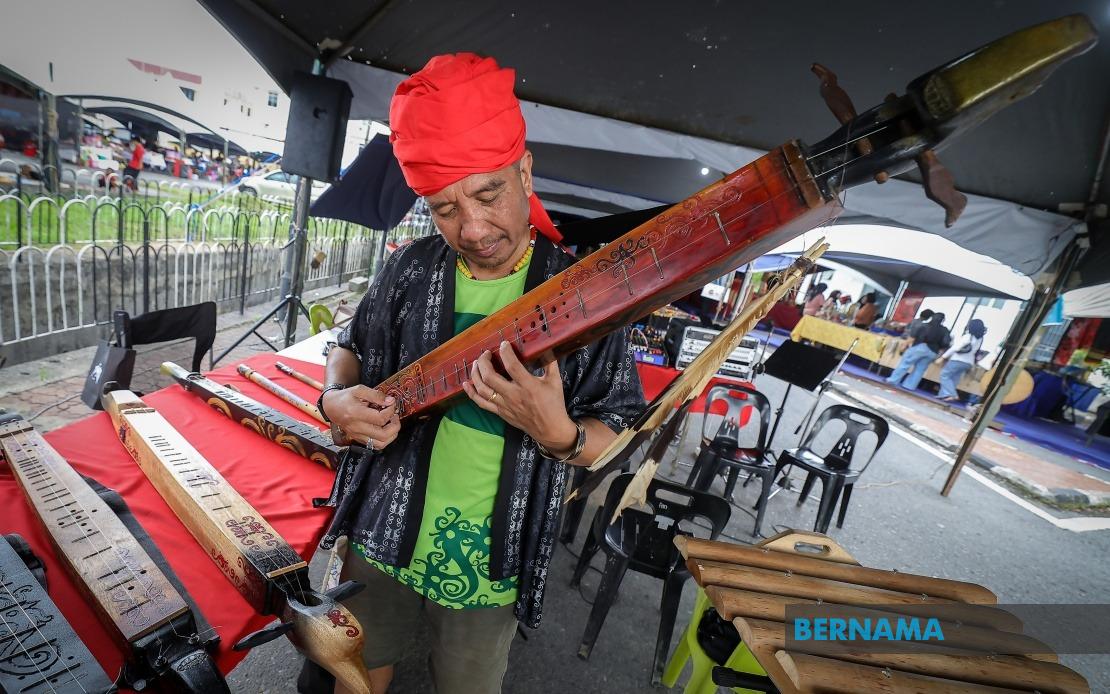
Sarawakian musician and cultural advocate Rining Peter Paris has unveiled his latest musical offering, 'Sigar Suba', a composition that places the spotlight firmly on the identity and traditions of Lun Bawang men. Released officially on July 1, the single marks an important milestone in the 53-year-old artist's decade-long mission to preserve and revitalise the heritage of his community through contemporary musical expression. Working alongside his ensemble Bata' Uduh, Rining has crafted a track that merges traditional instrumentation with modern production sensibilities, seeking to bridge generational divides and ensure that younger community members remain connected to their cultural roots.
The centrepiece of 'Sigar Suba' is the Tapi', an ancient two-string plucked instrument that holds profound significance within Lun Bawang cultural identity. Rather than presenting this heritage artifact in isolation, Rining has woven it into a soundscape that incorporates multiple layers of traditional instrumentation, including the Pek Bu, Ruding, and xylophone, creating a rich tapestry of sound that speaks to the depth and sophistication of Lun Bawang musical traditions. This approach demonstrates a sophisticated understanding of how cultural preservation need not mean freezing traditions in amber, but rather finding creative contemporary contexts through which ancestral knowledge can flourish and gain renewed relevance.
What distinguishes 'Sigar Suba' from Rining's earlier body of work is its thematic focus. His previous compositions, including 'Busak Baku' and 'Busak Elai', had predominantly explored feminine imagery and the aesthetic dimensions of nature and adornment. However, Rining recognised a significant gap in the musical representation of Lun Bawang culture—specifically, the absence of songs that meaningfully celebrate and document male identity, heritage, and ceremonial traditions. This observation prompted him to intentionally create a work that would address this imbalance and provide a cultural mirror for Lun Bawang men to see themselves reflected in contemporary artistic expression.
The song's title itself carries layered meaning that encapsulates Lun Bawang male heritage. 'Sigar' denotes the traditional head covering worn by community members, while 'suba' refers to the colour red, together creating a reference to the distinctive crimson headpiece that has become iconographic for Lun Bawang men during festive occasions and celebrations. Most notably, this ceremonial headdress features prominently during the Irau Aco festival, one of the community's most significant cultural gatherings. By foregrounding this visual symbol in both the song's title and lyrical content, Rining has chosen a focal point that immediately communicates masculine cultural identity to both community insiders and external audiences.
The lyrical content of 'Sigar Suba', composed entirely in the Lun Bawang language, functions as a detailed ethnographic catalogue of traditional male attire and material culture. The verses reference the kuyu talun, a bark shirt that represents an important element of historical Lun Bawang dress, the pelepet, a traditional machete integral to both practical and ceremonial contexts, and distinctive tusk ornaments that carry deep symbolic weight within the community's aesthetic and social systems. This meticulous attention to material detail transforms the song into something beyond mere entertainment—it becomes a pedagogical tool, encoding within its melody and rhythm crucial information about ancestral ways of living and dressing that younger generations must learn to recognise and value.
Rining's artistic philosophy reflects a conscious strategy to make traditional culture resonant with youth audiences who have grown up consuming reggae, fusion, and other contemporary genres. Rather than presenting Lun Bawang heritage as culturally remote or antiquated, he has deliberately incorporated modern musical styles into Bata' Uduh's arrangements, creating a sonic environment in which young people can encounter their traditions without experiencing them as disconnected from their contemporary musical tastes. This fusion approach acknowledges the reality that cultural preservation operates most effectively when it engages rather than alienates target audiences, particularly younger community members who are the ultimate custodians of these traditions.
Beyond his work as a performer and composer, Rining has also established himself as an instrument maker, a role that extends his cultural preservation efforts into the realm of material production. Over nearly a decade of dedicated craftsmanship, he has hand-constructed and sold 66 Tapi' instruments to buyers distributed across multiple continents, including Australia, the United States, and Canada. This international reach indicates that interest in Lun Bawang cultural artifacts extends well beyond Southeast Asian boundaries, suggesting potential market opportunities for artisanal musical instruments rooted in indigenous traditions. Notably, his work has attracted the attention of Belle Sisoski, an accomplished Malaysian experimental musician whose interest in the Tapi' further validates Rining's efforts to position the instrument within contemporary artistic discourse.
The distribution strategy for 'Sigar Suba'—making the single available on major streaming platforms—reflects Rining's sophisticated approach to cultural promotion in the digital age. Rather than limiting access to physical media or live performances, he has recognised that streaming platforms offer unparalleled reach to both diaspora communities and new audiences curious about global musical traditions. This democratisation of access means that Lun Bawang cultural content can circulate far beyond traditional geographic and social boundaries, creating opportunities for the music to resonate with listeners who might never otherwise encounter these traditions.
Looking forward, Rining has articulated an ambitious personal vision that frames his cultural work within a concrete timeline. By 2028, he aspires to transition entirely to full-time engagement with Tapi' instrument making and music composition, effectively transforming his cultural advocacy from a supplementary endeavour into a primary livelihood. This aspiration speaks to both his confidence in the market viability of culturally-grounded musical products and his deep commitment to ensuring that Lun Bawang heritage receives sustained, focused attention rather than fragmented efforts squeezed between other professional obligations.
The significance of Rining's work extends beyond individual artistic achievement to encompass broader questions about how indigenous communities in Malaysia maintain cultural vitality amid processes of modernisation and globalisation. At a time when traditional languages, instruments, and ceremonial practices face genuine pressures from cultural homogenisation, musicians like Rining demonstrate that heritage preservation need not involve nostalgic rejection of contemporary forms. Instead, creative fusion and strategic deployment of modern distribution channels can render ancestral traditions compelling and relevant for new generations. 'Sigar Suba' represents not merely a musical product but a methodological statement about how cultural continuity operates most effectively when it embraces rather than resists the aesthetic possibilities of the contemporary moment.

