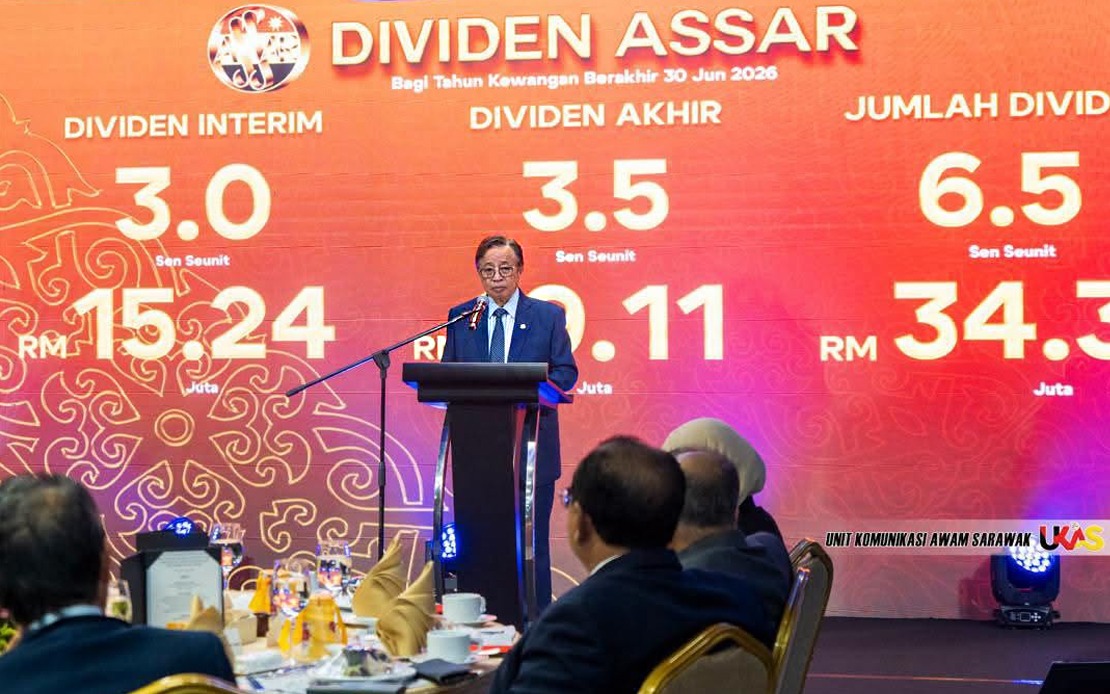
The Sarawak state government is examining the possibility of extending its flagship Amanah Saham Sarawak investment scheme to non-Bumiputera residents through the creation of a parallel investment vehicle, marking a significant shift in the state's approach to wealth-building opportunities. Sarawak Premier Tan Sri Abang Johari Tun Openg announced the initiative during the ASSAR dividend ceremony in Kuching, signalling that the proposal would undergo formal scrutiny by the scheme's board and management to determine its viability and implementation framework.
The expanded initiative, provisionally termed ASSAR 2, represents an attempt to democratise investment access in Sarawak while maintaining the original scheme's focus on Bumiputera participants. Abang Johari indicated that the Sarawak government would examine the operational model employed by Permodalan Nasional Berhad, the federal sovereign wealth fund manager, as a potential template for structuring the new vehicle. This reference to PNB's framework suggests that policymakers are looking toward proven institutional mechanisms for managing inclusive investment schemes at scale.
Currently, ASSAR functions exclusively as a Bumiputera-focused investment savings programme, concentrating capital mobilisation within a defined demographic segment. The proposed bifurcation into ASSAR and ASSAR 2 would theoretically allow non-Bumiputera Sarawakians to participate in similar wealth accumulation mechanisms, broadening the investor base and potentially increasing the capital available for deployment within the state economy. This structural approach mirrors federated models used in other jurisdictions where multiple investment vehicles operate under a unified institutional umbrella, each serving distinct demographic or economic cohorts.
The Premier's emphasis on inclusivity reflects broader strategic thinking within Sarawak's governance circles regarding economic participation and social cohesion. By explicitly framing the expansion as aligned with the state government's inclusive policy agenda, Abang Johari positioned the initiative not merely as a financial engineering exercise but as an expression of political commitment to ensuring that economic opportunities extend across communal boundaries. This rhetorical positioning carries weight in Malaysia's context, where investment access and wealth-building mechanisms have historically been segmented along constitutional and demographic lines.
Sarawak's economic trajectory provides compelling context for this expansion. The state has positioned itself as an increasingly diversified economy, moving beyond traditional resource extraction toward manufacturing, services, and technology sectors. A broader investor base through ASSAR 2 would potentially accelerate capital accumulation for state-focused investment opportunities, allowing the government to tap non-Bumiputera savings that might otherwise flow toward alternative instruments or external markets. The Premier explicitly highlighted Sarawak's strong economic performance as justifying expansion of investment channels, suggesting that growth momentum creates political space for structural economic reforms.
The operational mechanics of ASSAR 2 remain undetermined pending board deliberations, but the PNB reference indicates likely similarities to existing models. Both ASSAR and potential successors would probably function as unit trust vehicles, allowing subscribers to accumulate units through regular contributions, with returns generated through diversified portfolio management. The existence of two parallel structures could enable Sarawak to maintain policy flexibility—preserving Bumiputera-specific advantages within ASSAR while extending core investment mechanics to the broader population through ASSAR 2.
For Malaysian investors and policymakers beyond Sarawak, this development carries several implications. First, it suggests that state-level governments increasingly view inclusive investment vehicles as legitimate policy instruments, potentially opening pathways for similar expansions in other states. Second, it demonstrates how Bumiputera-focused schemes can evolve without dismantling their original architecture, offering a model for navigating the tension between constitutional provisions and contemporary economic inclusivity demands. The initiative therefore carries nationwide significance for ongoing debates around affirmative action mechanisms and their adaptation to modern economic realities.
The financial implications warrant consideration. ASSAR's existing asset base and dividend distribution capacity would provide a tested framework upon which ASSAR 2 could be built, potentially reducing implementation risks. However, the scheme would need to establish whether ASSAR 2 subscribers would access identical investment portfolios and dividend distributions or maintain separate pools. This distinction carries substantial consequences for risk management, governance structure, and regulatory oversight. The board's assessment must therefore address whether parallel vehicles would achieve genuine economies of scale or create supervisory complexity.
From a Southeast Asian perspective, Sarawak's consideration of broader investment democratisation reflects regional trends toward more inclusive financial architecture. Several ASEAN economies have expanded investment access mechanisms to non-preferred constituencies in recent years, recognising that growth imperatives and demographic shifts necessitate wider capital mobilisation. Sarawak's approach, should it proceed, would position the state alongside regional peers experimenting with balancing constitutional commitments against inclusive development objectives.
The timeline for board review remains unspecified, but Abang Johari's public announcement suggests the proposal commands sufficient political priority to warrant near-term consideration. The formal feasibility assessment will likely examine not only financial and operational dimensions but also legal questions regarding the constitutional parameters within which such schemes must operate. These legal considerations, while potentially complex, should not prove insurmountable given that ASSAR 2 would constitute a separate initiative rather than a modification of existing Bumiputera provisions.
Ultimately, the proposal reflects evolving thinking about wealth distribution mechanisms in Malaysia and the broader region. By considering structured expansion beyond demographic boundaries while preserving the core Bumiputera scheme, Sarawak's leadership appears to be seeking a middle path between maintaining constitutional protections and responding to contemporary demands for broader economic participation. The success or failure of this initiative could influence how other Malaysian states and Southeast Asian governments approach similar questions around inclusive investment architecture.

