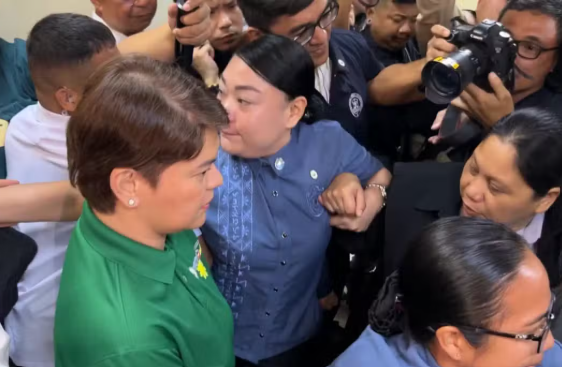
Vice President Sara Duterte arrived at the Philippine Senate on Tuesday to consult with her legal team, using the occasion to reinforce her defiant stance toward the impeachment proceedings against her. In remarks to waiting journalists, she invoked language that suggests she anticipates a punishing ordeal ahead but remains determined to withstand it. The phrase "bloodied but unbowed" carries particular resonance, drawing directly from William Ernest Henley's celebrated poem "Invictus," which explores themes of personal fortitude and the human capacity to endure hardship without yielding to circumstances beyond one's control.
This latest statement represents Duterte's continued willingness to frame the trial as an adversarial battle rather than a judicial process, a rhetorical approach that has become her trademark throughout the impeachment saga. The characterisation of proceedings as a "bloodbath" first emerged in May 2025, when she initially declared her desire for the trial to commence precisely because she anticipated such a clash. That earlier pronouncement drew considerable pushback from political opponents and observers who questioned the appropriateness of such combative language in a constitutional proceeding designed to determine whether she had violated her official duties.
The contrast between Duterte's aggressive public statements and her actual courtroom engagement has fuelled considerable controversy. Despite her earlier enthusiasm for a thorough trial, she noticeably absented herself from most House impeachment hearings across 2025 and 2026, leading critics to argue that her "bloodbath" rhetoric masks an unwillingness to confront substantive allegations directly. This disconnect between her inflammatory language and her selective participation has become a central point of contention among lawmakers and constitutional scholars alike.
The charges Duterte confronts are substantial and wide-ranging, encompassing four distinct articles that collectively paint a picture of systematic misconduct spanning multiple years and institutions. The first article alleges misappropriation of confidential funds totalling P612.5 million, with P500 million allegedly taken from her office as Vice President and an additional P112.5 million from the Department of Education. Such charges strike at the heart of financial accountability, particularly given the sensitive nature of confidential expenditures and the public interest in ensuring such discretionary funds are deployed appropriately.
Beyond financial impropriety, Duterte faces allegations of concealing her true wealth from official disclosure documents. The second article contends that her Statements of Assets, Liabilities and Net Worth covering 2022 through 2024 contained material omissions and false declarations, and further alleges that she failed to divest from business interests as required. These charges, if substantiated, would represent a breach of the transparency and conflict-of-interest safeguards that Filipino law imposes on public officials at all levels.
The third article introduces allegations of bribery and irregularities in procurement processes involving Department of Education officials, suggesting potential corruption extending beyond Duterte herself to involve complicity of subordinate officials. Such charges carry implications for institutional integrity across the education sector, an area of significant public concern given its fundamental importance to national development. The fourth and most incendiary article alleges that Duterte made threats against President Ferdinand Marcos Jr., First Lady Liza Araneta-Marcos, and former House Speaker Martin Romualdez, allegations that, if proven true, would constitute serious criminal conduct completely separate from financial malfeasance.
For Malaysian and regional observers, the Duterte impeachment trial offers instructive lessons regarding the strength and fragility of constitutional mechanisms in Southeast Asian democracies. The Philippines' impeachment process, codified in the 1987 Constitution, requires conviction by a supermajority of two-thirds of all senator-judges, a deliberately high threshold designed to prevent partisan witch hunts. However, the trial's extended timeline—projected to consume 92 days and potentially extend into early 2027—demonstrates how such proceedings can become protracted political theater that strains institutional resources and public attention.
The scheduled duration also raises questions about the practical implications of lengthy impeachment trials on executive function. While Duterte remains in office throughout the proceedings, the distraction of a sitting vice president navigating such serious charges inevitably affects governmental operations and policy continuity. Philippine politics has long been characterized by personalised factionalism and dynastic politics, patterns that Duterte's own rise to prominence—as the daughter of former president Rodrigo Duterte—exemplifies, making objective judicial determination of charges particularly challenging.
Duterte's selective attendance at hearings raises strategic considerations that merit examination. Her lawyers may have calculated that her physical absence, combined with defiant public statements, serves some tactical advantage—perhaps suggesting that she views the proceedings as illegitimate or politically motivated rather than as a serious constitutional matter requiring sustained engagement. Alternatively, her team may believe that limiting her exposure to hostile questioning while maintaining a posture of confident resolve maximises her position with potential swing voters among the senator-judges whose decisive votes will determine the trial's outcome.
The broader political context involves factions within Philippine government that extend far beyond Duterte herself. Her running-mate relationship with President Marcos has deteriorated significantly, with public disputes emerging over various policy matters and allegations of administrative impropriety. This fractured executive leadership has complicated governance and created vulnerabilities that opposition groups have exploited through the impeachment mechanism. Regional observers will watch whether the trial strengthens democratic accountability or, conversely, whether it becomes viewed as an example of weaponised legal processes deployed against political rivals.
The conviction threshold of two-thirds majority represents a substantial hurdle requiring either overwhelming evidence of wrongdoing or a rare moment of bipartisan political consensus. Philippine senators serve diverse constituencies and represent varying regional and factional interests, suggesting that achieving such supermajority support will prove extraordinarily difficult unless the prosecution presents overwhelmingly persuasive evidence. This institutional design choice potentially permits public officials facing serious allegations to survive trials that, in other jurisdictions, might result in removal, a reality that both strengthens the independence of elected executives and possibly weakens accountability mechanisms.
As the trial unfolds across the coming months, the fundamental question will be whether the judicial process can rise above the personalised factionalism that characterises much of Philippine politics. Duterte's invocation of "Invictus" suggests she anticipates a long struggle; whether that struggle ultimately vindicates her resilience or proves hollow will depend largely on the evidence presented and the senator-judges' capacity to prioritise constitutional duty over factional loyalty.

