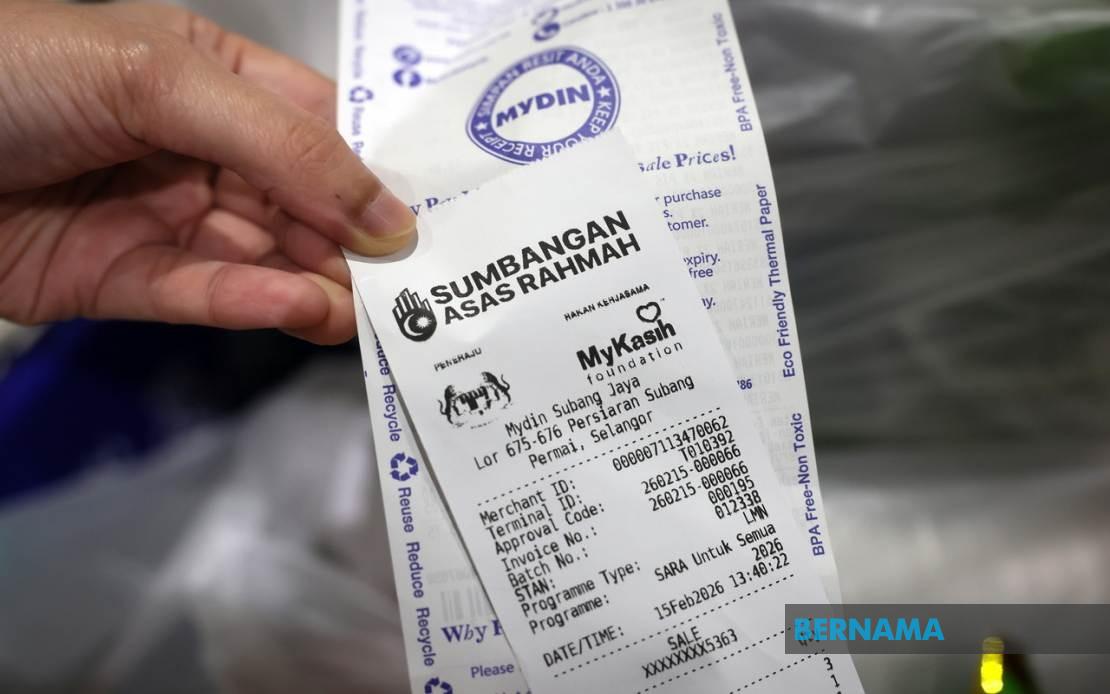
The government's Sumbangan Asas Rahmah (SARA) programme has demonstrated strong household engagement, with beneficiaries utilising nearly all available vouchers as the scheme approaches its second year of full operation. Official figures released by the Ministry of Finance show that almost nine million Sumbangan Tunai Rahmah (STR) recipients have achieved a 99 per cent take-up rate, translating into RM3.45 billion spent across the Malaysian economy since the year began.
The cashless component of the initiative, known as SARA Untuk Semua, has proven particularly effective in stimulating grassroots economic activity. Approximately 22 million people, representing 87 per cent of all eligible recipients in this tier, have already generated RM1.77 billion in local market transactions. The programme's structure—delivering aid through MyKad-linked credits rather than direct cash transfers—appears to be achieving its dual objectives of providing meaningful assistance while maintaining administrative oversight of how public funds are deployed.
Designed to address immediate cost-of-living pressures faced by lower and middle-income Malaysians, SARA operates through a network of approved vendors registered as SARA Rakan Niaga outlets. The scheme restricts redemptions to 15 essential product categories, including basic foodstuffs, personal hygiene items, household cleaning supplies, and over-the-counter medicines. This targeted approach allows the government to ensure that assistance reaches its intended beneficiaries and supports spending on genuine necessities rather than discretionary consumption.
The exceptionally high utilisation rate speaks to how closely the scheme's product basket aligns with household purchasing patterns among vulnerable income groups. Recipients are evidently finding the range of eligible goods sufficiently broad to accommodate their regular shopping needs. The Ministry of Finance emphasises that robust spending performance indicators serve as key metrics for evaluating programme effectiveness, suggesting that policymakers view actual transaction volumes as a primary success measure.
Beyond immediate relief to beneficiary households, the SARA initiative generates wider economic benefits through multiplier effects. When recipients spend vouchers at local merchants, money circulates through small businesses and supply chains, supporting employment and income generation in communities reliant on retail and wholesale trade. This economic stimulus dimension appears to factor prominently in the government's assessment of the programme's broader value, particularly given Malaysia's ongoing efforts to support small and medium enterprises.
The government's commitment to expanding the social safety net is evidenced by significant budgetary increases. Allocations for STR and SARA combined are scheduled to rise to RM15 billion in 2026, compared with RM10 billion in 2024—a 50 per cent increase over two years. This escalation reflects confidence in the delivery mechanisms and growing recognition that vulnerable populations continue facing elevated living costs despite recent moderation in inflation rates. The planned expansion signals that policymakers view these programmes not as temporary interventions but as integral components of Malaysia's structural approach to managing inequality.
The introduction of performance metrics and public reporting of transaction data represents a meaningful shift toward evidence-based social policy in Malaysia. By tracking utilisation rates and spending volumes, the government creates accountability mechanisms and gathers real-time data on programme effectiveness. This approach allows for rapid course corrections if uptake lags in particular regions or if uptake patterns reveal gaps in the eligible product range. The transparency also addresses longstanding concerns about whether targeted assistance genuinely reaches intended beneficiaries.
For Southeast Asian observers watching Malaysia's social spending evolution, the SARA experience offers insights into the scalability of cashless assistance mechanisms. As other countries in the region grapple with growing inequality and rising basic costs, Malaysia's model—combining direct cash transfers with voucher-based purchasing restrictions—demonstrates viable alternatives to purely unconditioned cash assistance. The high take-up rates suggest that beneficiaries accept the MyKad-based system without significant friction, potentially reducing implementation barriers that might hinder adoption in other jurisdictions.
The parliamentary question raised by Datuk Aminolhuda Hassan of Selangor reflects broader legislative scrutiny of the government's major social expenditures. Requests for key performance indicators suggest that opposition lawmakers are engaging substantively with the technical mechanics of these programmes rather than dismissing them on partisan grounds. This constructive engagement may reflect recognition that controlling inflation-driven pressures on household budgets has become a cross-party priority.
With cumulative spending already exceeding RM3.45 billion this year and participation rates approaching saturation among eligible recipients, SARA appears to have overcome initial rollout challenges that affected earlier similar initiatives. The government's stated commitment to continuous monitoring and adaptation suggests awareness that sustained effectiveness requires flexibility as economic conditions evolve and household circumstances shift. As Malaysia confronts structural cost pressures in sectors ranging from housing to healthcare, the scalability and tracking capabilities of SARA-type interventions may prove increasingly significant for policymakers weighing direct assistance against supply-side reforms.

