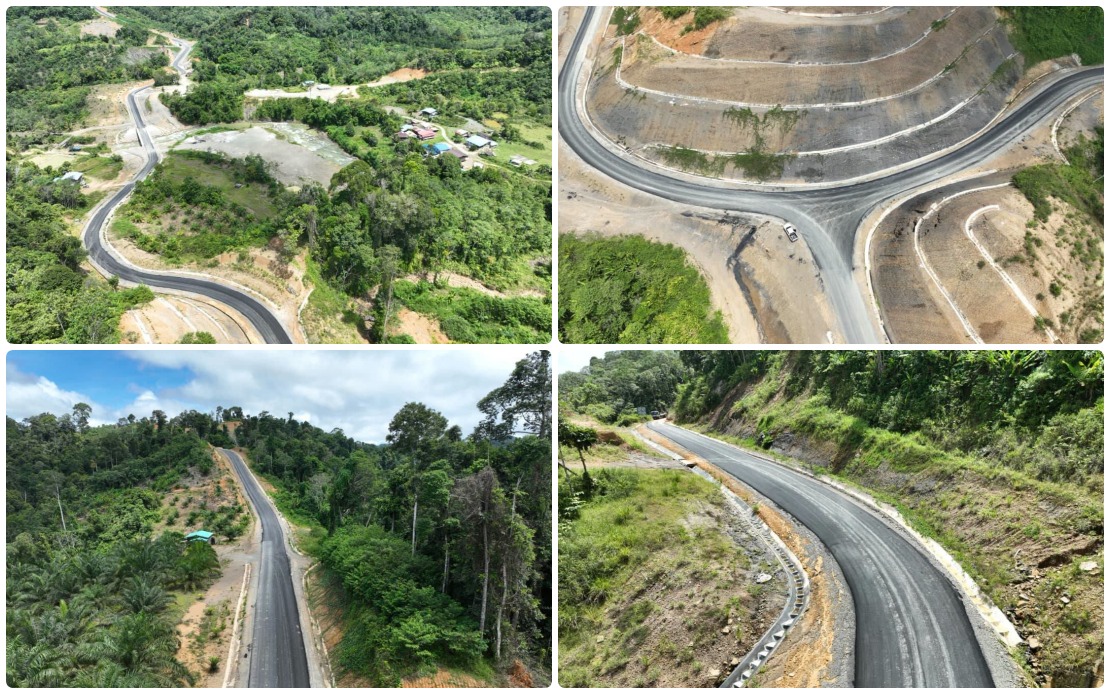
Infrastructure development in Sabah's remote parliamentary constituencies is beginning to yield tangible results, with the completion of the Sapulut-Salong-Pagalungan-Pensiangan road now reaching Pensiangan town and dramatically transforming mobility for interior residents. The project, delivered by Minister of Natural Resources and Environmental Sustainability Datuk Seri Arthur Joseph Kurup, represents a significant milestone in his broader master plan to develop Sabah's hinterland, where communities have historically struggled with isolation and the limited economic opportunities that isolation creates.
The transformation is striking when measured against recent history. The journey from Keningau to Pensiangan town has shrunk from over six hours to just three hours, a reduction that fundamentally changes the calculus of daily life for teachers, healthcare workers, and other professionals serving these areas. Previously, during unfavourable weather conditions, travellers faced genuine risks of becoming stranded on deteriorating roads, making the transition to reliable all-weather highway connectivity a matter of genuine safety improvement alongside economic benefit. Arthur's observation that Pensiangan now displays abundant parked vehicles where boats once dominated the landscape serves as a visible indicator of how transportation infrastructure shapes settlement patterns and economic behaviour.
The completion of this road phase also addresses a critical demographic challenge facing Malaysia's interior regions: youth migration. Young people have traditionally left these areas because employment opportunities and access to markets were severely constrained by poor connectivity. With improved roads now facilitating easier movement of goods and people, returning young adults can more realistically contemplate agricultural enterprises, small-scale commerce, and other activities that generate local income without requiring permanent relocation to urban centres. Arthur's noting that youth are beginning to return to develop family land suggests that improved infrastructure is already triggering behavioural changes in how people view rural economic potential.
This road project sits within a considerably larger development framework that Arthur has been orchestrating across the Pensiangan parliamentary constituency over several years. The completed Jalan Sinaron-Linayukan road in Tongod and the ongoing Jalan Rancangan Belia Tiulon-Simbuan construction represent complementary network improvements that collectively upgrade transportation capacity across multiple corridors. These parallel investments indicate strategic thinking about integrated infrastructure rather than isolated projects, an approach that tends to generate more substantial economic multiplier effects than piecemeal development.
Supporting infrastructure investments are advancing alongside road improvements. The Sapulut coffee processing factory under construction addresses a long-standing constraint in agricultural value addition, allowing farmers to capture greater economic benefits from coffee cultivation without requiring transit to distant processing facilities. Similarly, the upgrading of jetty and boat facilities at Pangkalan Salong recognises that riverine transport remains important in communities where road access is still developing, suggesting a complementary rather than replacement approach to different transport modes.
Beyond transportation and processing, the government is systematically addressing communications and institutional gaps. Telephone and internet connectivity upgrades throughout the district remove another layer of isolation, enabling market information access, digital commerce opportunities, and remote service delivery that were previously impossible in these areas. The completed agricultural collection centre and tamu markets at Pagalungan and Salong provide physical infrastructure where farmers can aggregate and trade products, reducing transaction costs and middleman dependencies that typically disadvantage remote producers.
The border development dimension deserves particular attention. Phase Four of the road project will extend connections to the Kalimantan border, creating cross-border economic opportunities and positioning Pensiangan as a potential trade gateway rather than a dead-end destination. The planned immigration and customs complex currently undergoing approval would formalise this connectivity, potentially enabling tourism, trade, and people movement flows that could diversify local economic bases well beyond traditional subsistence and smallholder agriculture.
Education infrastructure developments also feature in this coordinated approach. The completion of Sabah's first Sixth Form Centre at Sekolah Menengah Kebangsaan Nabawan within the district is significant because it eliminates the need for academically strong local students to relocate to urban areas for post-secondary education, a provision that historically accelerated youth outmigration. Allowing Form Six students to remain in their communities while pursuing advanced studies increases the likelihood of retention in the local workforce and creates a pool of educated young people capable of operating more sophisticated business enterprises.
The cumulative effect of these investments suggests an emerging strategy for interior development that moves beyond simple road-building to address multiple dimensions of rural disadvantage simultaneously. Rather than assuming that roads alone will trigger development, the government is coupling infrastructure with market infrastructure, telecommunications, education, and border trade mechanisms. This holistic approach recognises that interior regions have been chronically underinvested across multiple dimensions and that addressing only transportation while leaving other constraints intact produces limited returns.
For Malaysian policymakers and Southeast Asian observers, this Sabah experience offers a model worth studying. Interior regions across the region face similar patterns of youth outmigration, limited market access, and infrastructure deficits. The Pensiangan project demonstrates that coordinated, multi-dimensional investment can begin reversing these patterns within a relatively compressed timeframe. However, sustainability will depend on whether the improved infrastructure attracts private investment and entrepreneurship or remains primarily a public facility serving pre-existing patterns of settlement and economic activity.
The social dimensions are equally important. Reduced travel times mean healthcare access improves, allowing residents to reach tertiary medical facilities more readily in emergencies. Teacher recruitment and retention improve when professionals can maintain reasonable contact with urban amenities. Families can access education and services without permanent separation. These quality-of-life improvements constitute development outcomes in themselves, beyond narrower economic growth metrics. Whether the Pensiangan model will be successfully replicated in other remote parliamentary constituencies across Sabah and Malaysia's other interior regions remains to be seen, but the emerging results suggest that when infrastructure investment is combined with institutional development and market mechanisms, even historically marginalised regions can begin experiencing tangible improvement.

