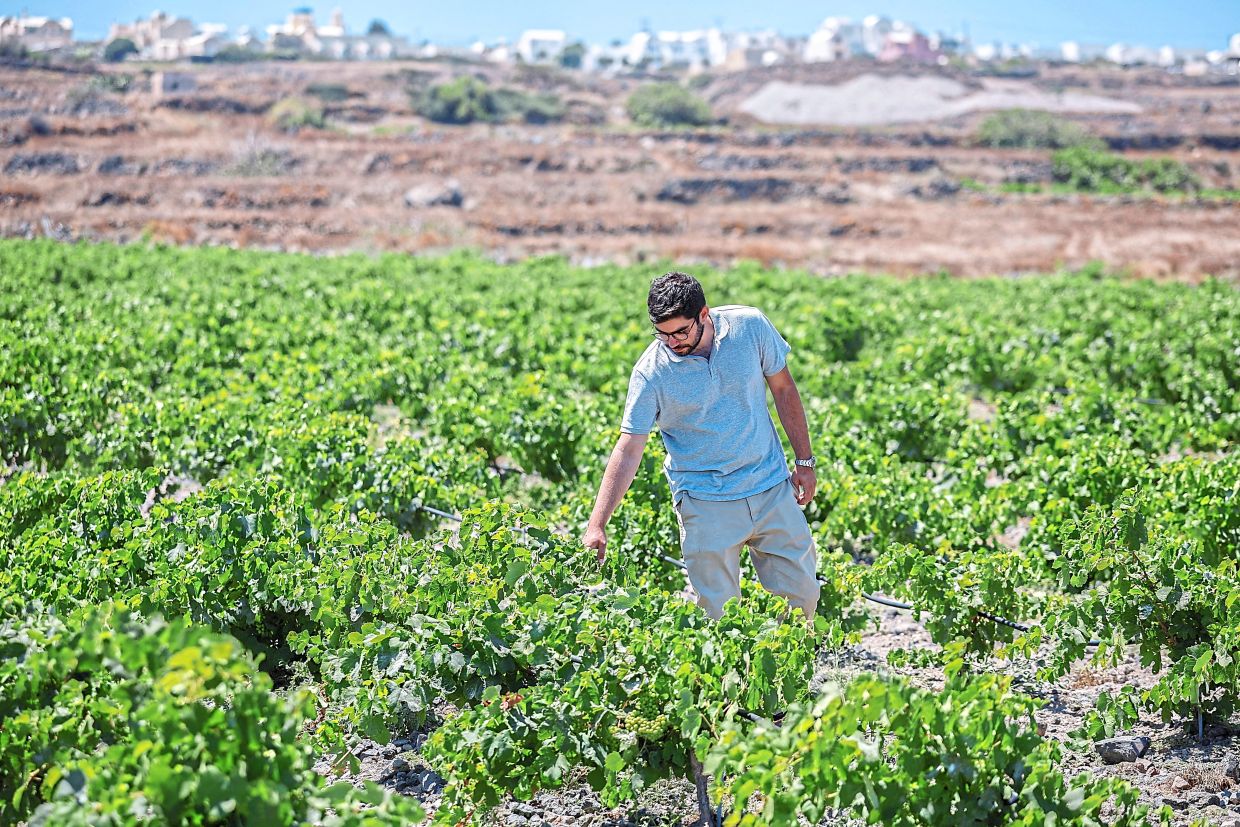
The consequences of climate change are becoming increasingly visible across Greece's islands, where centuries-old traditions collide with environmental reality. On Santorini, a vineyard winemaker named Yiannis Boutaris recently observed the death of a 90-year-old vine trained into the traditional basket shape, or "kouloura," a method developed to shield grapes from the island's scorching summer sun. This single loss exemplifies a cascading crisis affecting the entire region: between 2023 and 2025, persistently low rainfall combined with record-breaking temperatures have compressed grape yields, dramatically inflated production costs, and exposed the fragility of Santorini's most iconic agricultural sector.
The broader picture across Greece illustrates how climate volatility is reshaping the nation's economic landscape. Water scarcity, once a seasonal challenge, has become a structural problem affecting multiple sectors simultaneously. During the peak tourism months, Santorini experiences acute competition for its limited freshwater reserves, with hotels, swimming pools, and agricultural operations all competing for supplies that grow scarcer each year. The price of grapes on Santorini has risen substantially as yields plummet, creating economic hardship for producers even as tourism revenues remain relatively stable. Meanwhile, in less arid regions of northern Greece, grape prices languish at approximately €0.80 per kilogram, or roughly RM3.70, illustrating the geographic disparity in climate impacts across the country.
Boutaris, a sixth-generation winemaker who oversees Domaine Sigalas, now operates as part of the broader Kir-Yianni family of wineries. Rather than abandon Santorini's viticultural traditions, he and his peers are pursuing an adaptive strategy that preserves cultural heritage while incorporating cutting-edge resource management. The most promising initiative involves repurposing wastewater from residential and hospitality sectors for vineyard irrigation—a methodology already deployed successfully in California's wine regions. This approach offers tangible advantages over desalination, which remains prohibitively expensive and energy-intensive. By treating and redirecting what would otherwise be discharged into the environment, winemakers can access a reliable secondary water source while reducing strain on finite groundwater reserves.
Beyond wastewater recycling, Santorini's producers are experimenting with structural changes to vineyard layout and cultivation practices. Traditional methods scattered vines across hillsides in patterns optimized for hand harvesting and sun exposure, but these arrangements prove inefficient for targeted irrigation. Boutaris is testing linear row planting, which enables more precise water distribution and reduces waste through runoff or evaporation. Complementing this shift, atmospheric water harvesting represents an emerging frontier: specialized hydrogels capture moisture suspended in air, with solar panels providing the thermal energy needed to extract usable water. Though still in pilot phases, such innovations exemplify the sector's willingness to embrace technology historically foreign to its practices.
Another prominent producer, Yiannis Papaeconomou, operates younger vines established only six years ago, yet already he confronts the same pressures constraining older vineyards. His response combines subsurface drip irrigation—which delivers water directly beneath soil surfaces rather than overhead application, thereby minimizing evaporation losses—with trellising adjustments that optimize water delivery efficiency. These incremental adaptations, while less dramatic than technological overhauls, reflect a practical philosophy: meaningful resilience emerges through layered, complementary strategies rather than single interventions.
The academic community has begun documenting the severity of Santorini's climatic transformation. Stefanos Koundouras, a professor of viticulture at Aristotle University in Thessaloniki, has analyzed decades of temperature records and determined that the heat waves of 2023 and 2024 represented the most extreme conditions in six decades. Beyond raw temperature readings, the implications threaten wine quality itself. Mediterranean varietals evolved over millennia in specific temperature and moisture ranges; when those parameters shift rapidly, grapes struggle to develop their characteristic chemical profiles, aromatic compounds, and flavor complexity. Early evidence suggests qualitative degradation in several traditional Greek wine styles, a trend likely to accelerate without intervention.
The stakes extend far beyond individual producers or even Greece's wine sector. Koundouras and fellow researchers warn that Europe's entire viticultural landscape, particularly regions bordering the Mediterranean, faces potential unsustainability if warming and desiccation trends persist. This prospect carries profound implications for a continent where wine production represents not merely economic activity but cultural and historical continuity spanning thousands of years. Nations like Spain, France, and Italy face comparable pressures, creating incentives for coordinated research and policy responses across the European Union.
Santorini's geographic and economic position amplifies its vulnerability. The island's volcanic soils produce distinctive wines with limited geographic alternatives, generating premium prices but also creating dependencies. Unlike broader agricultural sectors that can shift to drought-tolerant crops, winemakers cannot easily relocate or fundamentally alter their product without destroying the very heritage that commands market value. This constraint has catalyzed the collaboration between Boutaris and local authorities alongside university scientists to develop the wastewater recycling pilot project—a necessity-driven partnership reflecting recognition that individual action suffices only when coordinated with public infrastructure and knowledge networks.
The psychological and cultural dimensions merit consideration alongside technical and economic factors. For sixth-generation winemakers like Boutaris, adaptation carries an implicit acknowledgment that the environmental conditions enabling their family's livelihood have fundamentally changed. This realization does not necessarily diminish commitment to the craft; rather, it reframes the challenge as preservation through transformation. "We are not abandoning tradition," Boutaris explicitly states, "we are adapting the vineyard to the new circumstances." This articulation captures the delicate balance between honoring established practices and embracing operational innovations essential for survival.
Looking forward, Santorini's experiments with wastewater systems, atmospheric water harvesting, and modified cultivation geometries will generate data and experiential knowledge applicable across the Mediterranean and potentially beyond. If successful, these pilots could demonstrate that heritage agricultural sectors need not face binary choices between preservation and extinction. However, success hinges on sustained investment, continued technological development, and—critically—moderating the underlying climate trends themselves. The winemakers of Santorini are demonstrating remarkable ingenuity and adaptability, yet their innovations represent responses to a problem they did not create and cannot fully solve alone.

