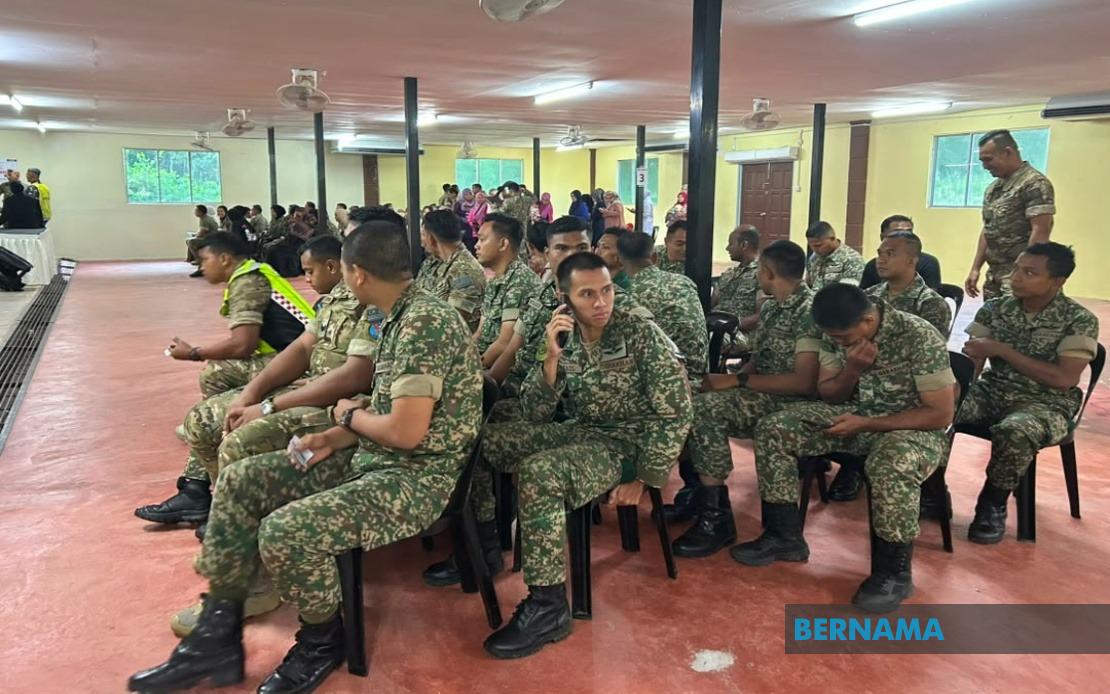
Senior government figures rallied security personnel to the ballot box on Tuesday as the 16th Johor State Election entered its early voting phase, with calls for citizens to approach the democratic process with seriousness and national pride. The joint appeal from Home Minister Datuk Seri Saifuddin Nasution Ismail and Defence Minister Datuk Seri Mohamed Khaled Nordin highlighted the symbolic importance of military and police participation in elections, reinforcing the principle that democratic engagement transcends partisan boundaries and represents a fundamental civic obligation.
The cohort of 24,751 eligible early voters comprises 12,041 members of the Malaysian Armed Forces and their spouses, alongside 12,710 police personnel and their families. These servicemen and women cast their votes across 64 designated early voting centres that opened at 8 am, with staggered closings between noon and 6 pm depending on venue size and registration figures. The arrangement accommodates the operational demands of security forces while ensuring their voices shape the electoral outcome that will determine Johor's direction for the coming years.
Saifuddin Nasution, who carries the additional portfolio of Pakatan Harapan secretary-general, framed the exercise as a celebration of constitutional rights rather than a mere administrative formality. His public message emphasised that voters should approach the ballot with both accountability and democratic spirit, signalling that the coalition views early voting not as a bureaucratic convenience but as an affirmation of Malaysia's democratic institutions. The minister's dual messaging—simultaneously addressing supporters and speaking to broader civic virtue—reflects how opposition coalitions position themselves on electoral integrity and democratic norms.
Mohamed Khaled's intervention underscored a security-focused dimension to the election narrative. His message connected individual voting decisions to broader state development and stability, suggesting that voter choices at this juncture carry implications for Johor's trajectory beyond the immediate election cycle. This framing attempts to elevate the security forces' participation above factional politics, positioning their votes as instrumental to the state's continued progress and prosperity.
Menteri Besar Datuk Onn Hafiz Ghazi, representing the governing Barisan Nasional coalition, deployed similar rhetoric while advocating explicitly for his slate of candidates. His appeal to early voters to trust BN candidates reflected the coalition's messaging that continuity in leadership guarantees stability and development dividends. The strategic timing of these appeals—targeting voters with their ballot papers in hand—demonstrates how both major blocs prioritise messaging to security personnel, whose votes often swing tightly contested constituencies.
The election encompasses all 56 state assembly seats, with 172 candidates split between Pakatan Harapan and Barisan Nasional, signalling a intensely competitive environment where every bloc of votes carries disproportionate significance. Early voting provision for security forces acknowledges both their operational constraints and their political weight as a voting bloc. In a state where margins have historically been narrow, the consolidated participation of military and police families can meaningfully influence final results.
The early voting arrangement itself reflects Malaysia's pragmatic approach to electoral participation, recognising that rigid polling schedules can exclude citizens whose duties prevent attendance on Election Day proper. Saturday's general polling will occur after this early phase concludes, providing security personnel whose schedules permit normal voting an additional opportunity. The compressed early voting timeline—concentrated on a single Tuesday—creates logistical intensity but ensures security force participation is completed before main polling begins.
All three senior figures included prayers and wishes for smooth, peaceful proceedings, language that carries particular weight in Malaysian electoral discourse where communal harmony remains a contested ideal. These invocations of orderliness and unity suggest ongoing concerns about potential tension between competing interests during high-stakes elections, even as the formal election framework operates transparently and without historical violence in Johor.
The messaging from competing coalitions reveals differing strategic priorities. Pakatan Harapan emphasised democratic principles, institutional integrity, and the maturity of campaign conduct, suggesting a framework that appeals to voters valuing reform and procedural fairness. Barisan Nasional stressed developmental outcomes and institutional continuity, appealing to voters prioritising proven delivery over political transformation. For security personnel making their early electoral choice, these competing visions represented distinct platforms for Johor's governance.
The involvement of armed forces and police in elections carries particular resonance in Southeast Asia's political context. Malaysia's security forces maintain formal political neutrality while operating within a democratic system, and their participation as voters underscores the military and police's integration into civilian democratic processes rather than positioning outside them. This early voting arrangement thus serves symbolic and practical functions simultaneously.
Johor remains economically vital to Malaysia, serving as an industrial hub and contributor to federal revenue. The state election outcome will shape policy directions affecting commerce, infrastructure investment, and development priorities across the southern region. Early voter participation from security personnel, while statistically modest relative to overall electorate size, carries outsized influence in deciding which coalition governs during Malaysia's ongoing political realignment.

