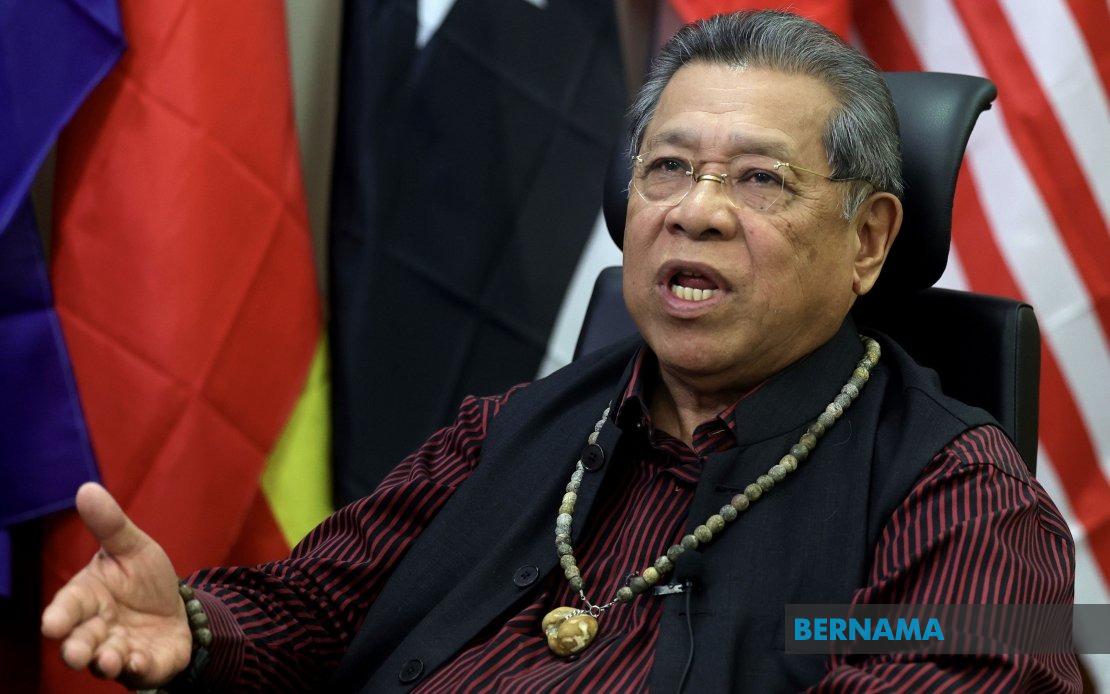
The Malaysian federal government's commitment to increasing financial support for Sabah has drawn endorsement from regional political leaders, who view the expanded budget allocation as a catalyst for transforming the state's development landscape. Tan Sri Pandikar Amin Mulia, president of the United Sabah National Organisation, expressed confidence that the enlarged funding envelope will unlock opportunities for accelerated infrastructure and welfare initiatives, ultimately benefiting ordinary Sabahans and reinforcing the nation's trajectory toward prosperity.
Prime Minister Datuk Seri Anwar Ibrahim announced the scale of this financial commitment during his presidential address at the 2026 PKR National Congress, held at the Melaka International Trade Centre in Ayer Keroh. The figures he presented underscore a significant reorientation of federal spending priorities toward East Malaysia. Sabah's allocation has expanded substantially, rising from RM13 billion in 2022 to RM17.6 billion in the 2026 fiscal framework—a 35 per cent increase that ranks among the more substantial adjustments to any state budget in recent years.
Pandikar Amin framed this fiscal gesture as evidence of the MADANI administration's commitment to geographical equity and inclusive governance. Speaking to journalists at the congress venue, the USNO chief argued that the injection of resources into Sabah would generate multiplier effects throughout the state economy. Beyond direct infrastructure development, the enhanced allocation is expected to fund education facilities, healthcare infrastructure, and transportation networks that have historically lagged those in peninsular Malaysia.
The timing of this announcement carries political significance for the coalition that backs Anwar's government. Sabah, as a crucial electoral territory in East Malaysia, has become increasingly important to federal coalition dynamics. USNO's support for the federal administration reflects broader calculations within Sabah's political establishment about maintaining productive relationships with the central government. By backing the MADANI framework publicly, Pandikar Amin signals that his party perceives tangible returns flowing from federal collaboration rather than confrontational opposition politics.
The Prime Minister seized the platform of the PKR Congress to address a persistent criticism leveled against his administration: accusations that certain states have been sidelined in favour of others. Anwar rejected such characterizations, arguing that budget allocations reflect varying developmental needs and geographic circumstances rather than political favoritism. He emphasized that every state has experienced enhanced federal support during his tenure, though the magnitude and composition of these increases necessarily differ based on regional priorities and strategic objectives.
This defense of the MADANI government's allocation methodology reflects awareness of sensitivities regarding regional equity that have long animated Malaysian political discourse. Opposition figures and civil society observers have periodically questioned whether funding decisions reflect genuine developmental need or partisan calculations. By establishing that all states have received increased support while simultaneously highlighting the substantial rise for Sabah, Anwar attempted to position his administration as both equitable and responsive to East Malaysian interests.
For Sabah's development agenda, the expanded federal allocation opens practical possibilities that have remained constrained by previous budgetary limitations. The state faces persistent infrastructure gaps in transportation, utilities, and telecommunications—challenges compounded by its geographical dispersion across coastal and interior regions. RM17.6 billion provides scope for meaningful progress on multiple fronts, though implementation capacity and project management efficiency will ultimately determine whether allocated funds translate into tangible improvements in citizen welfare.
The increase also carries implications for intra-regional competition within East Malaysia. Sabah's enhanced allocation may influence expectations in Sarawak regarding its own federal budget treatment. Both states have historically negotiated their financial relationships with Putrajaya, and comparative funding decisions can generate political friction if perceived as inequitable. The magnitude of Sabah's increase may necessitate corresponding consideration of Sarawak's budgetary claims to maintain political balance within the broader coalition.
From a macroeconomic perspective, increased federal spending in Sabah supports broader national objectives around regional development and poverty reduction. East Malaysia has historically registered higher poverty incidence and lower per capita income than peninsula regions. Strategic federal investment targeting infrastructure and human capital development in Sabah aligns with long-term strategies to narrow these disparities and integrate the state more fully into the national economy.
Pandikar Amin's explicit endorsement of Anwar Ibrahim's leadership reflects calculations about continuity and predictability in federal-state relations. His statement that Malaysia requires Anwar's stewardship in both international and domestic political spheres suggests that USNO leadership views the Prime Minister as providing stability valuable to Sabah's interests. This positioning also signals to federal authorities that USNO remains a cooperative coalition partner deserving of consideration in resource allocation decisions.
The political choreography surrounding this announcement demonstrates how fiscal policy intersects with coalition management in Malaysian governance. Development funding becomes not merely a technical budgeting question but also a mechanism for signaling political commitments and reinforcing coalition cohesion. Pandikar Amin's presence at the PKR Congress and his subsequent public comments represent the expected performance of coalition solidarity, even as all parties understand that such relationships remain conditional and subject to shifting political circumstances.
Looking forward, the critical question for Sabahans concerns implementation. Budget allocations require conversion into actual projects that deliver services, employment, and economic opportunities. The MADANI government's track record on project execution and timely fund disbursement will determine whether the RM17.6 billion allocation translates into the promised development gains or becomes another example of budgetary announcements that produce limited tangible results for ordinary residents seeking improved living standards and economic prospects.

