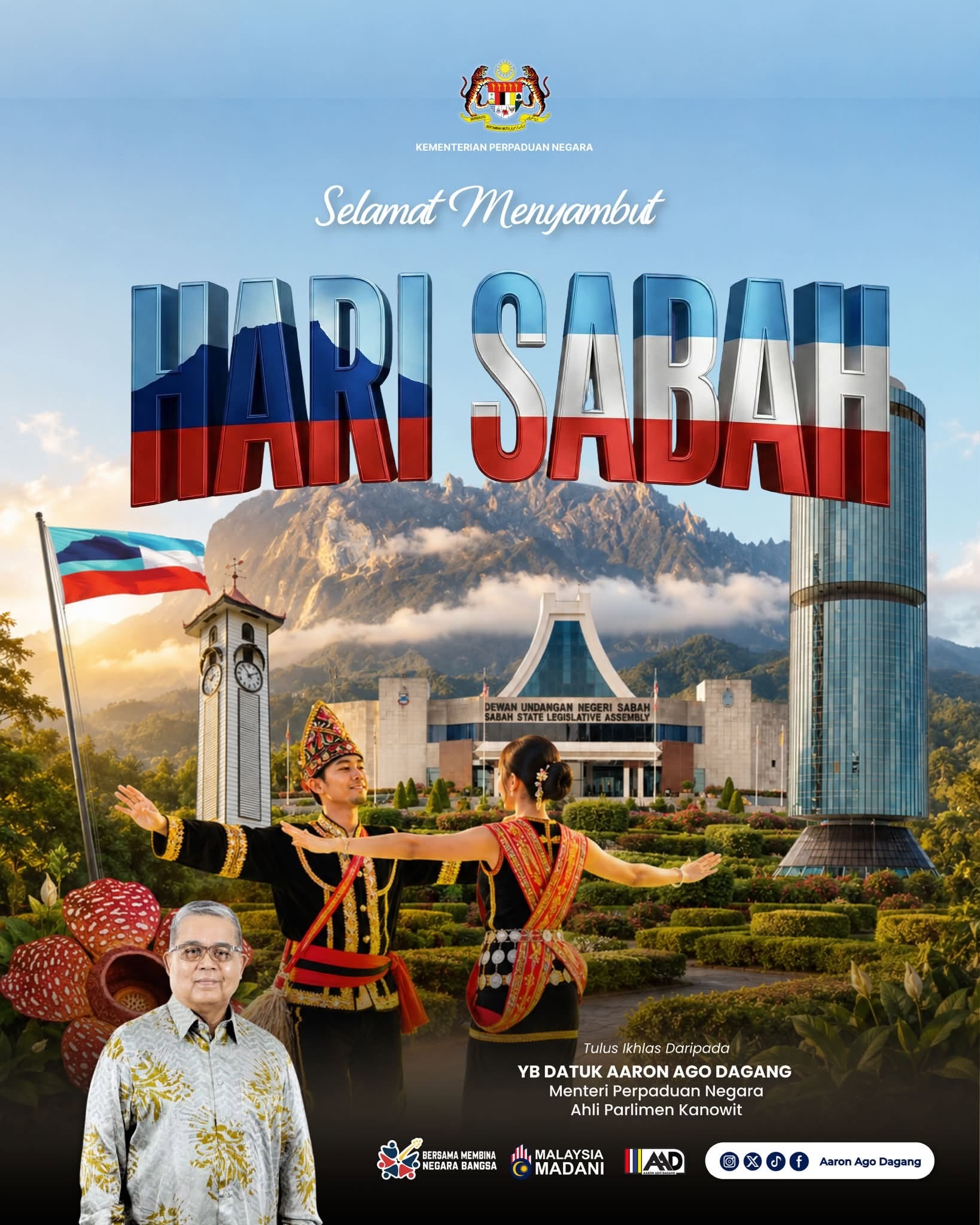
Malaysia's National Unity Minister Datuk Aaron Ago Dagang has described Sabah's striking cultural and ethnic mosaic as one of the state's greatest assets, exemplifying the broader multiracial character that defines the Malaysian nation. Speaking during Sabah Day celebrations on August 31, the minister underscored how the state's composition—encompassing 35 distinct ethnic groups and 217 sub-ethnic categories—represents a living embodiment of Malaysia's founding principle of unity through diversity.
Sabah's demographic complexity reflects centuries of interconnected histories and migrations across the Borneo island. The Kadazan, Dusun, Bajau, Murut, Rungus, Bisaya, Lotud, and Lundayeh communities, among many others, have each contributed layers of linguistic, artistic, and spiritual traditions that collectively constitute Sabah's distinctive cultural identity. Each group brings its own distinct language, traditional attire, musical forms, dance repertoires, and spiritual practices, creating an environment where cultural expression remains vibrant and locally rooted rather than homogenised.
Datuk Aaron's remarks carry particular significance for Malaysia's ongoing national conversation about social cohesion. Rather than portraying ethnic and cultural differences as potential sources of tension or division, the minister positioned diversity explicitly as a unifying force when accompanied by genuine mutual understanding, respect, and acceptance. This framing is noteworthy in a regional context where ethnic plurality has occasionally been mischaracterised as inherently destabilising, a narrative that Malaysia has largely rejected since independence.
The historical trajectory outlined by the minister traces Sabah's journey through multiple administrative systems and sovereignty arrangements. The territory transitioned from its pre-colonial indigenous governance structures through the era of the British North Borneo Company's commercial administration, endured Japanese occupation during the Second World War, returned to British colonial governance, and eventually achieved internal self-government before joining the Malaysian federation. This complex historical pathway has imbued Sabah with a distinctive political consciousness that frequently emphasises state-level autonomy and cultural preservation within the national framework.
Sabah's accession to the Federation of Malaysia on September 16, 1963, represented a pivotal moment in both state and national history. The formation of Malaysia itself was premised partly on recognising and accommodating the distinct constitutional arrangements and demographic realities of the two Borneo territories. Sabah's incorporation affirmed a model of federalism that acknowledged regional particularities whilst building a unified nation-state. The explicit marking of August 31 as Sabah Day in 2024 represents an official recognition of the state's historical significance and cultural distinctiveness within Malaysia's federal structure.
The minister's emphasis on intergenerational responsibility carries practical implications for Sabah's future trajectory. Datuk Aaron called upon the current generation of Sabah's residents to advance the state across multiple developmental dimensions—specifically naming education, economic opportunity, technological adoption, and infrastructure development as priority areas. This forward-looking perspective acknowledges that cultural preservation and contemporary progress need not be contradictory objectives; rather, they represent complementary commitments that responsible leadership must balance.
For Malaysian policymakers and regional observers, Sabah's model of managing ethnic diversity offers instructive lessons applicable to other parts of Southeast Asia grappling with similar demographic complexities. The state demonstrates that sustained peaceful coexistence among numerous ethnic communities is achievable through institutional arrangements that respect both collective identity and individual rights, through educational curricula that foster intercultural literacy, and through political leadership that consistently affirms the value of pluralism rather than advocating assimilationist approaches.
The invocation of historical sacrifice and past contributions serves another important function in the minister's framing. By reminding contemporary Sabahans of the efforts expended by previous generations in building the state's institutions and establishing its place within Malaysia, Datuk Aaron invoked a sense of historical stewardship. This perspective suggests that present-day custodians of Sabah's identity and governance inherit not merely rights and privileges, but obligations to honour the accomplishments of predecessors whilst extending progress further.
Sabah's situation also illuminates the broader Malaysian experience of negotiating federal relationships in a context of significant regional variation. The state enjoys constitutional provisions regarding matters such as immigration and religious affairs that differ from peninsular Malaysia, reflecting accommodation of its particular circumstances at the federation's founding. These arrangements underscore how Malaysia's constitutional architecture was designed to permit considerable diversity in how federating units manage their internal affairs whilst participating in a shared national project.
For economic and social planners, the minister's emphasis on Sabah's cultural strength as a foundation for harmony has practical ramifications. Cultural tourism, heritage preservation, educational programming highlighting intercultural understanding, and creative industries built around traditional arts can generate economic activity whilst simultaneously reinforcing social cohesion. Several Southeast Asian jurisdictions have developed these linkages effectively, demonstrating that cultural distinctiveness need not impede economic modernisation.
The timing of these remarks during Sabah Day celebrations carries symbolic weight in reasserting state identity within the national framework. Malaysia's federal system permits considerable space for state-level commemorations and identity affirmation, a feature that distinguishes it from more centralised regional peers. This permissiveness reflects an underlying assumption embedded in Malaysia's constitutional design: that strengthening regional and subnational identities, rather than threatening national unity, can actually reinforce it by ensuring that citizens maintain meaningful attachment to multiple levels of political community.
Moving forward, the challenge for Sabah's leadership involves ensuring that the minister's rhetorical commitment to diversity translates into concrete institutional practices, resource allocation, and policy implementation. This requires sustained investment in education systems that genuinely promote intercultural competence rather than merely teaching about differences; economic opportunities distributed equitably across different communities; and decision-making processes that meaningfully incorporate voices from across Sabah's ethnic spectrum. When diversity receives only rhetorical affirmation without corresponding institutional support, its unifying potential diminishes considerably.

