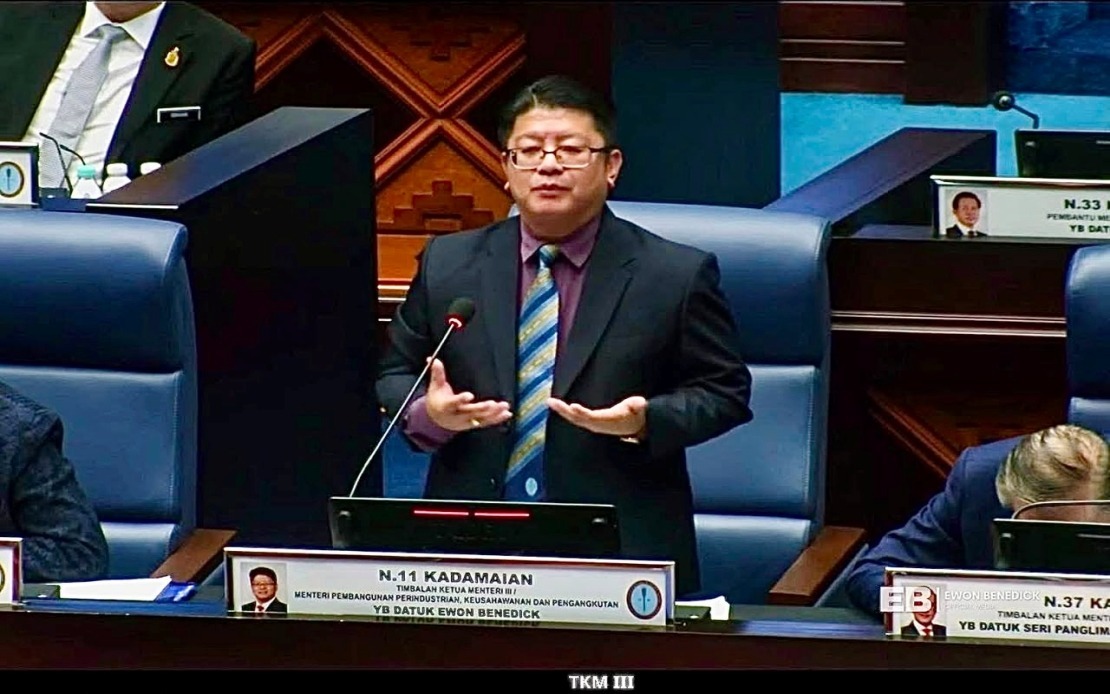
The Sabah government has taken decisive steps to resolve a longstanding operational challenge at Sepanggar Port by introducing revised fee structures designed to discourage prolonged container storage. Deputy Chief Minister III Datuk Ewon Benedick revealed to the Sabah State Legislative Assembly that the policy initiative has already yielded measurable results, with 103 previously idle containers being relocated following the announcement of the new charges.
The containers in question had accumulated at the facility over extended periods, with some languishing for more than 21 days and the worst case involving a container held for 407 days. This accumulation created significant congestion, reducing the operational capacity of the port and limiting its ability to handle fresh shipments. The root cause of the problem lay in the structure of previous tariffs, which were pitched at levels too modest to discourage companies from using the port as an informal storage facility rather than moving cargo through proper logistics channels.
Ewon, who holds the portfolio of Sabah Minister of Industrial Development, Entrepreneurship and Transport, explained that the old fee regime inadvertently created an economically rational incentive for container owners to leave goods at Sepanggar rather than incurring the expense of renting dedicated warehouse or depot space elsewhere. By recalibrating charges to reflect true holding costs, the government altered the financial calculus. The strategy proved effective once implemented, prompting swift action by affected parties to retrieve their containers and clear congestion within the port.
Critically, the new framework includes a regulatory enforcement mechanism. The port authority has established a clear rule stating that any container remaining on-site beyond 21 days becomes subject to disposal procedures compliant with relevant maritime regulations. This combination of financial disincentive and enforcement threat concentrated minds effectively; once the disposal threat became tangible, container owners moved quickly to recover their property and avoid liability. The freed-up space has since been allocated to active cargo operations, improving throughput.
Despite the success of the initiative, Ewon acknowledged that port user associations have filed appeals requesting a review of the new charges. Rather than dismissing these concerns, his ministry has signalled willingness to engage in ongoing dialogue to reach outcomes that balance operational efficiency with the legitimate concerns of maritime stakeholders. This pragmatic approach reflects an understanding that port operations depend on sustained cooperation from the private sector operators who depend on the facility.
To institutionalize this collaborative approach, the government has incorporated representatives from port user associations, shipowners' associations, and shipping associations into a formal task force structure. This body conducts monthly meetings to discuss implementation issues and identify potential refinements to the fee framework. The inclusion of diverse stakeholder voices acknowledges that effective port management requires buy-in from multiple constituencies with varying interests, and that sustainable solutions emerge through structured engagement rather than top-down imposition.
The broader legislative context for these operational changes involves administrative restructuring within the Sabah state government. The Sabah Ports (Privatisation) (Amendment) Bill 2026, which the assembly passed by majority voice vote, reflects a portfolio reorganization in which responsibility for ports has shifted from the Ministry of Works and Utilities to the Ministry of Industrial Development, Entrepreneurship and Transport. This realignment created the necessity to amend the governing Sabah Ports (Privatisation) Enactment 1998 to reflect the new ministerial designation and reporting lines.
The amendment also serves a harmonization function, bringing the statutory definition of 'Minister' within the Ports Privatisation Enactment into alignment with the parallel Sabah Ports Authority Enactment 1981. This technical correction eliminates potential ambiguities and inconsistencies that could have created confusion regarding authority and accountability in port governance. Such legislative housekeeping, while less visible than operational reforms, is essential for maintaining coherent governance frameworks.
The assembly sitting also advanced two additional pieces of legislation addressing native affairs and community governance structures. The Sabah Native Affairs Council (Amendment) Bill 2026, tabled by Local Government and Housing Minister Datuk Dr Mohd Arifin Mohd Arif, expands the council's advisory role to encompass customary education and native customary law. This expansion reflects recognition that heritage preservation and legal pluralism require dedicated institutional attention. The amendment also creates a new position of Native Affairs Officer drawn from the state civil service, with responsibilities for handling investigations and proceedings related to customary law matters within Native Courts.
The District Chief, Native Chief and Headman Bill 2026 establishes comprehensive legal parameters governing the selection, functions, remuneration, and accountability of local leadership positions holding authority over district and native communities. The legislation specifies that appointment authority rests with the relevant minister acting upon District Officer recommendation, while establishing grounds for revocation including incapacity, bankruptcy, criminal conviction, customary law violations, misconduct, or relocation outside the jurisdiction. This codification brings clarity to roles that operate at the intersection of traditional authority structures and modern bureaucracy.
For Malaysian businesses engaged in maritime trade through Sabah ports, the container clearance initiative represents an important signal of operational improvements aimed at reducing unnecessary holding periods and associated costs. The experience at Sepanggar demonstrates how targeted fee adjustments can reshape economic behavior at ports without requiring major infrastructure investment or disruptive operational changes. Stakeholders monitoring the implementation should note that the government's stated openness to ongoing adjustment suggests the charge structure remains subject to refinement based on demonstrated impact and feedback.
The Port Authority's ability to rapidly clear accumulated inventory once new incentives took effect suggests that congestion often reflects economic incentives rather than fundamental capacity constraints. This insight carries implications for ports throughout Southeast Asia grappling with similar challenges. As regional trade patterns shift and logistics networks evolve, port authorities increasingly recognize that competitive advantage derives not merely from physical infrastructure but from tariff structures and regulatory frameworks that encourage efficient cargo movement. Sabah's experience offers a case study in how modest policy adjustments can yield measurable operational benefits.

