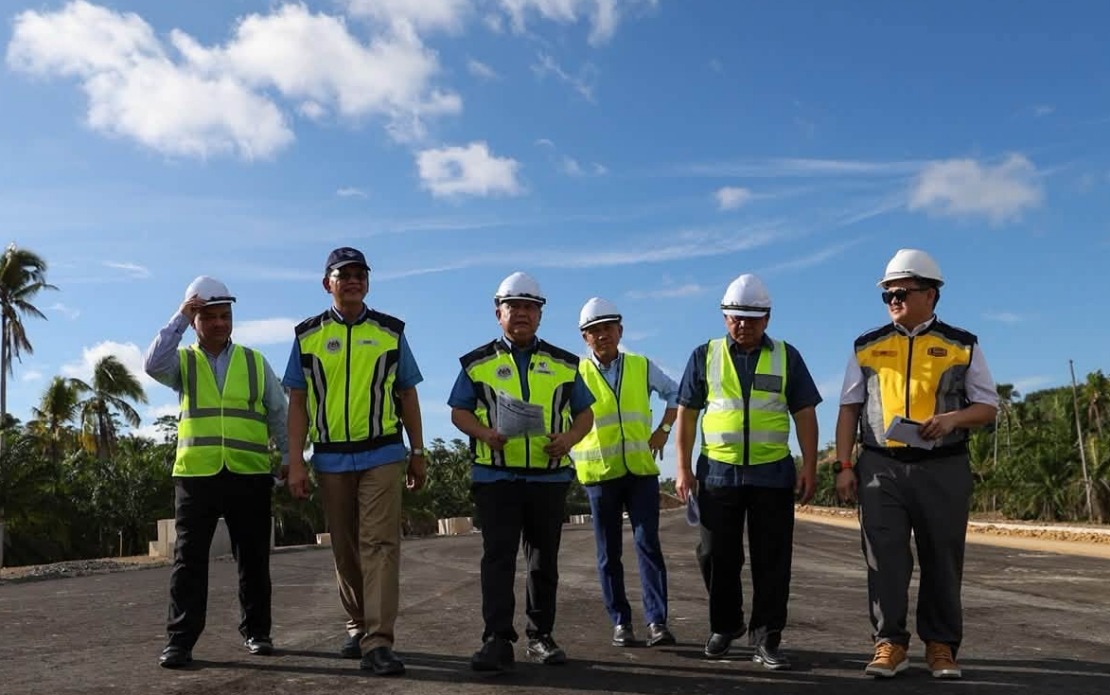
The contractor managing the Sabah Pan Borneo Highway Work Package 11 has formally lodged a recovery plan with federal authorities to address mounting construction delays that have already cost the project nearly a month of progress. The 7.3-kilometre alignment segment, designated Phase 1B and spanning the Rampayan Laut-Sarang route, has fallen behind schedule despite achieving over 60 per cent physical completion. Works Minister Datuk Seri Alexander Nanta Linggi disclosed the submission on July 20, signalling the project team's commitment to keeping the RM167.48 million undertaking on track for its September 29, 2026 contractual finish date.
The Pan Borneo Highway represents one of Malaysia's most ambitious transport infrastructure initiatives in East Malaysia, designed to improve connectivity across Sabah and Brunei. Work Package 11 occupies strategic importance within this broader development corridor, serving as a critical link in the northern transport network. The project's 32-day shortfall, while substantial, still leaves sufficient time for remedial measures if execution accelerates as planned. Ministry officials acknowledge that the delay reflects genuine construction challenges rather than contractual negligence, a distinction that shapes how recovery efforts are being framed and resourced.
As of late June, the alignment had attained 61.76 per cent physical progress, placing it 4.35 per cent adrift of the baseline construction schedule. This gap represents a manageable deviation in the context of large infrastructure projects, though the rate of delay accumulation suggested continued monitoring would be necessary. The recovery plan aims to pare back the schedule backlog to merely 14 days by August 2026, a trajectory that would accommodate an extended but not unmanageable final push toward the contractual completion milestone. The Works Ministry, collaborating with Sabah's Public Works Department, project consultants, and the contractor, intends to scrutinise implementation progress at regular intervals to ensure adherence to recovery milestones.
Utility relocation has emerged as the principal impediment to consistent forward momentum on this segment. Three major service providers—Sabah Electricity Sdn Bhd, the Sabah State Water Department, and Celcom Timur Sabah Sdn Bhd—maintain infrastructure assets requiring careful relocation to accommodate the new highway alignment. Coordination among these agencies, the contractor, and the project authorities has historically proven complex in Malaysian infrastructure ventures, particularly in less densely populated regions where technical expertise and equipment availability vary. Land acquisition processes have compounded these challenges, introducing additional administrative and negotiation delays beyond the direct control of the construction team.
Nanta emphasised that resolving these interconnected obstacles demands heightened cooperation among all stakeholders, moving beyond the conventional siloed approach that often characterises infrastructure delivery in Malaysia. This observation carries particular weight given that similar utility-relocation delays have previously derailed timelines for other regional projects. The minister's call for integrated problem-solving reflects a maturing recognition within Malaysia's infrastructure establishment that coordination failures represent a distinct category of risk requiring proactive governance attention. The recovery plan appears to incorporate specific mechanisms for accelerating utility-relocation approvals and land-acquisition processes, though technical details remain undisclosed.
Beyond the immediate scheduling concerns, Nanta highlighted the transformative potential of Work Package 11 for Sabah's northern economic corridors. The new alignment will substantially curtail travel distances to key destinations including Simpang Mengayau and Kudat, reducing journeys by up to 30 kilometres and saving travellers between half an hour and one hour of driving time depending on origin and destination. This efficiency gain carries genuine economic implications for regional commerce, tourism, and personal mobility. The improved connectivity will unlock access to Sabah's Tourism Belt and facilitate development under the Northern Sabah Coastal Tourism Master Plan, a comprehensive strategy aimed at diversifying Sabah's revenue streams beyond traditional resource-extraction industries.
The infrastructure enhancement promises indirect employment and investment benefits for northern Sabah communities, though realising these advantages depends substantially on complementary investments in tourism facilities, hospitality services, and local economic development. Regional observers note that transport infrastructure alone rarely generates prosperity; rather, it creates preconditions enabling private investment and economic diversification. The Malaysian and Sabah state governments have indicated commitment to coordinated development initiatives across the tourism belt, suggesting that the highway investment forms part of a broader strategic vision rather than an isolated infrastructure project.
The Works Ministry's framing of the recovery plan emphasises not merely schedule compliance but also quality, safety, and integrity standards. This articulation reflects heightened scrutiny of infrastructure quality in Malaysia following high-profile project failures and maintenance issues affecting various federal works. Accelerating construction while sustaining quality represents a genuine tension that recovery plans must navigate; the ministry's explicit commitment to maintaining standards alongside schedule recovery suggests awareness of this trade-off. Independent certification and oversight mechanisms will likely feature prominently in the recovery plan's implementation architecture.
For Malaysian investors and businesses monitoring infrastructure development timelines, the Work Package 11 recovery plan offers a useful case study in managing delays within large government-contracted projects. The willingness to acknowledge delays transparently and articulate remedial strategies contrasts with earlier project-management practices and reflects evolving government accountability standards. Similar delays affecting other Pan Borneo segments and federal infrastructure initiatives have generated political scrutiny, establishing a climate where transparent communication about construction challenges has become essential for maintaining stakeholder confidence.
The September 2026 deadline remains achievable if the recovery plan executes effectively over the subsequent months. Sabah's position as a priority development region within Malaysia's vision for Borneo economic transformation means that Pan Borneo delays receive proportionate attention from federal authorities. The Works Ministry's public commitment to regular monitoring suggests that implementation progress will be subject to periodic public disclosure, establishing accountability mechanisms that earlier infrastructure projects sometimes lacked. Whether Work Package 11 ultimately achieves its completion target will provide important indicators about Malaysia's capacity to deliver complex regional infrastructure projects within acceptable timeframes and cost parameters.

