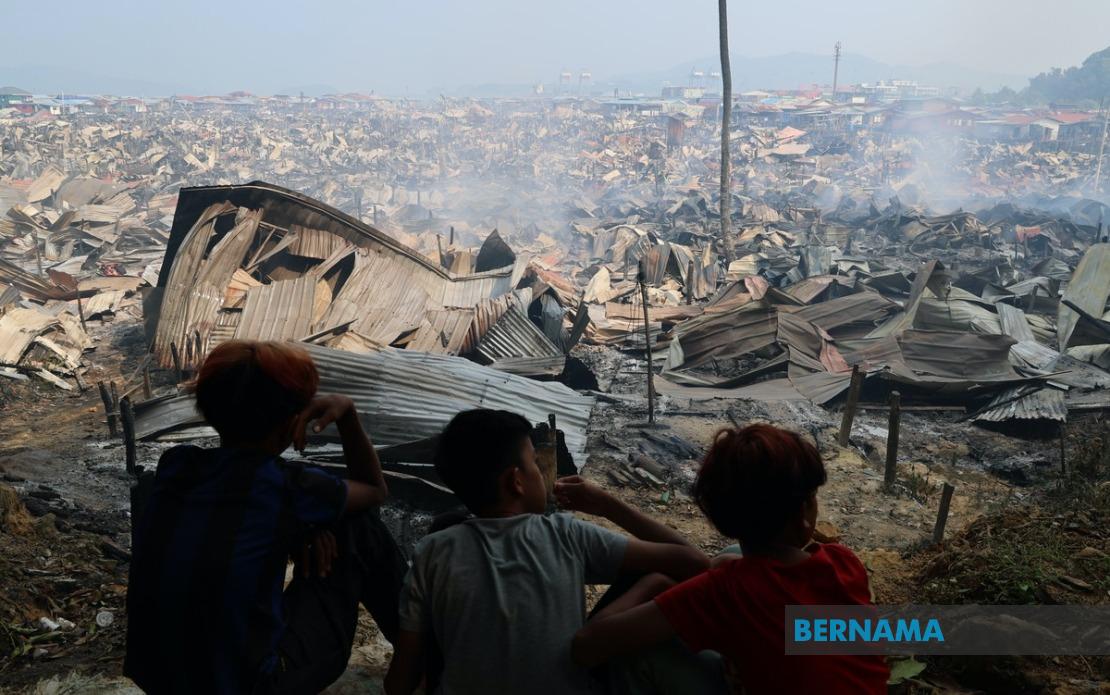
The Sabah state government has moved swiftly to provide financial relief following a catastrophic fire that devastated Kampung Lok Buta in Numbak, Kota Kinabalu, destroying over 200 residential structures and displacing hundreds of families in the early hours of the morning. Chief Minister Datuk Seri Hajiji Noor announced a comprehensive assistance package of RM3,000 per household head during a visit to displaced residents sheltering at the Likas Multipurpose Hall temporary relief centre, signalling the government's commitment to supporting those affected by this unprecedented disaster.
The relief allocation represents a collaborative financial response drawing contributions from multiple sources across federal and state levels. Each affected Malaysian household head will receive RM1,000 from the state government, RM1,000 from federal authorities, and a further RM1,000 from Yayasan Kebajikan Sabah, a charitable foundation that has historically played a significant role in addressing humanitarian crises within the state. This tripartite arrangement demonstrates coordination between Putrajaya and Kota Kinabalu in responding to provincial emergencies, a mechanism that underscores the importance of inter-governmental cooperation during natural disasters and sudden displacement crises affecting large civilian populations.
The government's compassionate approach extends beyond Malaysian citizens to include non-citizen household heads impacted by the inferno. These individuals, who may be undocumented or hold temporary residential status, will receive RM1,000 in state government assistance, recognising humanitarian obligations regardless of immigration status. This inclusive policy reflects contemporary understanding of disaster relief management in cosmopolitan Malaysian contexts where migrant populations often constitute vulnerable communities with limited access to safety nets or social insurance mechanisms.
Beyond immediate cash transfers, the state administration has committed to material support encompassing essential provisions such as food supplies and household necessities for displaced families navigating the immediate aftermath of losing their homes and possessions. These practical interventions address the urgent daily requirements of communities in crisis, providing temporary respite while longer-term reconstruction planning proceeds. The distribution of such items through the temporary relief centre ensures that basic survival needs are met during the critical transition period before families can return to stable housing circumstances.
The government has undertaken to coordinate comprehensive home reconstruction efforts through collaboration between the State Secretary's Office and Majlis Amanah Rakyat, Malaysia's principal agency tasked with advancing economic and social development initiatives. This institutional framework indicates that rebuilding will follow structured processes rather than ad hoc individual arrangements, potentially ensuring quality standards and equitable access to reconstruction support. The decision regarding whether affected families will rebuild at their original settlement site or be relocated to alternative locations remains pending, contingent upon detailed assessment of site suitability and infrastructure capacity to accommodate resettlement activities.
The tragedy itself claimed three young lives in circumstances that underscore the particular vulnerability of children in informal settlements during emergency situations. Nana Abdullah, aged four, her brother Mohd Asrul, six, and their eight-year-old cousin Nurfarahdilah Mohd Tajihah perished in the conflagration that erupted at approximately 1:40 am on the morning of the incident. These deaths represent a profound human dimension to the statistics of destroyed properties and displaced households, highlighting how disasters disproportionately impact the youngest members of affected communities and often create lasting psychological and social consequences within families and wider communities.
Kampung Lok Buta's fire exposes enduring vulnerability patterns within informal or densely-populated residential areas across Malaysian urban peripheries, where wooden or improvised structures afford minimal fire protection and evacuation routes remain congested during emergencies. The destruction of over 200 homes in rapid succession suggests inadequate fire detection systems, limited water supply infrastructure, and the compressed spacing of dwelling units that characterises many informal settlements in Malaysian cities. These structural vulnerabilities warrant broader policy attention regarding building regulations, fire prevention standards, and urban planning frameworks governing informal communities beyond this particular incident.
For Sabah specifically, the fire disaster arrives amid ongoing discussions about governance priorities and administrative capacity in addressing provincial challenges. Chief Minister Hajiji Noor's personal engagement at the relief centre and direct announcement of assistance packages demonstrates political attention to the crisis, yet also highlights the degree to which state-level responses depend upon individual leadership decisions rather than institutionalised disaster protocols. The coordination between state government, federal authorities, and charitable organisations suggests functional mechanisms, though the adequacy of these systems for future, potentially larger-scale disasters merits assessment and potential strengthening.
The broader implications for disaster preparedness across Southeast Asia remain significant, as rapid urbanisation, informal settlement proliferation, and climate variability create conditions where fire disasters similar to Kampung Lok Buta recur with concerning frequency across the region. Malaysia's demonstrated willingness to allocate substantial immediate relief funding and coordinate multi-level governmental response provides some model framework, yet prevention-focused investments in fire prevention infrastructure, community early warning systems, and safer building standards may ultimately prove more cost-effective than post-disaster relief expenditure. The challenge facing Malaysian policymakers involves translating individual incidents into systemic improvements protecting vulnerable populations from future catastrophes.

