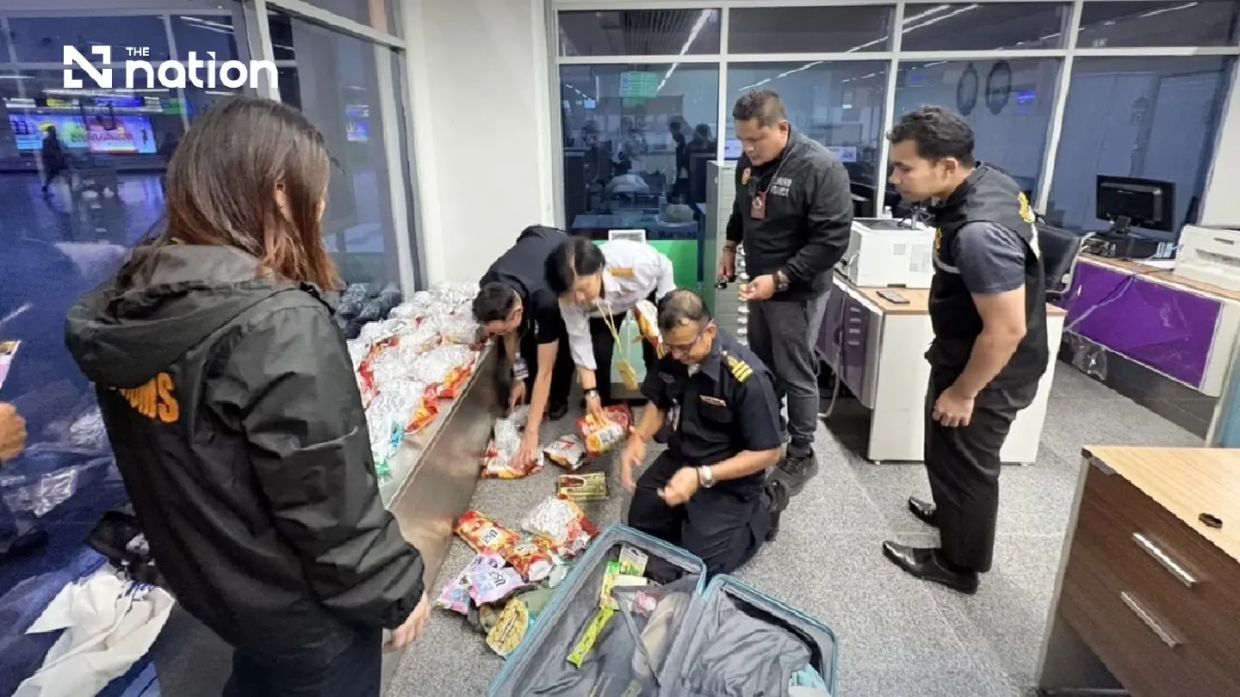
A 30-year-old Russian national was arrested at Phuket International Airport's international departure terminal on Wednesday after Thai customs officers uncovered a substantial quantity of cannabis concealed within his checked baggage. The discovery of 17.6 kilogrammes of marijuana products represents another significant trafficking interdiction at one of Thailand's busiest international gateways and underscores the ongoing vigilance of border enforcement agencies in combating narcotics smuggling through air terminals.
The arrest of Sergei Chalabari occurred in the Mai Khao subdistrict of Thalang district as he prepared to depart Thailand. Customs inspectors, led by chief of the Phuket Airport Customs House Nucha Jeeradit, conducted a routine examination of two blue BP WORLD wheeled suitcases weighing approximately eight kilogrammes combined. The decision to open the luggage yielded a substantial seizure that halted what authorities characterize as an attempt to export controlled substances without proper documentation or declaration.
The contents retrieved during the search comprised two distinct forms of cannabis products packaged for transport. Officers discovered 35 vacuum-sealed packages of cannabis flowers totalling 11.4 kilogrammes, alongside 12 separate packs of cannabis resin weighing 6.2 kilogrammes collectively. The methodical packaging and compartmentalization of the substances suggest deliberate preparation for concealment, a typical hallmark of organized trafficking operations rather than personal possession. Both the narcotics and the luggage itself were immediately seized as evidence for further investigation and potential court proceedings.
During preliminary interrogation at the airport, Chalabari acknowledged ownership of both the suitcases and their contents. Thai authorities subsequently informed him of charges relating to attempted smuggling of goods across the kingdom's borders without adherence to customs declaration protocols. Such charges carry substantial penalties under Thailand's narcotics and customs legislation, with potential sentences extending significantly depending on prosecutorial discretion and judicial determination during trial proceedings.
The suspect was transferred to Sakhu Police Station for further legal processing, where investigators began compiling evidence for submission to relevant prosecutorial authorities. The operation's coordination reflected the systematic approach Thai agencies employ when addressing major drug seizures, involving multiple command structures within customs and police hierarchies. Pol Col Salan Sankhisasanakun, superintendent of Sakhu Police Station, and Pol Lt Col Rattanawut Nukaew, the station's deputy superintendent for investigation, supervised the procedural aspects of the arrest and detention. Administrative processing fell under Pol Capt Chaphinya Surithamkul, the station's deputy investigation inspector, who received formal custody of Chalabari.
The seizure reflects a continuing challenge facing Southeast Asian nations regarding transnational drug trafficking networks that exploit international travel corridors. Russia and former Soviet republics have emerged as significant sourcing regions for narcotics destined for regional markets, with Thailand's geographic centrality making it both a transit hub and consumption market. The sophistication evident in this particular smuggling attempt—the use of proper luggage, multiple packaging units, and timing during standard passenger flows—suggests participation in a broader trafficking infrastructure rather than opportunistic individual enterprise.
Phuket International Airport, serving approximately 20 million passengers annually, presents both commercial opportunity and enforcement challenge for Thai authorities. The volume of daily departures creates inevitable gaps in comprehensive screening capacity, yet the airport's strategic importance in Thailand's tourism economy mandates robust security protocols. Customs operations at the facility have intensified scrutiny of outbound passengers following detection of multiple major drug shipments in recent years, reflecting heightened operational awareness among uniformed personnel.
Thailand's drug enforcement priorities have shifted in recent years, particularly following changes in cannabis classification that permit limited medical and research applications while maintaining strict controls on recreational use and export. The recovery of substantial quantities destined for foreign markets demonstrates Thai authorities' commitment to preventing narcotic outflows that could feed international trafficking networks. The distinction between permitted medical cannabis production and illicit trafficking remains a critical enforcement line that agencies must navigate with precision.
For Malaysian and broader Southeast Asian stakeholders, this incident illustrates the permeable nature of regional borders and the constant necessity for vigilance in combating organized drug crime. Malaysian customs and aviation security personnel maintain comparable operations at Kuala Lumpur International Airport and other major entry points, facing similar challenges from organized smuggling networks employing increasingly sophisticated concealment methods. Regional cooperation through information-sharing mechanisms and coordinated enforcement has proven essential, particularly given the cross-border mobility of criminal organizations targeting multiple jurisdictions simultaneously within the region.

