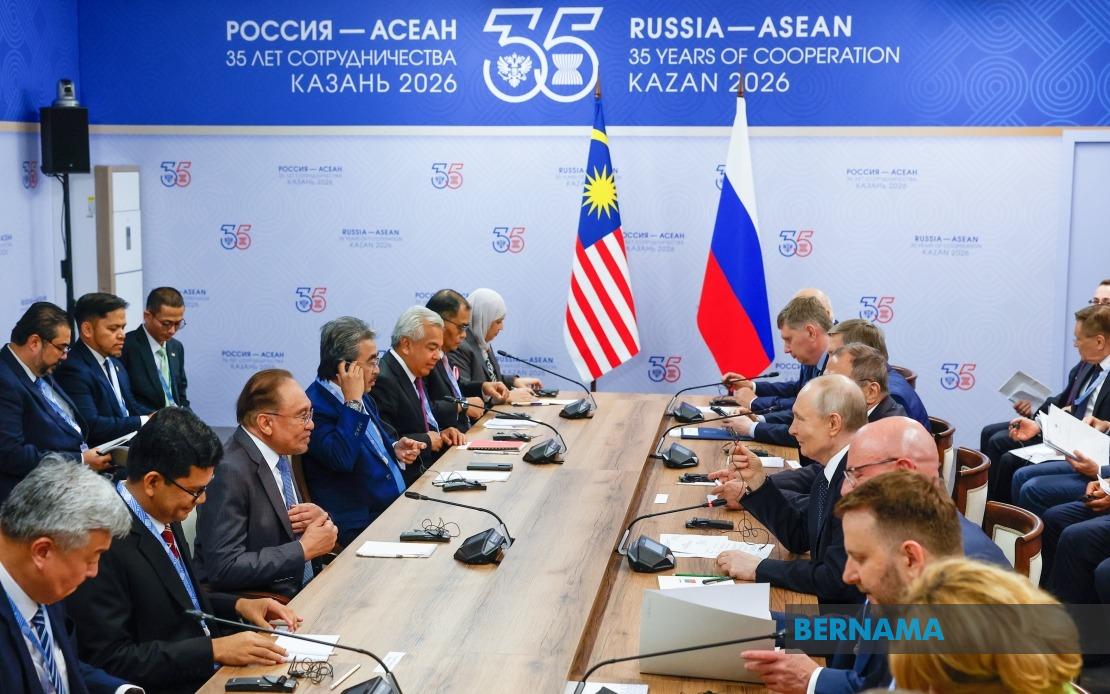
Russian President Vladimir Putin has indicated that Moscow and Kuala Lumpur are well positioned to expand their strategic relationship during a bilateral meeting with Malaysian Prime Minister Datuk Seri Anwar Ibrahim at the ASEAN-Russia Commemorative Summit in Kazan. The encounter underscores both nations' commitment to strengthening ties as they approach a significant milestone in their diplomatic history. Putin characterised the relationship as having solid groundwork for future collaboration, reflecting decades of engagement between the two governments.
The forthcoming 60th anniversary of diplomatic relations between Russia and Malaysia in 2026 provides an important symbolic moment for both countries to consolidate their partnership. Putin emphasised that the two nations are approaching this juncture with what he described as "substantive positive experience" across multiple dimensions of bilateral engagement. This framing suggests that rather than viewing the anniversary as merely a ceremonial occasion, both Moscow and Kuala Lumpur intend to use it as a platform to demonstrate concrete achievements and renewed momentum in their cooperation.
Trade performance between the two countries has emerged as a key indicator of strengthening economic ties. During 2025, bilateral commerce expanded by 12.9 per cent, a figure Putin highlighted as demonstrative of healthy economic momentum. For Malaysia, this growth rate is significant given the broader global economic uncertainties and shifting trade patterns that have characterised recent years. The expansion suggests that despite geopolitical tensions elsewhere, Russian and Malaysian business communities have found sufficient grounds for expanded commercial engagement across various sectors.
Institutional frameworks underpin the practical realisation of bilateral cooperation. Putin noted that Russia and Malaysia maintain consistent contact through their respective ministries, government agencies, and parliamentary bodies. More significantly, an intergovernmental commission dedicated to economic, scientific, technical, and cultural matters serves as the primary mechanism for implementing joint projects. These structures provide continuity and systematic coordination that transcends the personalities of individual leaders, lending stability to the relationship.
Beyond commerce, Russia has demonstrated particular interest in broader spheres of engagement with Malaysia. Putin specifically highlighted education, science and technology, tourism, and humanitarian exchanges as priority areas for cooperation. Such diversification across multiple sectors suggests that Russia views Malaysia not merely as a commercial partner but as a comprehensive strategic engagement opportunity. For Malaysia, these avenues offer potential benefits in knowledge transfer, technological advancement, and cultural enrichment.
Malaysia's role within ASEAN has become increasingly relevant to Russia's strategic calculations in Southeast Asia. Putin acknowledged Malaysia's historical significance in anchoring Russia-ASEAN relations, referencing the 2005 summit held in Kuala Lumpur as the inaugural summit-level meeting between Russia and the regional bloc. He further commended Malaysia's continued support for developing the Russia-ASEAN strategic partnership, particularly noting Malaysia's chairmanship of ASEAN in the preceding year. This recognition underscores how bilateral relationships can serve as conduits for broader regional diplomacy.
The geopolitical context informing this engagement reflects Russia's broader strategy of maintaining influence in Asia-Pacific despite Western sanctions and international isolation. Southeast Asia remains strategically important to Moscow, both as a market and as a counterweight to perceived Western dominance in the region. Malaysia, as a moderate Muslim-majority nation with significant economic clout and diplomatic standing within ASEAN, occupies a particularly valuable position in this calculus. Russian efforts to strengthen ties with Kuala Lumpur thus form part of a larger pivot toward Asia that has accelerated in recent years.
From Malaysia's perspective, cultivating a robust relationship with Russia serves multiple national interests. Economically, diversified trade partnerships reduce dependence on any single market or political bloc. Diplomatically, maintaining substantive engagement with major powers including Russia enhances Malaysia's non-aligned credentials and strengthens its voice within ASEAN on questions involving major power relations. Culturally and educationally, expanded cooperation with Russia opens new avenues for Malaysian citizens to access Russian expertise and institutions.
Putin's personal touches during the meeting, including his recall of previous encounters with Anwar Ibrahim and his conveyance of greetings to His Majesty Sultan Ibrahim, King of Malaysia, reflect the importance Russia places on maintaining cordial high-level relationships. Such diplomatic courtesies, while seemingly ceremonial, carry weight in international relations by signalling respect and continuity. They also create positive atmospherics conducive to productive engagement on substantive matters.
The emphasis on mutual respect and consideration of interests as foundational principles suggests both parties view their relationship as one between equals rather than one of dominance and subordination. This framing is important for Malaysia, which has consistently sought to maintain strategic autonomy and resist pressure to align exclusively with any major power. Russia's articulation of this principle may reflect an understanding that Malaysia will not tolerate relationships perceived as compromising its independence.
Looking forward, the 60th anniversary offers both countries an opportunity to reset and recalibrate their partnership for the contemporary era. Rather than simply commemorating past achievements, both Moscow and Kuala Lumpur appear inclined to use this occasion to announce new initiatives, expanded trade targets, or deepened cooperation in emerging fields. The timing also coincides with broader shifts in global geopolitics, potentially creating space for regional powers like Malaysia to expand relationships with actors like Russia.
For Southeast Asian observers, the Russia-Malaysia dynamic represents a microcosm of the region's broader challenge of managing relationships with major powers while maintaining autonomy. Malaysia's success in balancing engagement with Russia, China, the United States, and other powers while preserving its ASEAN identity offers lessons for the region. As the international environment continues to shift, such diversified partnerships may become increasingly essential for regional stability and prosperity.