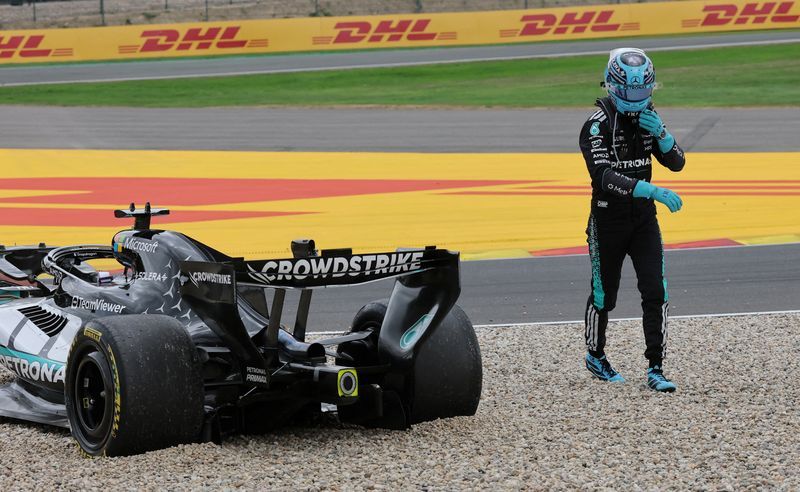
George Russell's Formula One championship hopes suffered another setback at Spa-Francorchamps on Sunday when the Mercedes driver crashed out of the Belgian Grand Prix during the opening lap. The collision with Ferrari's Lewis Hamilton, his former teammate, ended Russell's race immediately and saw him walking away from the gravel trap as Hamilton continued with the safety car deployed. For a driver already struggling with consistency this season, the disappointment appeared to have worn him down to resignation rather than fresh anger.
Russell's race unravelled with remarkable speed despite an encouraging start from third position on the grid. The Briton made promising progress into the first corner, tucking in behind Red Bull's Max Verstappen as hoped. That early promise, however, masked an emerging technical crisis that would ultimately prove his undoing. A critical power delivery failure left him severely disadvantaged when competing for position on the straights, a fundamental weakness that exposed him to the field and set up the inevitable collision.
The root cause, according to Russell's post-race analysis, lay in his car's energy management system failing at the most crucial moment. As he exited the opening corner, his battery charge sat at just 35 per cent of capacity due to a recharging malfunction at Turn One. The situation deteriorated further when the turbocharger failed to function properly, leaving him with zero battery charge by the time he reached Eau Rouge. This left the Mercedes vulnerable in a way that Russell considered genuinely dangerous, unable to keep pace with rivals surging past on the straight section.
The consequence of this mechanical deficit was swift and damaging. Russell found himself swamped by three cars over successive corners, dropping from his initial position into an untenable situation. Rather than assign blame for his retirement to the collision alone, Russell expressed greater frustration at being placed in such a precarious position in the first place. The incident with Hamilton, he acknowledged, was more a racing accident than a deliberate attack, though he conceded the Ferrari driver bore greater responsibility for the contact.
Stewards reviewing the incident reached a similar conclusion, handing Hamilton a five-second penalty for causing the collision. Yet for Russell, the penalty offered little consolation as he had already retired from the race. The real damage extended beyond Sunday's results to his championship prospects, which were already deteriorating given his recent form. Russell has now failed to score points in three races this season, a pattern of underperformance that contrasts sharply with the consistency expected from a front-running driver.
The championship leader, Kimi Antonelli, capitalized on the chaos around him by starting from pole position and hunting for his sixth victory of the campaign. Antonelli's comfortable 25-point lead over Russell in the standings after nine of 22 rounds reflects the growing gap between the two Mercedes drivers. While Antonelli has managed two non-scoring rounds, his overall record demonstrates the kind of reliability and consistent point accumulation that wins championships. The disparity highlights how much ground Russell has lost through a combination of mechanical failures and racing incidents.
Russell's demeanor following the Belgian Grand Prix revealed the psychological toll of repeated setbacks. When asked about the disappointment, his response cut to the heart of his frustration: "When it happens so often you just get used to it." This resignation rather than renewed determination suggests a driver grappling not just with momentary bad luck but with a pattern of underperformance that extends across multiple races. For a championship contender, such fatalism is dangerous, as momentum and confidence prove crucial in the latter stages of a Formula One season.
The technical issues Russell identified had been apparent since qualifying on Saturday, when he noticed serious problems with his car's performance on the straights. Rather than resolving these concerns overnight, Mercedes appeared unable to fully rectify the problem before the race, a troubling sign for a team with the resources and expertise typically available to top-tier operations. This suggests either a fundamental design issue or a gap in problem-solving capability that Russell's struggles have increasingly exposed.
For Malaysian and Southeast Asian Formula One enthusiasts, Russell's declining form raises questions about Mercedes' championship challenge this season. The team, which has dominated recent campaigns, now finds itself with only Antonelli genuinely competing for the title while Russell slips further behind. The narrative of the championship battle is shifting away from a Mercedes versus the field dynamic toward a more open competition where Antonelli must fend off challengers from other teams. As the season progresses toward the crucial middle rounds, Russell faces mounting pressure to reverse his fortunes before his title hopes disappear entirely.

