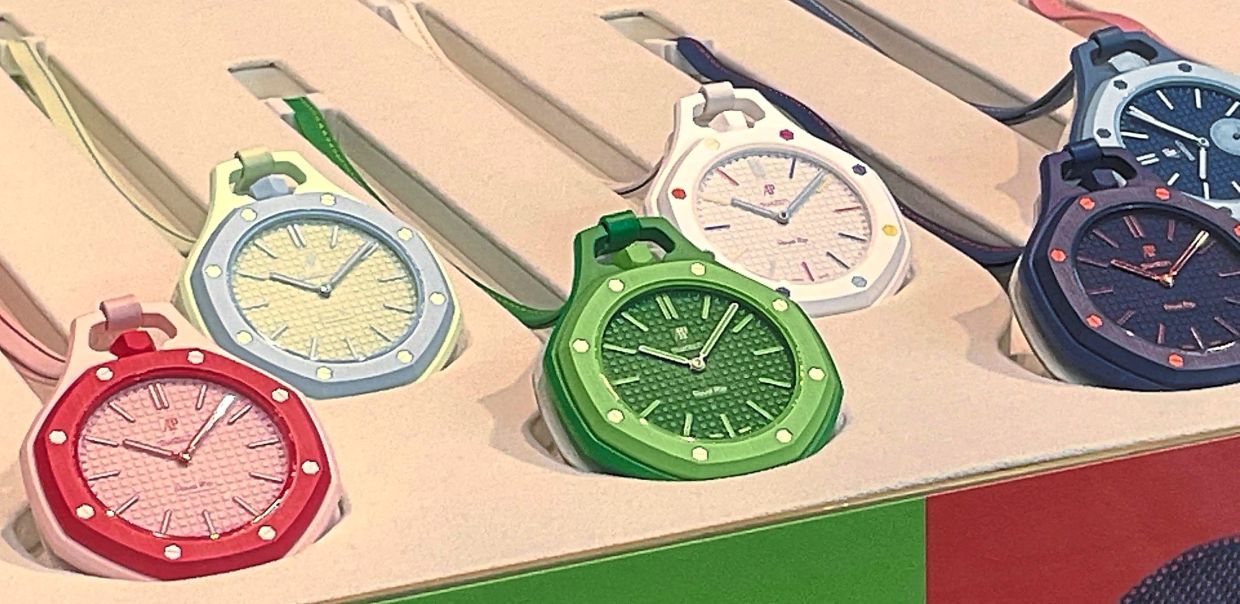
The watch industry stirred with excitement on May 16 when Swatch and Audemars Piguet unveiled Royal Pop, a bold collaboration that brought haute horlogerie aesthetics to bioceramic pocket watches priced below RM1,800. The launch created unprecedented buzz in the horological community, simultaneously revealing how effectively orchestrated scarcity can captivate consumers willing to queue for hours without any assurance of purchase—even when products are not officially limited editions.
Weeks of mysterious teasers across newspapers and digital platforms fueled speculation before the May 12 announcement. Reddit users and watch enthusiasts circulated AI-generated concepts while official details remained locked behind strict non-disclosure agreements. This calculated secrecy amplified anticipation to a fever pitch. When the collection finally debuted, it surprised nearly everyone: rather than traditional wristwatches, the collaboration presented eight colourful pocket watches featuring Gerald Genta's most recognisable Royal Oak elements—the distinctive octagonal bezel, Petite Tapisserie dial, and eight exposed hexagonal screws.
The eight pieces came in two formats: Lepine models with the crown positioned at 12 o'clock, and Savonnette versions featuring the crown at 3 o'clock alongside a small seconds subdial. Both utilised hand-wound SISTEM51 movements, delivering mechanical intrigue through minimalist engineering rather than traditional haute horlogerie craftsmanship. The bioceramic construction deliberately reinforced the collection's playful character, positioning it as a creative reimagining rather than a budget Royal Oak alternative. This distinction proved strategically significant—entry-level Royal Oak wristwatches command prices near RM94,881, making a low-cost watch collaboration potentially damaging to brand prestige. By relocating the design language to pocket watches, a nostalgic niche category removed from AP's core business, the company could experiment freely without threatening its primary wristwatch line.
For Swatch, Royal Pop represents a natural evolution from its phenomenally successful 2022 MoonSwatch partnership with Omega. That collaboration demonstrated the commercial potency of pairing mass-market accessibility with prestige branding. Global cities witnessed lengthy queues, authorities deployed crowd control in several locations, and resellers profited substantially from secondary market markups—all for watches originally priced below RM1,265. Royal Pop amplifies this winning formula considerably, though with a crucial distinction: unlike Omega, which operates within the Swatch Group, Audemars Piguet remains independent. This independence transforms Royal Pop beyond a typical corporate co-brand into evidence of Swatch's emerging role as a prestigious platform enabling luxury houses to broaden cultural reach without diluting core products.
Pat Law, founder of local marketing agency Goodstuph, notes the mutual benefits at play. Swatch gains cultural credibility through decades of horological heritage and craftsmanship association, while AP achieves broad relevance without compromising exclusivity. "Most young consumers would not walk into an AP boutique," Law observes, "but now the brand gets to live rent-free in their heads years before they can afford one." Yet academic research on luxury positioning raises caution: while democratisation drives immediate sales surges and publicity, widespread access to a brand's visual identity risks erosion of long-term exclusivity and prestige.