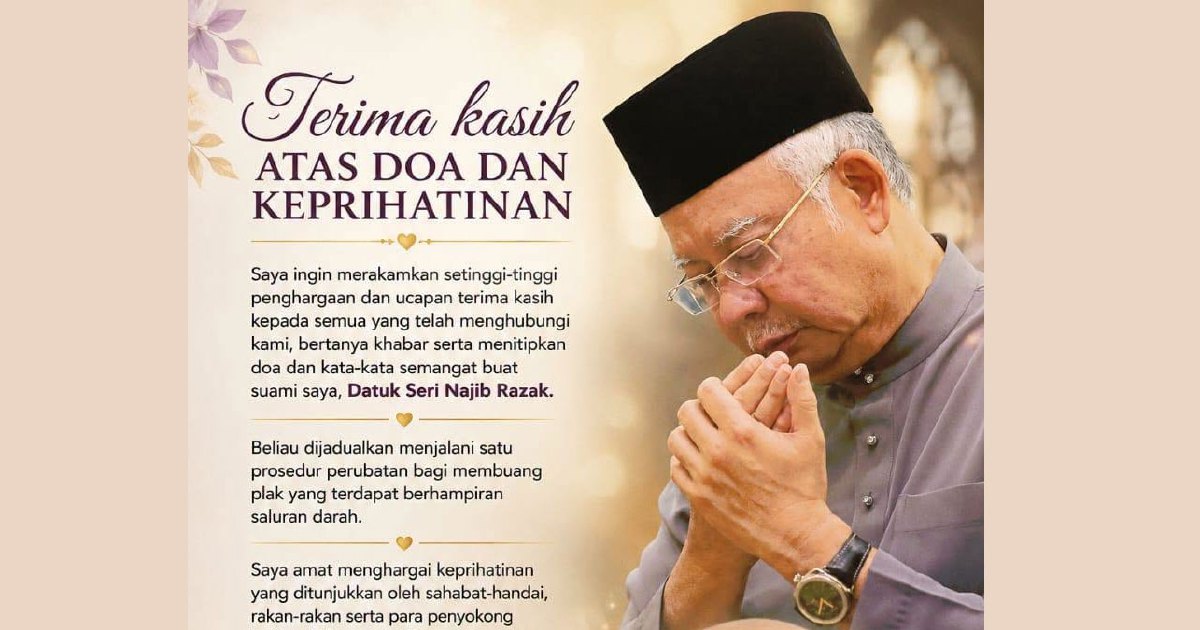
Datin Seri Rosmah Mansor has made a public appeal for prayers and support as her husband, former Prime Minister Datuk Seri Najib Razak, undergoes a scheduled medical procedure to address plaque accumulation near a blood vessel. The appeal reflects the family's reliance on well-wishes from their supporters during what appears to be a period of health concern for the high-profile political figure.
The former first lady's request for public prayer represents a significant moment in the personal life of one of Malaysia's most recognisable political couples. Rosmah's message of gratitude toward those offering support underscores the emotional dimensions of health challenges faced by public figures, who often navigate medical situations with heightened public scrutiny.
Najib's forthcoming procedure addresses a specific cardiovascular concern—the removal of plaque deposits that have accumulated adjacent to a blood vessel. This type of intervention, typically performed through minimally invasive techniques, aims to restore proper blood flow and reduce associated health risks. The scheduled nature of the treatment suggests the condition was identified proactively, allowing medical teams to plan the procedure in advance rather than responding to an emergency situation.
For Malaysian observers, Najib's health situation carries broader implications given his continued prominence in domestic political discourse. As a former occupant of the nation's highest political office, developments affecting his wellbeing remain matters of public interest. His continued engagement with political and social matters over recent years has maintained his visibility within the national conversation, making health circumstances newsworthy to various segments of Malaysian society.
Rosmah's public acknowledgment of the upcoming procedure and her request for prayers demonstrates a common approach among Malaysian families navigating health crises—seeking collective support from their communities and supporters. This cultural practice of involving the broader public in moments of personal challenge reflects values of communal solidarity that remain significant in Malaysian society.
The timing of such a procedure raises questions about Najib's broader health management and medical supervision. Like other individuals in his age bracket and public position, he likely has access to comprehensive healthcare services and specialised medical expertise. The proactive identification and scheduled treatment of the arterial condition reflects appropriate medical vigilance, potentially preventing more serious complications that could arise from untreated vessel blockage.
Vascular procedures targeting plaque removal represent standard interventions within modern medicine, with established protocols and typically positive outcomes when performed by experienced specialists. The specific nature of Najib's condition—plaque near a blood vessel—suggests a localised issue rather than systemic cardiovascular disease, which may indicate a more straightforward clinical situation amenable to targeted intervention.
For supporters of Najib, Rosmah's appeal likely resonates as an opportunity to express continued loyalty and concern beyond the realm of politics. Many individuals who maintain connections to political figures often extend support during personal challenges, reflecting personal relationships that exist parallel to political affiliations. The public nature of the request therefore serves multiple functions—securing genuine prayers from well-wishers while also acknowledging the family's broader support network.
The situation also illustrates how senior Malaysian political figures navigate health matters within the context of public life. Their medical circumstances often become subjects of public knowledge and commentary, distinguishing them from private citizens who might manage similar health conditions without public engagement. This transparency, whether voluntary or circumstantial, creates opportunities for public discourse around health, aging, and medical intervention among Malaysia's political elite.
Moving forward, the success of Najib's procedure and his recovery trajectory will likely remain matters of public interest, particularly within circles that maintain political connections to his era of governance. Medical outcomes following vascular interventions typically become evident relatively quickly, and updates regarding his recovery may be anticipated by observers tracking his continued role in Malaysian public life.
Rosmah's statement ultimately reflects a family moment transcending political identity—a reminder that public figures experience vulnerabilities and health concerns that touch all members of society. Her gratitude toward supporters and appeal for prayers represents a human dimension of political life that occasionally breaks through the typically combative nature of Malaysia's political discourse, creating space for collective concern and shared hopes for positive medical outcomes.
As Najib prepares for the procedure, the episode underscores broader realities about aging, health management, and mortality that affect individuals across all strata of Malaysian society, regardless of their previous prominence or political standing. The medical community's capacity to address such conditions through planned intervention continues to offer hope for maintaining quality of life among individuals facing vascular challenges.

