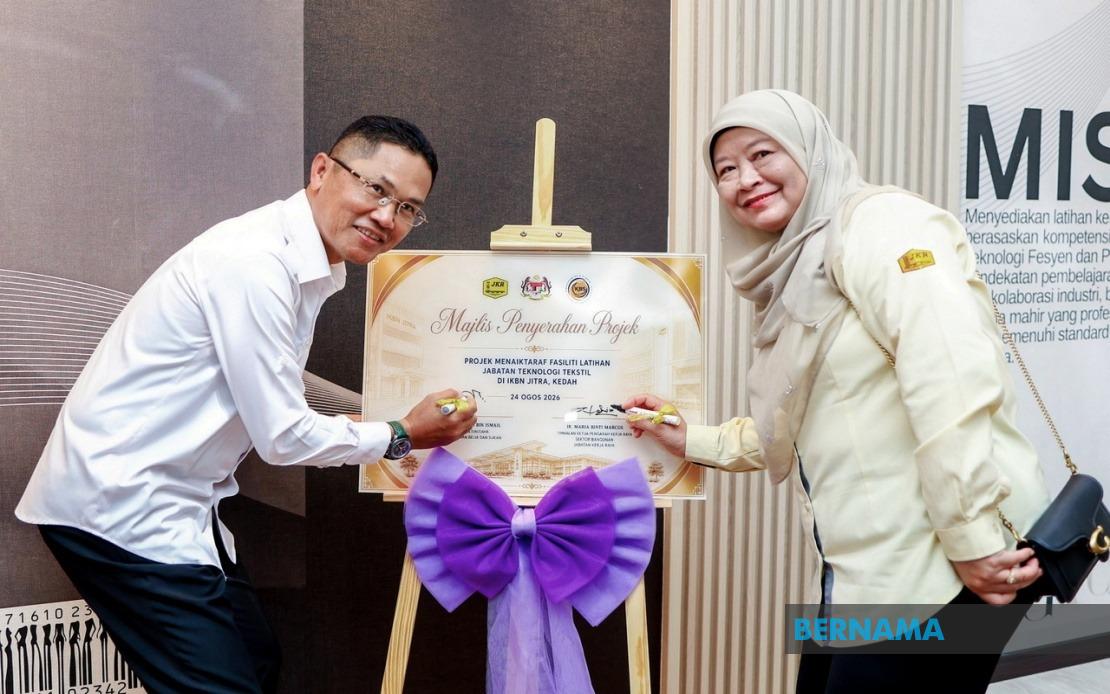
The government has completed a major infrastructure overhaul at the National Youth Skills Institute (IKBN) in Jitra, reflecting a broader strategy to refresh Malaysia's technical and vocational education ecosystem. The RM3.7 million Fashion and Clothing Technology Department upgrade was formally handed over this month, marking the culmination of work that commenced in mid-2025 under the 12th Malaysia Plan's Rolling Plan 4. Youth and Sports Ministry secretary-general Datuk Rahimi Ismail emphasised that the investment demonstrates the administration's conviction that TVET institutions must remain competitive and relevant in a rapidly evolving global marketplace.
The project encompasses three distinct components designed to create a contemporary learning environment. The Public Works Department managed building upgrades at a contract value of RM1.577 million, which included structural improvements and expansion of training spaces. Alongside this, the ministry procured information and communications technology equipment and new furniture, transforming classrooms into digitally integrated spaces. Together, these elements address longstanding capacity constraints that have hampered the institute's ability to deliver world-class training experiences to its students.
One of the project's flagship additions is a Level Three fashion workshop that replicates industrial conditions more faithfully than previous facilities. This progression towards industry-standard environments is deliberate—vocational educators argue that students who train on equipment and in settings analogous to their future workplaces develop practical competencies more swiftly and retain knowledge more effectively. The institute also commissioned a smart classroom equipped with modern audiovisual and digital learning tools, enabling instructors to integrate case studies, virtual demonstrations, and real-time industry data into their curricula.
Rahimi's remarks during the handover ceremony underscored a fundamental tension in Malaysia's TVET sector: the fashion and textiles industry operates in an environment shaped by technological innovation, creative entrepreneurship, and volatile consumer demand. Training institutions that fail to keep pace risk producing graduates whose skills become obsolete within months of entering employment. By upgrading IKBN Jitra's infrastructure, the government is attempting to compress the lag between classroom instruction and workplace reality, ensuring that students encounter emerging technologies and contemporary design methodologies before they graduate.
The timing of this investment carries particular significance for Malaysia's regional positioning. The Southeast Asian fashion and textiles market has experienced structural shifts in recent years, with production hubs increasingly moving towards higher-value activities such as design, digital marketing, and sustainable manufacturing practices. Countries like Vietnam and Indonesia have made aggressive investments in TVET infrastructure for these sectors, attracting international brand partnerships and investment. Malaysia risks losing competitive advantage if its vocational graduates lack training in digital design tools, supply chain digitalisation, and contemporary fashion technologies that define the industry's trajectory.
Datuk Rahimi articulated an ambition that IKBN Jitra's students aspire beyond domestic recognition, specifically targeting international markets and participation in the global fashion landscape. This aspiration, while commendable, requires sustained attention to curriculum alignment, instructor development, and ongoing facility modernisation. A single infrastructure upgrade, however comprehensive, cannot guarantee such outcomes; institutions must continuously adapt as industry standards evolve. The completion of this project therefore represents a foundation rather than a conclusion—a baseline from which the institute must build.
The investment also reflects an implicit acknowledgment that Malaysia's TVET sector has historically suffered from underinvestment relative to academic pathways. Perceptions of vocational education as a secondary option for lower-achieving students have deterred talented individuals from pursuing technical qualifications, despite robust employment demand. By showcasing modern facilities and contemporary learning environments through projects like the IKBN Jitra upgrade, the government appears intent on rebranding TVET as a legitimate and attractive educational choice. This cultural shift requires not only infrastructure but also coordinated messaging from educational authorities, industry bodies, and policymakers.
The project's alignment with the 12th Malaysia Plan signals that TVET modernisation remains a stated priority within Malaysia's medium-term development framework. However, observers note that infrastructure investments must be accompanied by adequate recurrent funding for maintenance, instructor training, and curriculum development. Without such complementary investments, facilities risk deteriorating or becoming underutilised if the institution lacks the human and financial resources to operate them effectively. The government's track record suggests that post-handover sustainability cannot be assumed.
For Malaysian employers in the fashion and textile sectors, this upgrade presents both opportunity and expectation. Training institutions that offer contemporary, industry-aligned programmes create talent pipelines that reduce hiring and onboarding costs for companies. Yet employers must reciprocate by engaging with IKBN Jitra through internship placements, guest lectures, equipment donations, and feedback mechanisms that keep curricula responsive to evolving skill demands. The institute's success depends significantly on the strength of such industry partnerships.
Regionally, Malaysia's investment in TVET infrastructure contributes to a competitive dynamic among Southeast Asian nations vying for attractiveness to international investors and students. Countries with reputation for quality vocational training attract both foreign direct investment in labour-intensive sectors and international students seeking alternative pathways to employment. This infrastructure competition, while potentially beneficial for raising standards, also creates resource pressures on governments with limited budgets. Malaysia's decision to invest RM3.7 million in a single institute's upgrade reflects a deliberate prioritisation that other vocational facilities may not receive.
Looking forward, the success of the IKBN Jitra project will be measured not merely by the physical completion of construction or installation of equipment, but by whether the upgraded facilities translate into measurably better graduate outcomes. Metrics such as employment rates, starting salaries, employer satisfaction surveys, and student progression to further study or self-employment will indicate whether the investment has achieved its strategic objectives. Similarly, whether IKBN Jitra students genuinely penetrate international markets—as Rahimi hoped—will depend on factors extending well beyond infrastructure, including brand development, business acumen training, and access to global supply chains.
The IKBN Jitra upgrade exemplifies how governments attempt to bridge the gap between vocational aspirations and institutional capacity. By investing in modern facilities, Malaysia signals that TVET deserves serious resources and attention. Yet realising the full potential of such investments requires sustained commitment, strategic industry engagement, and recognition that infrastructure alone does not guarantee transformation. The project therefore represents both a genuine commitment to TVET modernisation and an implicit acknowledgment that much work remains to position Malaysia's vocational sector as regionally competitive.

