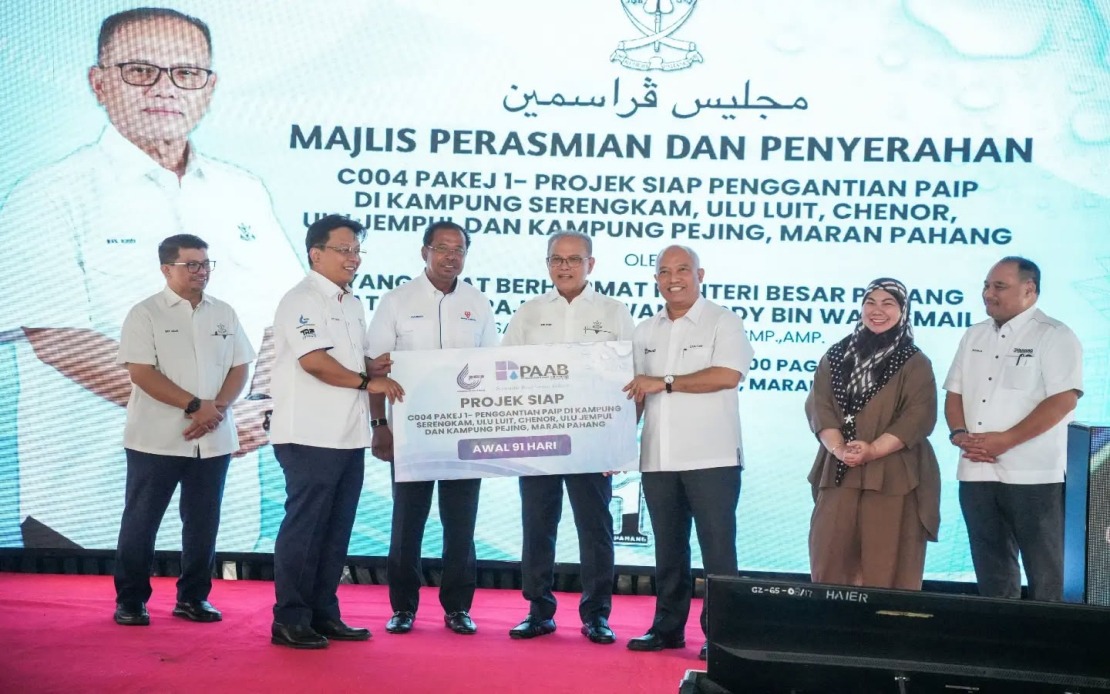
The persistent water supply challenges that have haunted Maran residents for nearly 20 years appear to be reaching an end with the successful completion of a RM11.19 million pipe replacement initiative by Pengurusan Aset Air Berhad (PAAB). The ambitious infrastructure upgrade, officially handed over by Pahang Menteri Besar Datuk Seri Wan Rosdy Wan Ismail at the Chenor Water Treatment Plant, represents a watershed moment for a district that has long struggled with unreliable water service, particularly in the Chenor sub-district where supply disruptions have been most acute.
The scale of the undertaking underscores the depth of Maran's water infrastructure problems. PAAB's teams replaced 29.6 kilometres of deteriorating and ageing pipes across multiple villages including Kampung Serengkam, Ulu Luit, Pejing, Ulu Jempul and Chenor—a scope that reflects the widespread nature of the district's water system decay. What makes this outcome particularly noteworthy is that PAAB delivered the project three months ahead of its original timeline, suggesting efficient project management and sustained commitment to resolving a long-standing public service gap.
The practical benefits for Maran's approximately 10,000 directly affected residents are substantial and multifaceted. Beyond the simple restoration of continuous water supply, the new pipeline network addresses the specific vulnerability of frequent burst pipes that had plagued older sections of the infrastructure. More significantly, the replacement substantially reduces non-revenue water losses—the industry term for water lost through leakage before reaching customers—a persistent drag on water utility efficiency across Malaysia. The project also stabilises water pressure during peak demand periods, a critical advantage during the dry season and festive holidays when consumption spikes and pressure fluctuations typically trigger supply failures.
The presence of high-ranking federal officials at the handover ceremony—Deputy Energy Transition and Water Transformation Minister Datuk Seri Abdul Rahman Mohamad and Deputy Economy Minister Datuk Mohd Shahar Abdullah—signals that this initiative carries broader significance within Malaysia's national water sector transformation agenda. This reflects the Malaysian government's commitment to treating water infrastructure modernisation as a cornerstone of economic and social development, particularly in states like Pahang where geographical and demographic challenges complicate service delivery across dispersed communities.
Maran's resolution, however, should be understood as part of a much larger and ongoing water infrastructure overhaul across Pahang. PAAB has committed to collaborating with Pengurusan Air Pahang Berhad (PAIP) over the next three years on a more comprehensive, strategic approach to water system planning across multiple districts. This phased approach reflects a pragmatic acknowledgment that water infrastructure rehabilitation across an entire state cannot be tackled simultaneously, requiring sequenced investment prioritising areas with greatest vulnerability or population impact.
The pipeline of planned projects demonstrates the scale of investment now flowing into Pahang's water sector. A RM35.7 million initiative targeting 76.2 kilometres of ageing pipe replacement in Jerantut and Lipis will address supply challenges in communities surrounding Pulau Tawar and Kuala Tahan—two areas popular with tourists that have experienced their own service reliability issues. Simultaneously, an RM13 million investment in Felda Keratong will replace 11 kilometres of pipes, specifically targeting efficiency improvements in Rompin's water distribution network. Additionally, PAAB is upgrading electrical systems at the Jengka Utama Water Treatment Plant's pumping station to eliminate recurrent supply disruptions affecting Felda Jengka settlements.
The financial commitment embedded in these plans is staggering. As of July this year, PAAB has allocated RM1.17 billion specifically for Pahang water infrastructure initiatives. Breaking down this allocation reveals strategic foresight: RM69.79 million has already been spent on completed projects, RM66.94 million is committed to projects currently under construction, while the remaining RM981.04 million sits in the planning and design pipeline. This distribution suggests PAAB is building a sustainable implementation rhythm rather than attempting unsustainable expenditure bursts—a measured approach to long-term system rehabilitation.
Underlying these tactical improvements sits a broader institutional evolution. PAAB itself, established in 2006 under the Water Services Industry Act 2006, was created precisely to coordinate the federal government's water sector transformation agenda across multiple entities and state boundaries. As an entity wholly owned by the Minister of Finance Incorporated and regulated by the newly renamed Ministry of Energy Transition and Water Transformation (PETRA), PAAB operates at the intersection of national development policy and regional water service delivery. The 2020 Pahang State Water Supply Services Restructuring Agreement with PAIP formalised a partnership framework that enables coordinated planning and investment across state boundaries while respecting federalism.
For Malaysian water consumers, particularly those in states with dispersed populations and challenging topography, Maran's success offers both promise and perspective. The project demonstrates that chronic, long-standing infrastructure failures are remediable through sustained investment and professional management—conditions increasingly present under Malaysia's evolving water sector governance structures. Yet the three-year implementation horizon for Pahang's broader infrastructure programme, combined with the billion-ringgit investment queue, also illustrates the magnitude of catch-up investment required across the nation to bring all regions to reliable service standards.
The socioeconomic implications extend beyond convenience. Reliable water supply directly influences public health outcomes, agricultural productivity, industrial investment decisions, and quality of life metrics that determine whether communities thrive or stagnate. For Maran, ending nearly two decades of supply disruptions potentially unlocks development possibilities that chronic infrastructure failure had constrained. Similarly, efficient water systems reduce operational costs for utilities, creating fiscal space for further expansion and maintenance—a virtuous cycle absent when systems hemorrhage water through leakage.
The Maran project also illuminates a critical difference in Malaysia's water sector approach. Rather than treating infrastructure modernisation as a temporary crisis-response exercise, the government's establishment of permanent entities like PAAB and the multi-year planning commitments evident in Pahang suggest a transition toward systematic, professionally managed water infrastructure development. This institutional maturation, combined with substantial capital commitment, creates the preconditions for transforming Malaysia's water sector from a source of periodic crisis to a foundation for sustainable development—a transformation that residents of Maran are finally experiencing firsthand.

