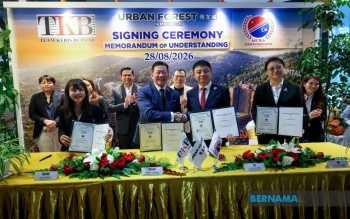
Team Keris Bhd (TKB) has embarked on an ambitious vision to reshape Perak's tourism landscape through a RM1 billion urban forest project spanning 84 acres in the Tambun area of Ipoh. The initiative, which involves partnerships with RJJ Hotels Sdn Bhd and the Malaysian Chinese Restaurant Association (MCRA), represents a strategic effort to diversify the state's economic drivers beyond its traditional industries. When completed within the next three years, the development is expected to function as a significant catalyst for regional economic expansion, anchored by the convergence of high-quality hospitality, culinary experiences, and commercial infrastructure.
The urban forest concept represents a departure from conventional tourism development in Perak, which has historically relied on domestic visitor markets. According to Loh Sze Yee, chairman of Perak's Tourism, Industry, Investment and Corridor Development Committee, the project addresses a critical gap in the state's ability to compete for international tourist dollars. By complementing existing attractions such as Lost World of Tambun and other commercial establishments, the development creates a cohesive ecosystem that can appeal to travellers seeking authentic experiences combined with world-class amenities. This positioning is crucial as regional tourism competition intensifies, with neighbouring states and countries aggressively marketing their offerings to affluent travellers from developed markets.
The collaboration between TKB, RJJ Hotels, and MCRA reveals a sophisticated understanding of what drives contemporary tourism preferences. Rather than treating accommodation and dining as separate service categories, the project integrates them into a unified visitor experience. TKB group executive chairman Datuk Lee Seng Hee articulated this philosophy by emphasising that food possesses inherent drawing power across geographical and cultural boundaries, while hospitality determines the emotional resonance of a destination. This insight reflects international tourism research demonstrating that culinary experiences rank among the most influential factors in destination selection and repeat visitation decisions.
The food and beverage component has been strategically designed to showcase Malaysia's gastronomic diversity while maintaining operational efficiency and quality standards. The proposed composition allocates 40 per cent of F&B operators to MCRA-affiliated establishments and 60 per cent to other Malaysian operators, creating a balanced portfolio that neither overwhelms the market with a single cuisine style nor dilutes the Malaysian culinary narrative. Critically, the development incorporates religious and dietary inclusivity by dedicating 30 per cent of F&B offerings to Muslim-friendly options, with MCRA pioneering offerings such as halal dim sum. This approach acknowledges that international tourism increasingly comes from markets with diverse religious compositions, and accessibility to appropriate dining options significantly influences visitor satisfaction and willingness to extend their stays.
RJJ Hotels' involvement introduces substantial international distribution capability through its affiliation with Jin Jiang Hotels, a global hospitality network encompassing more than 50 countries and 40 hotel brands with over 200 million members. This partnership essentially provides TKB's Ipoh project with access to pre-established marketing channels, travel agent relationships, and package tour mechanisms that would take years to develop independently. RJJ Hotels CEO Yap Lip Seng emphasised that the company's integrated approach addresses a persistent challenge for Perak tourism: geographical remoteness from Malaysia's main international gateways. By packaging complete travel experiences that eliminate the friction of connectivity between Kuala Lumpur or Penang and Ipoh, the project transforms distance into an asset rather than a liability, enabling extended stays where visitors can experience multiple dimensions of local culture and commerce.
The culinary focus creates particular advantages for Malaysian food operators seeking international exposure and scale. Participation in the urban forest provides local restaurateurs and food manufacturers with validated access to affluent international consumers from established markets including Australia, Britain, and the United States. These are precisely the demographic segments that demonstrate high spending capacity and growing interest in authentic Asian culinary experiences. For many participating operators, this represents a low-risk entry point into international markets, as the urban forest provides venue, infrastructure, and traffic rather than requiring independent marketing and distribution arrangements.
The partnership with MCRA extends beyond immediate F&B operations to encompass workforce development and supply chain upgrades. Gao Houyun, MCRA president, signalled the association's commitment to providing training and skills development for local workers and operators, recognising that international service standards require capabilities that may not yet exist uniformly across Perak's hospitality sector. This workforce investment ensures that the project generates not merely short-term employment but sustainable career pathways and skill accumulation. The emphasis on upskilling is particularly significant for Perak, which has historically faced challenges in retaining young talent due to limited opportunity diversity compared to Kuala Lumpur or Selangor.
The supply chain dimension introduces manufacturing and value-added production opportunities that extend the project's economic impact beyond tourism services. By encouraging Chinese manufacturers of sauces, spices, and food ingredients to establish production facilities in Perak, the initiative creates foundation for light manufacturing employment and export development. These manufacturers, seeking proximity to their client restaurants and supply stability, would be incentivised to locate in the state, generating skilled employment, technology transfer, and foreign exchange earnings through ingredient exports. Such integration between retail tourism, food service, and underlying production infrastructure transforms a tourism project into a diversified economic development platform.
Malaysia's halal certification framework emerges as a strategic asset enabling Perak-developed food products and restaurant concepts to expand beyond the immediate urban forest into broader domestic and Southeast Asian markets. Halal certification, while essential for accessing Islamic markets, increasingly serves as a quality and safety signal even in non-Muslim consumer segments. The MCRA's emphasis on this dimension reflects sophisticated market analysis: products and brands validated in the international urban forest environment, combined with Malaysia's globally recognised halal standards, create compelling positioning for market expansion into Indonesia, Brunei, and other Southeast Asian economies with substantial Muslim populations. This multiplier effect extends the project's economic footprint far beyond Ipoh's immediate geography.
The development represents a calibrated response to structural shifts in global tourism patterns. The rise of experiential and culinary tourism, combined with increasing consumer preference for authentic local experiences rather than homogenised international resort environments, creates opportunities for destinations like Perak to compete effectively. By combining heritage food cultures with contemporary hospitality standards, the urban forest positions Perak as appealing precisely because it offers integration of authentic Malaysian experiences with international-grade comfort and service consistency. This differentiation strategy acknowledges that affluent international travellers increasingly seek destinations that feel neither entirely foreign nor entirely familiar, but rather offer carefully curated exposure to local distinctiveness within frameworks of accessibility and comfort.
For Malaysian policymakers and investors across the region, the Ipoh urban forest project offers a replicable model for destination development that transcends conventional tourism infrastructure. Rather than constructing isolated resorts or theme parks, the approach embeds tourism economics within broader community and production systems. By simultaneously addressing visitor experiences, worker skills, local business growth, manufacturing opportunities, and supply chain development, the project demonstrates how tourism investments can function as catalysts for multi-sector regional transformation. As other Malaysian states and Southeast Asian jurisdictions consider tourism strategies, this integrated framework combining hospitality, culinary excellence, and underlying production infrastructure provides a sophisticated template for creating sustainable competitive advantage in increasingly crowded regional tourism markets.

