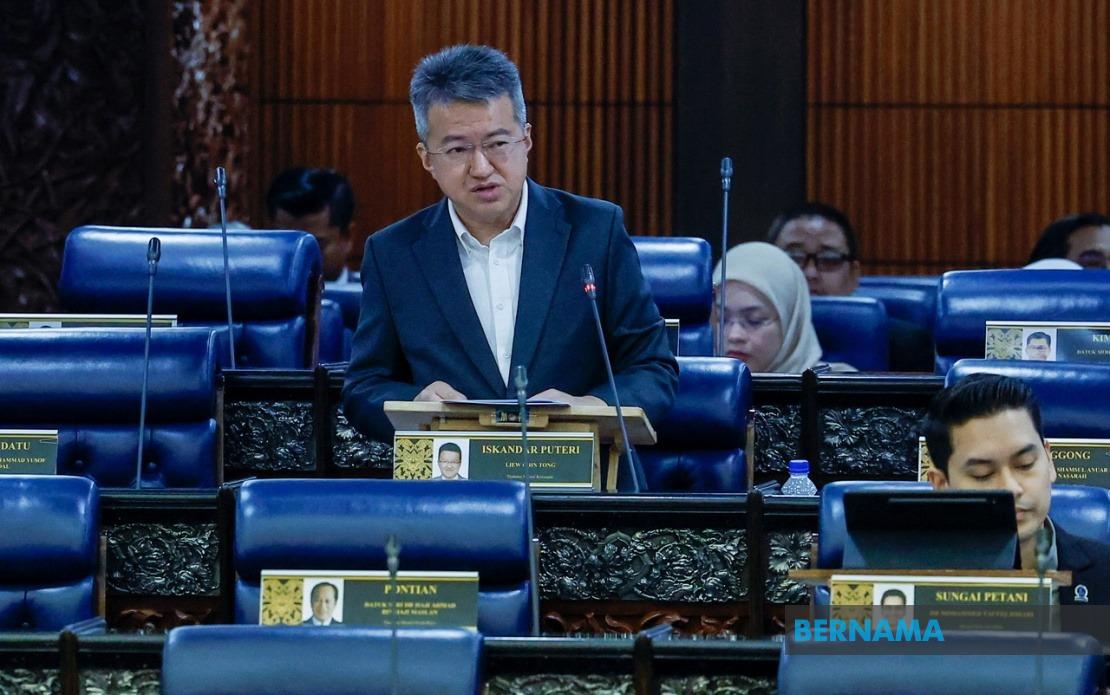
The federal government has moved to allay concerns that Sabah's newly increased interim special grant of RM1.5 billion will come at the expense of the state's broader development budget. Deputy Finance Minister Liew Chin Tong made the clarification during parliamentary proceedings on July 14, responding to queries about how the substantial grant would be administered and whether it might squeeze other funding mechanisms designated for Sabah's infrastructure and services.
The RM1.5 billion increase, which was first announced by Prime Minister Datuk Seri Anwar Ibrahim in May, represents a significant injection of resources into Sabah's coffers. However, the announcement had raised questions among lawmakers about potential trade-offs between the special grant and the state's regular development budget envelope. Liew's statement seeks to reassure both the Sabah state government and the federal parliament that this new financial commitment operates independently from existing allocations.
Sabah's development allocation has actually expanded this year to RM6.9 billion, up from RM6.7 billion previously, demonstrating the federal government's commitment to sustained investment in the state's infrastructure. This increase supports a diverse portfolio of projects aimed at addressing longstanding service gaps and connectivity challenges across Sabah. The Pan Borneo Highway continues to dominate development priorities, serving as a critical transportation spine linking remote communities to urban centres and improving regional trade connectivity.
Beyond major infrastructure, federal support extends to foundational services that underpin quality of life in the state. Rural road networks, electricity provision to remote villages, and water supply infrastructure all receive dedicated funding allocations within the RM6.9 billion envelope. These initiatives address persistent disparities between Sabah and Peninsular Malaysia, where rural residents have historically faced longer waits for basic utilities. The federal government has positioned infrastructure spending as a deliberate strategy to promote more equitable development across the nation.
Healthcare and education remain priority sectors within the development budget. Liew highlighted ongoing investment in hospital construction and upgrades, clinic expansion, renovation of deteriorating school buildings, and police station infrastructure. For a state with vast geographic distances and dispersed population centres, adequate healthcare facilities are critical for public health outcomes. Similarly, upgrading existing schools addresses overcrowding and safety concerns in communities where educational infrastructure has lagged behind demand.
Electricity subsidies represent another substantial federal commitment to Sabah, particularly important given the state's unique constitutional position. Although regulatory authority over electricity supply transferred to the Sabah state government in 2024, the federal government has committed to continuing subsidy payments to stabilise energy costs for consumers. The subsidy allocation is projected to reach RM880 million in 2026, underscoring the cost of maintaining affordable power across a state where geographical challenges make electricity distribution expensive. This ongoing support demonstrates federal backing for essential services despite devolved administrative responsibilities.
Water supply, a critical resource in tropical climates, also sees expanded investment. Liew disclosed that rural water supply allocations have increased substantially from RM103.5 million in 2025 to RM143 million in the current year, reflecting growing recognition of water security challenges and infrastructure gaps in outlying districts. For Malaysian readers familiar with periodic water rationing and supply disruptions, this increase signals federal prioritisation of service reliability in a state where geography compounds distribution difficulties.
Cost-of-living assistance programmes further augment federal support to Sabah's residents. The Sumbangan Tunai Rahmah (STR) and Sumbangan Asas Rahmah (SARA) cash assistance schemes represent direct transfers to vulnerable households in the state, with estimated allocations reaching RM1.2 billion. These programmes have become significant components of federal social policy, providing income support to lower-income families across Malaysia. The magnitude of these transfers in Sabah underscores the federal government's recognition of affordability pressures facing the state's residents.
The administration of the new special grant itself must navigate constitutional requirements stipulated under Articles 112C and 112D of the Federal Constitution. These provisions govern the process and procedures for special grants to Sabah, reflecting historical commitments made when Sabah joined the Malaysian federation. Liew indicated that payment mechanisms will follow the same framework implemented in previous years, including 2022, 2023, and 2025, ensuring consistency with constitutional requirements.
Understanding the constitutional framework is essential for Malaysian readers seeking clarity on federal-state relations in Sabah. Article 112C formally recognises special grants as a constitutional entitlement for Sabah, while Article 112D prescribes the procedural mechanisms for determining and administering these grants. The federal government's stated respect for these constitutional provisions, despite having filed an appeal against certain aspects of a Kota Kinabalu High Court ruling on the matter, suggests an acknowledgment that Sabah's special status within the federation carries legal weight and historical significance.
The broader context involves ongoing negotiations between federal and state authorities to develop new mechanisms for determining future special grants. Liew's statement indicates that the federal government views the current agreement as potentially temporary or subject to refinement, with discussions aimed at establishing more systematic approaches aligned with Articles 112C and 112D. Such negotiations reflect the delicate balance between federal fiscal management and constitutional obligations to Sabah, a tension that has periodically surfaced in Malaysian politics.
For Malaysia's regional standing, maintaining investor confidence in Sabah's development trajectory carries implications. Political clarity regarding funding commitments and budget stability helps create predictable conditions for both public infrastructure development and private investment. The federal government's explicit assurance that the special grant does not diminish regular development allocations represents an attempt to signal fiscal responsibility and consistency to economic observers.
The policy stance also reflects broader federal strategy toward East Malaysian states, where geographic challenges, lower population density, and constitutional arrangements require differentiated approaches compared to Peninsular Malaysia. By expanding both the special grant and regular development allocations simultaneously, the federal government seeks to demonstrate commitment to narrowing development disparities while respecting Sabah's constitutional position within the federation. This dual approach—honouring special grants while maintaining general development funding—represents an effort to balance historical commitments with contemporary economic management priorities.

