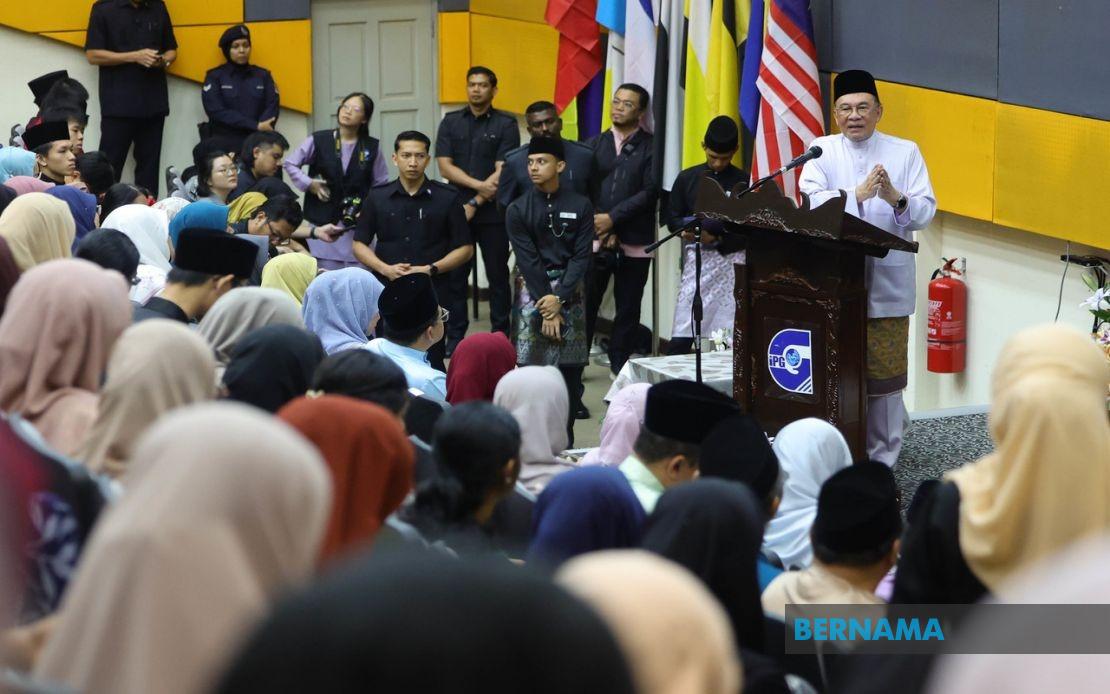
Prime Minister Datuk Seri Anwar Ibrahim has pinpointed the most significant barrier to Malaysia's comprehensive reform agenda, attributing setbacks not to deficiencies in technology or professional capability, but to the intransigence of those unwilling to abandon established systems. Addressing participants at a "Temu Anwar" forum held at the Technical Education Campus of the Institute of Teacher Education in Bandar Enstek, the Prime Minister argued that institutional change encounters formidable opposition from entrenched interests, particularly among elite circles who derive benefit from perpetuating a culture normalised around corrupt dealings and structural weaknesses.
Anwar's characterisation of reform obstacles reflects the accumulated experience of more than three years navigating the complexities of governance transformation. Throughout his tenure, he has observed how initiatives designed to strengthen institutional frameworks and systematically dismantle corruption repeatedly encounter resistance from quarters invested in maintaining the status quo. This resistance, the Prime Minister suggested, emerges not from principled disagreement but from the calculations of those whose advantages depend upon preserving existing arrangements.
The Prime Minister acknowledged an uncomfortable reality about the reform journey: such initiatives frequently prove unpopular among those whose privileges and accumulated advantages depend on systemic opacity. Nevertheless, he emphasised that sustained commitment to reform remains essential despite the political and administrative friction it generates. The strengthening of governance structures and the eradication of corruption may not enjoy widespread enthusiasm, yet abandoning these efforts would undermine the project of building a more transparent, accountable, and functionally effective administrative system.
Anwar articulated a philosophical position grounded in religious principle, cultural heritage, and civilisational progress. He contended that continuous improvement of institutional systems represents not merely a technical necessity but a moral imperative rooted in Islam, Malaysian cultural values, and humanity's broader developmental trajectory. By situating reform within this broader moral framework rather than presenting it as purely administrative modernisation, the Prime Minister sought to elevate the discourse beyond mere procedural adjustment.
Central to Anwar's analysis is his observation that resistance to reform often comes from individuals who maintain surface-level modernity in appearance and personal lifestyle while remaining fundamentally opposed to substantive systemic change. This paradox highlights how modernisation and institutional transformation represent different phenomena. Individuals may embrace contemporary fashions, technology adoption, and cosmopolitan aesthetics while simultaneously defending practices, networks, and power structures that demand secrecy, informal accountability mechanisms, and discretionary decision-making beyond public scrutiny.
The Prime Minister framed reform opposition as inherently threatening to established hierarchies and accumulated privileges. When systemic change challenges embedded practices that have become normalised through repetition and institutional acceptance, those positioned advantageously within such systems experience such challenges as existential threats. The resistance emerges because meaningful reform necessarily redistributes power, narrows avenues for discretionary action, and introduces transparency mechanisms that expose previously concealed transactions and relationships.
Anwar's remarks carry particular significance for Malaysia's development trajectory. As a nation seeking to consolidate democratic institutions, attract sophisticated foreign investment, and enhance its competitive position within regional and global markets, institutional credibility becomes increasingly vital. Investors, trading partners, and international institutions increasingly scrutinise governance quality, transparency standards, and corruption indicators. Reform obstacles that appear manageable from a domestic perspective may prove costly when assessed within competitive international contexts where alternative jurisdictions offer stronger institutional assurances.
The comments also underscore challenges confronting reform-minded leadership more broadly in Southeast Asia. Institutional inertia, networks of mutual obligation, patronage systems, and vested interests in opacity represent region-wide phenomena. Leaders attempting substantive institutional transformation discover that technical expertise and policy frameworks prove insufficient without addressing the human and political dimensions of resistance. Anwar's candid acknowledgment of these difficulties reflects the mature perspective of a leader who understands that reform represents a protracted struggle rather than a technical problem susceptible to administrative solution.
For Malaysian stakeholders monitoring governance developments, Anwar's analysis suggests that visible reform progress depends significantly on political capacity to manage and overcome organised resistance from beneficiaries of existing arrangements. The Prime Minister's willingness to publicly identify and characterise such resistance indicates conviction that institutional transparency and public acknowledgment of reform obstacles may itself contribute to changing political dynamics. By articulating clearly where reform challenges originate and identifying resistance sources, the government potentially mobilises constituencies favouring institutional improvement and increases costs for those seeking to obstruct reform efforts.
The broader implication of the Prime Minister's remarks concerns the nature of institutional change in societies where corruption has achieved significant normalisation. Eradicating practices regarded as standard operating procedure requires not only policy revision and procedural modification but also cultural reorientation and political will to confront powerful interests. This multidimensional challenge explains why reform implementation in Malaysia, despite considerable political determination and substantial technical capacity, proceeds incrementally and encounters sustained resistance.
Looking forward, Anwar's emphasis on identifying and naming reform obstacles may signal the government's strategy for sustaining reform momentum despite resistance. By framing the challenge as primarily political and volitional rather than technical, the Prime Minister potentially shifts burden of justification onto those defending corrupt practices and institutional opacity. This rhetorical positioning, combined with continued reform initiatives, may gradually alter the political landscape surrounding governance transformation in Malaysia.

