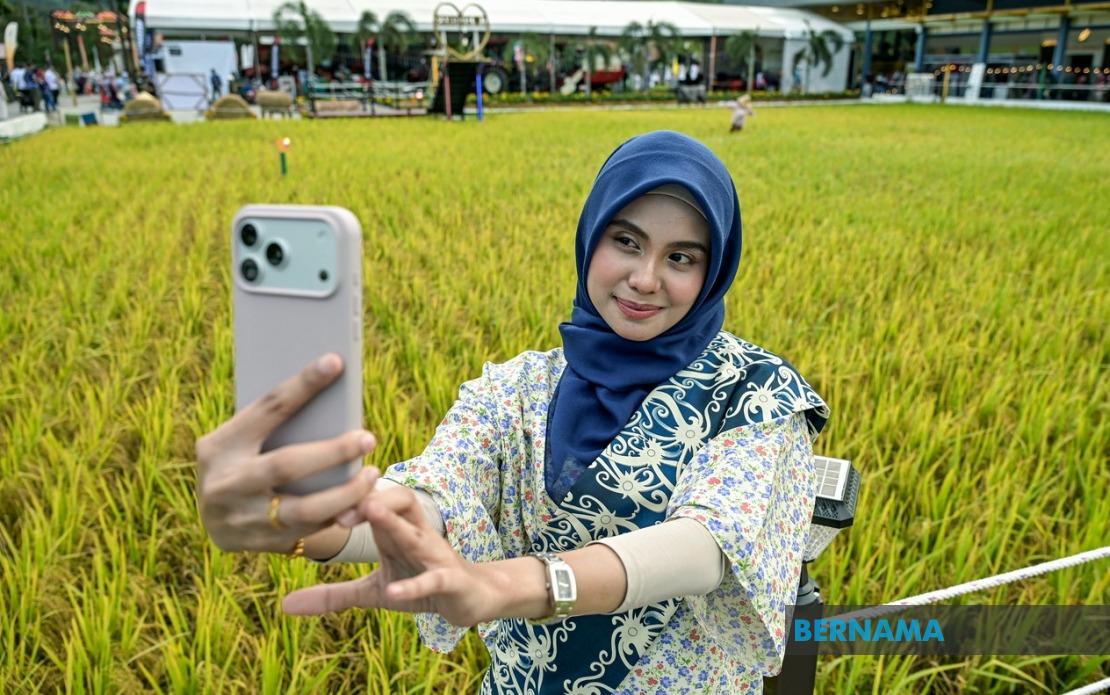
The Malaysia Agriculture, Horticulture and Agrotourism Exhibition (MAHA) 2026 has generated its first record-breaking achievement with the official recognition of Laman Padi's monumental paddy art installation by the Malaysia Book of Records. The spectacular field artwork, created on a seven-hectare site at Malaysia Agro Exposition Park Serdang (MAEPS), showcases the Jalur Gemilang national flag alongside heart and hand motifs and the word 'Jati', representing national identity and unity. The creation required meticulous agricultural planning, employing staged planting techniques that harness varying crop maturity levels to produce the vivid visual contrasts necessary for the design—a practical demonstration of how traditional farming methods can merge seamlessly with artistic expression.
The ambitious project represents a collaborative venture between Malaysia's agricultural ministry and private sector partners, utilising the MR284 paddy variety selected for its visual properties and growth characteristics. Minister of Agriculture and Food Security Datuk Seri Mohamad Sabu emphasised during the opening ceremony that this achievement extends far beyond artistic accomplishment, signalling a fundamental shift in how the nation conceptualises its agricultural landscape. Rather than viewing paddy cultivation exclusively through the lens of food production and yield metrics, the initiative demonstrates that rice-growing regions possess untapped potential as experiential destinations capable of generating diverse economic streams and cultural engagement.
The broader implications of Laman Padi's launch reflect evolving consumer expectations and demographic shifts across Malaysia. Urban populations and younger generations increasingly demonstrate limited direct exposure to agricultural realities, creating both a knowledge gap and a commercial opportunity. By transforming paddy fields into carefully curated tourist attractions integrated with educational programming, the agriculture sector positions itself as a gateway for reconnecting Malaysians with their agrarian heritage. This repositioning becomes particularly relevant as urbanisation accelerates and agricultural employment declines across the region—agrotourism offers farmers and rural communities pathways to supplementary income beyond commodity sales.
The physical infrastructure of Laman Padi supports this multi-purpose vision through seven distinct paddy plots and two information centres designed to narrate the evolution of rice cultivation from historical practices to contemporary methodologies. Rather than presenting farming as a static practice, the layout encourages visitors to understand technological progression, sustainability considerations, and the industry's contemporary challenges. Educational programming forms a cornerstone of the visitor experience, with approximately ten schools integrating paddy-related activities into their curricula and providing students with hands-on engagement in planting operations. This pedagogical dimension addresses a critical need to rebuild agricultural literacy among the younger generation, potentially influencing long-term career decisions and policy perspectives.
Visitor projections underscore the commercial viability of this approach. The Paddy Industry Development Division secretary Shamsul Akbar Sulaiman indicated that organisers anticipate approximately ten thousand daily visitors across MAHA 2026's ten-day run, with preliminary attendance figures already demonstrating strong interest—four thousand visitors arrived during the initial day. These numbers suggest that agrotourism attractions can generate footfall comparable to conventional exhibition spaces while offering distinctly immersive content. The economic multiplier effects extend through the wider regional ecosystem, as tourism spending circulates through accommodation, food and beverage enterprises, and local service providers.
The experiential model employed at Laman Padi incorporates what organisers term an 'infotainment' methodology, blending educational content delivery with entertainment value and interactive participation. Visitors engage with demonstrations, product showcases, and promotional activities rather than encountering static displays. This approach recognises that contemporary audiences, particularly younger cohorts, expect multi-sensory engagement and hands-on participation rather than passive information consumption. The integration of culinary offerings showcasing regional Malaysian food traditions tied to rice and paddy production further enhances the holistic experience, linking agricultural heritage to contemporary dining culture.
The collaborative framework underlying Laman Padi's development merits particular attention for demonstrating ecosystem-wide cooperation across the paddy and rice industry value chain. Government-organised infrastructure provides the venue and foundational programming, while private enterprises including BERNAS and other industry participants leverage the platform for product promotion and brand engagement. This arrangement allows commercial entities to reach concentrated audiences of both consumers and industry professionals while contributing to experiential quality. The resulting synergy between public sector vision and private sector execution, resource allocation, and expertise represents a replicable model for future agrotourism initiatives across Southeast Asia.
For Malaysia's broader agricultural policy framework, Laman Padi signals official recognition that farming's economic contribution increasingly encompasses non-traditional metrics. Rather than evaluating sector performance exclusively through production volumes, yield per hectare, or international commodity prices, policymakers acknowledge that cultural heritage preservation, rural employment diversification, educational outcomes, and tourism revenue constitute legitimate agricultural sector contributions. This conceptual evolution aligns with global trends emphasising sustainable agriculture, rural vitality, and experiential economy development—domains where Malaysia's geographic advantages and cultural diversity present competitive strengths.
Regional observers should note that Malaysia's emphasis on agricultural tourism innovation carries implications for Southeast Asian agricultural policy more broadly. The region's rural populations face pressure from commodity price volatility, climate variability, and demographic flight toward urban centres. By demonstrating that paddy cultivation sites can function as income-generating tourism destinations without abandoning their primary food production role, Malaysia offers a potentially applicable model for Thai, Vietnamese, Indonesian, and Philippine rice-producing regions confronting similar structural challenges. The MAHA 2026 initiative therefore represents both a domestic development and a demonstration project with regional relevance.
The Malaysia Book of Records recognition, while symbolically important, ultimately validates an emerging consensus that creative reimagining of agricultural spaces generates genuine economic and social value. This represents progression beyond rhetoric about agricultural sustainability toward demonstrable mechanisms enabling farmers and rural communities to capture value from activities extending beyond commodity production. As Laman Padi's visitor experience unfolds across the MAHA 2026 period, the operational data generated—regarding visitor demographics, engagement patterns, spending behaviour, and educational impact—will provide empirical evidence concerning agrotourism's viability as a sustainable rural development strategy for Malaysia.

