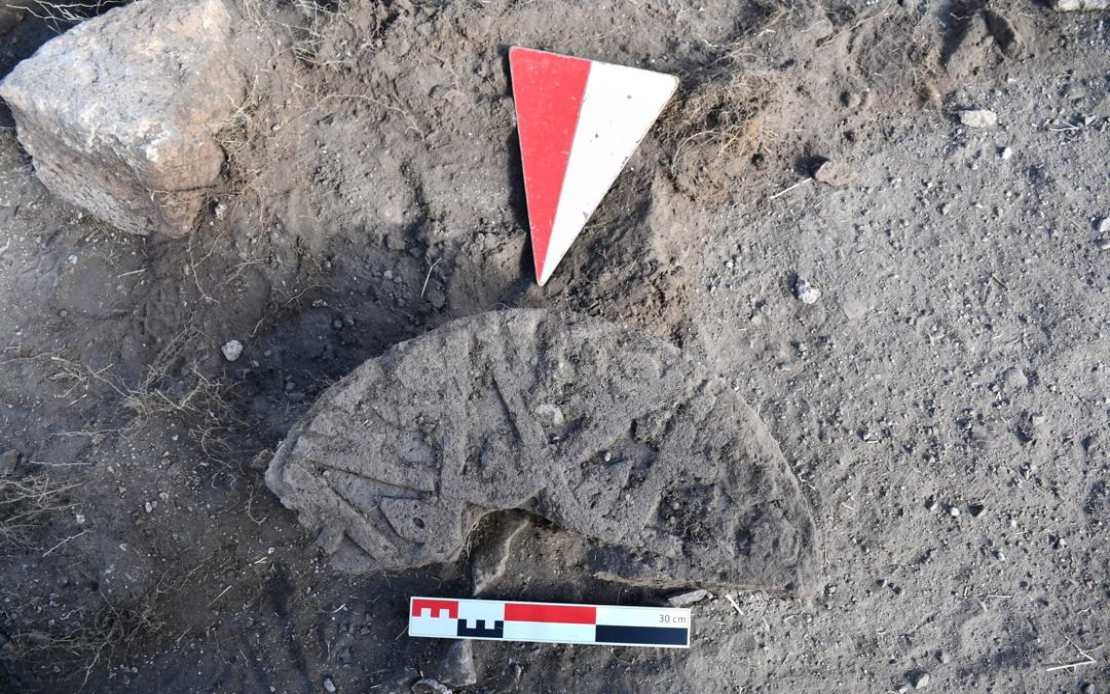
A significant archaeological discovery has emerged from excavations at Ani, the historic ruins in eastern Türkiye's Kars province, where researchers have uncovered a stone inscribed with the name of Prophet Muhammad. Turkish Culture and Tourism Minister Mehmet Nuri Ersoy announced the find through social media, drawing attention to what specialists believe is a centuries-old artifact originating from a Seljuk-era tomb tower. The discovery adds another layer of understanding to the religious and cultural practices of the medieval Islamic period in Anatolia.
The inscribed stone reveals remarkable craftsmanship characteristic of the Seljuk period. Minister Ersoy highlighted that the Prophet's name appears six times across the artifact, rendered in Kufic script—an early angular style of Arabic calligraphy that flourished during the Islamic Golden Age. Three of these inscriptions form part of an ornate decorative band that encircles an eight-pointed star, suggesting the stone served both a spiritual and aesthetic function within its original architectural context. The geometric precision and artistic integration of the religious inscriptions demonstrate the sophistication of Seljuk artisans working in the region during the medieval period.
The artifact emerged during ongoing excavations at a Seljuk cemetery that has been the focus of systematic archaeological study since 2021. The cemetery site represents an invaluable resource for understanding burial practices, religious beliefs, and daily life during the Seljuk occupation of Anatolia. Each discovery from these systematic digs contributes to a more complete historical record of how various civilizations layered their cultures across this strategically significant territory. The disciplined archaeological approach has yielded findings that would likely have remained hidden without such sustained academic effort.
Ani itself occupies a position of extraordinary historical importance spanning multiple civilizations and centuries. Located at the crossroads of ancient trade networks, particularly the Silk Road, the site served as a commercial and cultural hub connecting East and West. During the 10th and 11th centuries, Ani functioned as the capital of the Bagratid Armenian kingdom, a prosperous period reflected in its architectural heritage. Subsequently, the city fell under Byzantine dominion, then Seljuk rule, and eventually became part of the Ottoman Empire, with each civilization leaving distinct marks on the urban landscape and cultural fabric.
The layering of different empires and religious traditions at Ani creates a palimpsest of historical significance that resonates with modern scholars and archaeologists worldwide. For Malaysian and broader Southeast Asian audiences, Ani's story parallels the multicultural and religiously diverse heritage found throughout our own region. Like Melaka, Angkor, or Borobudur, Ani represents a place where multiple civilizations converged, traded, and influenced one another, creating distinctive architectural and artistic syntheses. Understanding how ancient sites navigated religious and cultural pluralism offers perspective on contemporary challenges of heritage preservation and interfaith coexistence.
The archaeological significance of Ani received formal international recognition when UNESCO inscribed the site as a World Heritage Site in 2016. This designation acknowledged not only the physical remains but the site's importance in documenting the historical interaction between Armenian, Byzantine, Persian, and Turkic civilizations. UNESCO recognition brings increased research opportunities, enhanced conservation resources, and international scholarly attention—all factors that enable discoveries such as the recently found inscribed stone to be properly documented, analyzed, and shared with global academic communities.
The Seljuk period, during which the inscribed stone originated, represents a crucial chapter in Anatolian and broader Islamic history. The Seljuks, a Turkic dynasty that established major territorial holdings across the region from the 11th to 13th centuries, were known for their cultural patronage, architectural innovation, and religious devotion. The appearance of Prophet Muhammad's name on the stone reflects the deep religiosity characteristic of the period, when mosques, madrasahs, hospitals, and religious monuments proliferated under Seljuk rule. Such inscriptions often served apotropaic functions—believed to offer spiritual protection to the deceased in their tombs.
The discovery methodology employed by Turkish archaeologists demonstrates contemporary best practices in heritage preservation and scientific documentation. Rather than opportunistic treasure hunting, the systematic excavation of the cemetery since 2021 represents the patient, methodical accumulation of knowledge about past societies. Each artifact, no matter how small, is recorded with precise spatial information, photographed, and analyzed within its archaeological context. This approach allows researchers to understand not just individual objects but the broader patterns and practices they reveal about beliefs, social organization, and cultural values.
For the international archaeological community and heritage institutions across Southeast Asia, findings such as this inscribed stone underscore the continuing potential of sites once thought fully explored. Ani, despite centuries of documented history and previous archaeological work, continues yielding new discoveries that refine and deepen understanding. This serves as an important reminder that heritage sites across the region—from the temple complexes of Cambodia to the ancient kingdoms of Srivijaya—may still hold undiscovered artifacts and insights. Sustained, properly funded archaeological research remains essential for unlocking these historical narratives.
The implications of such discoveries extend beyond academic circles into questions of contemporary geopolitics and heritage stewardship. Ani's location on the Turkish-Armenian border has made the site occasionally controversial, with both nations claiming historical connections and preservation rights. International designation as a UNESCO World Heritage Site theoretically transcends national boundaries, positioning Ani as humanity's shared heritage rather than a nationalist possession. In the Southeast Asian context, where multiple nations share borders and heritage sites, this model of international cooperation offers valuable lessons for how countries might jointly protect and study archaeological treasures that span their territories.
Turkish authorities have signaled their commitment to sustained research and proper conservation of discoveries at Ani through continued excavations and the public announcement of significant finds. Minister Ersoy's social media announcement reflects a broader trend of heritage institutions using digital platforms to engage public interest and maintain transparent communication about archaeological work. Such accessibility helps foster appreciation for historical research beyond specialist circles and demonstrates how contemporary tools can enhance awareness of cultural heritage. For Malaysian institutions managing their own archaeological sites and museums, this approach suggests effective strategies for public engagement with heritage research.

