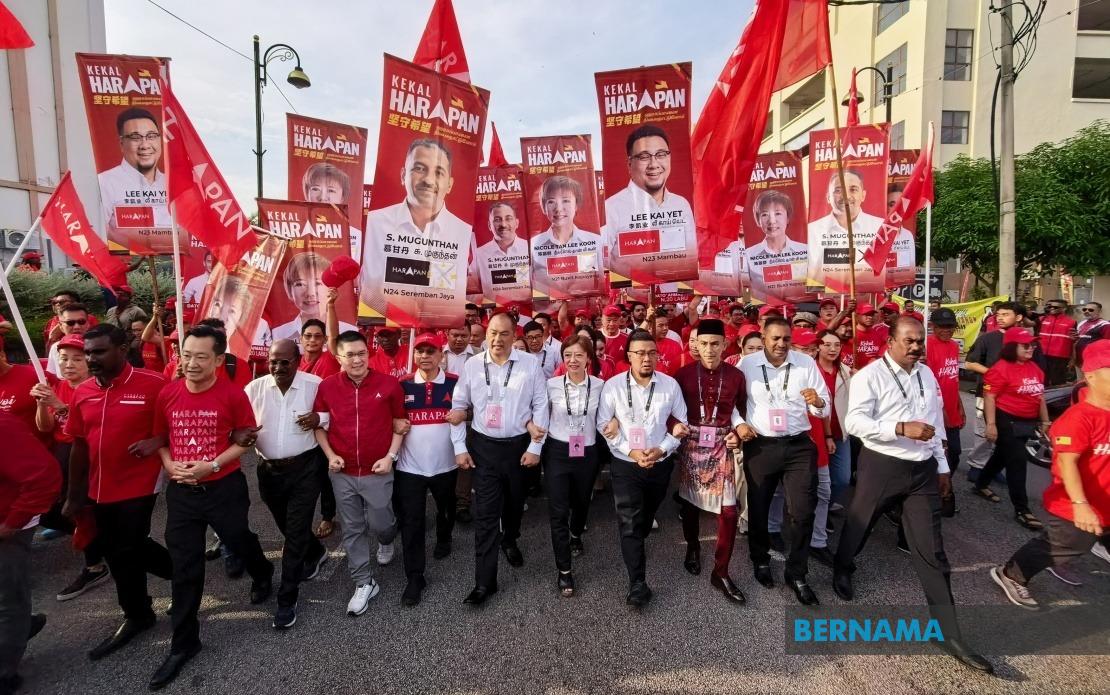
The Rahang seat in Negeri Sembilan has emerged as one of the more competitive contests in the state election, with Pakatan Harapan incumbent Siaw Meow Keong preparing to defend his position against rivals representing three separate political coalitions. Siaw, who serves as treasurer of DAP's Negeri Sembilan chapter, has held the constituency since 2023 and will be tested by a notably diverse field of challengers in what the returning officer confirmed as a four-cornered race during nomination proceedings held in Seremban on July 18.
The depth of competition reflects broader fragmentation in Malaysian politics, with Siaw's challengers spanning the ideological spectrum. Yap Siok Moy, representing Barisan Nasional, brings credentials as Rasah MCA Wanita chief and represents the traditional coalition seeking to reclaim ground in the state. S. Thinagaran, contesting under the banner of Parti Sosialis Malaysia, offers voters a left-leaning alternative outside the mainstream coalitions. Tang Jay San's candidacy for Bersatu underscores the influence of the Muhyiddin-led faction in Negeri Sembilan politics, particularly among voters who may favour its positioning as an alternative to UMNO-dominated BN.
The nomination filing process itself provided insight into candidate dynamics, with the sequence revealing little about internal campaign coordination. Thinagaran filed first at 9.06 am, followed by Tang at 9.10 am, Siaw at 9.12 am, and Yap completing the quartet at 9.13 am. Such timing details, while procedural, occasionally signal campaign momentum or organisational readiness among political operatives managing each candidature. The compressed timeframe of nominations filing underscored the efficiency of the returning officer's administration in processing the elevated number of candidates.
Elsewhere in Negeri Sembilan, the electoral landscape shows considerable variation in contest structure. The Bukit Kepayang seat stands as an exception to the four-way dynamic, where DAP Wanita chief Nicole Tan Lee Koon will engage in a direct two-candidate contest against Perikatan Nasional's Lee Boon Shian. This straight fight may prove decisive, as such contests typically produce clearer mandates and reduce vote-splitting concerns that plague multi-cornered races. Tan's position as an incumbent with organisational backing from her party structure contrasts with her single challenger, suggesting BN has either chosen not to contest or withdrawn in favour of the PN candidate.
Three other constituencies will feature three-way contests, adding further complexity to the state election narrative. In Labu, Pakatan's Datuk Ahmad Faez Abdul Razak confronts both Bersatu's Mohamad Hanifah Abu Baker and BN's Siti Nur Umaira Hasim, a composition that fragments the traditional two-coalition framework. The Mambau seat presents a similarly tripartite scenario, where PH's Lee Kai Yet faces competition from both Bersatu and Perikatan Nasional in the form of N. Sarawanan and Eric Michael respectively. This three-way dynamic reflects the erosion of clear two-coalition politics that once dominated Malaysian elections, replaced by a more atomised party system where multiple factions compete for voter attention.
Seremban Jaya rounds out the three-cornered contests, with PH candidate S. Mugunthan pursuing defence against BN's Datuk T. R. Thinalan and Bersatu's R. Mahendran. The proliferation of three and four-cornered races across multiple constituencies suggests voters in Negeri Sembilan face genuine choice architecture rather than binary options. For traditional supporters of either major coalition, this multiplication of candidates complicates voting calculations and may influence turnout patterns. Some voters may feel energised by expanded choice, while others may experience decision fatigue when evaluating candidates across competing party platforms.
The presence of Parti Sosialis Malaysia in the Rahang race distinguishes that contest within Negeri Sembilan's electoral calendar. PSM's participation signals its attempt to establish footholds in state-level politics beyond its traditional strongholds, though its historical weakness in electoral competition suggests Thinagaran's candidacy may function more as an anti-establishment marker than a serious contention for the seat. Nevertheless, even marginal candidates can shape electoral outcomes if their vote share proves decisive between leading contenders.
Bersatu's presence across multiple constituencies indicates strategic resource allocation by the party in Negeri Sembilan, reflecting its transition from a single-leader vehicle toward a more institutionalised political force. Tang Jay San in Rahang, Sarawanan in Mambau, and Mahendran in Seremban Jaya represent discrete candidate selections, suggesting no blanket fielding strategy but rather targeted engagement in constituencies where the party perceives competitive advantage or strategic positioning value.
The Election Commission's timeline establishes July 28 for early voting, allowing voters unable to participate on the main polling day to cast ballots in advance. August 1 has been designated as polling day for the entire state election, compressing the campaign period into a relatively brief window for candidates to mobilise supporters and articulate their platforms. This compressed timeframe may advantage incumbents with established machinery and disadvantage new entrants seeking to build name recognition and campaign presence.
For Negeri Sembilan's political observers and voters, the election presents a fragmented landscape where no single coalition can assume automatic dominance. The Rahang contest exemplifies this fragmentation most acutely, with four distinct political movements competing for a single constituency mandate. How voters navigate this multiplicity—whether consolidating around traditional coalitions, splitting votes among preferred independents and smaller parties, or rewarding performance of incumbent representatives—will significantly influence the composition of the state assembly and the governing coalition's ability to form government.

