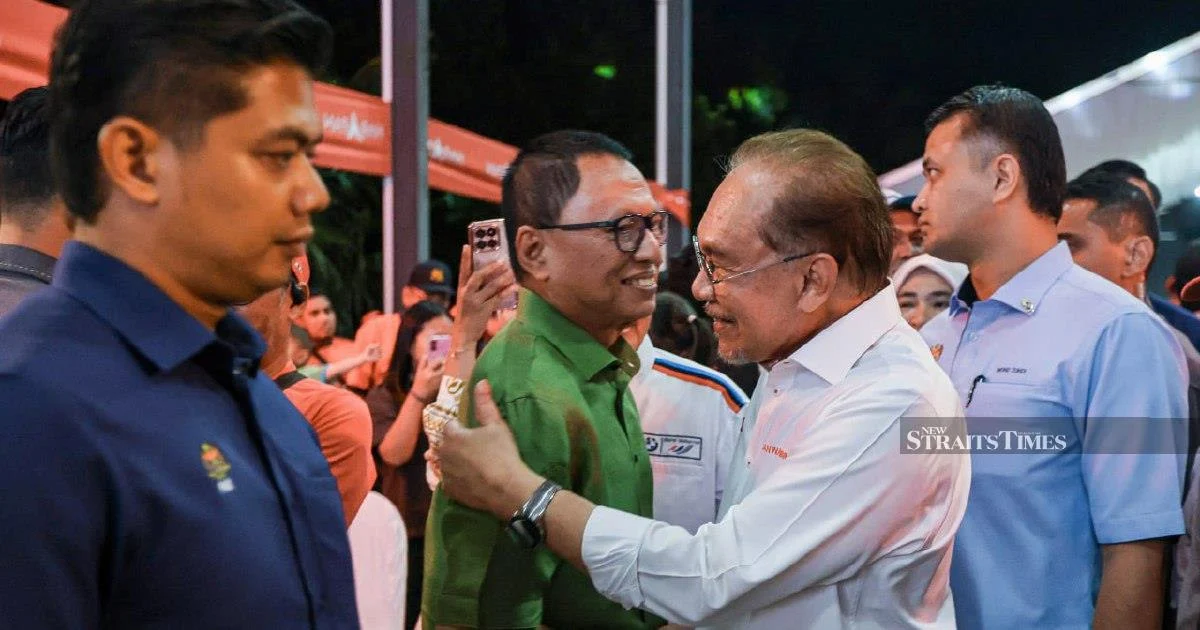
Bersama leader Datuk Seri Rafizi Ramli has delivered a pointed political jab at Datuk Dr Mohd Puad Zarkashi, using humour to comment on the latter's public encounter with Prime Minister Anwar Ibrahim in Johor Baru on Saturday. The exchange underscores the ongoing tensions and shifting allegiances within Malaysia's fractious political landscape, where public displays of camaraderie between politicians from different parties frequently spark speculation about broader coalition realignments.
Rafizi's barbed remark—framing Puad's affectionate greeting with the Prime Minister as evidence of a metaphorical portfolio swap from Umno to PKR—captures a recurring pattern in Malaysian politics. When senior figures are seen in warm, publicly documented moments with rival party leaders, it inevitably triggers commentary from opposition figures and political observers questioning the stability of existing party loyalties. The timing and visibility of such interactions matter significantly in Malaysia's intense political ecosystem, where every gesture carries symbolic weight.
The incident reflects deeper undercurrents within the ruling coalition and its relationship with the opposition. Umno, traditionally the largest component of the Barisan Nasional, has experienced considerable internal strain and defections in recent years. Meanwhile, PKR, as the dominant party in the Pakatan Harapan alliance, has been actively courting political figures who might strengthen its parliamentary position or bring fresh constituencies into its fold. Puad's prominence in Umno circles makes any apparent warming towards the Prime Minister's circle a matter of political significance.
Rafizi's public commentary serves multiple purposes in Malaysia's media-saturated political environment. Such remarks generate headline coverage, energise his party's supporters, and subtly probe whether high-profile Umno members might be considering their political futures. Bersama, as a newer political force, has sought to position itself as a fresh alternative in Malaysian politics, and Rafizi's visible engagement with political developments demonstrates the party's intent to remain relevant in national discourse despite its limited parliamentary representation.
The embrace captured on Saturday appears to have been unexpected enough to warrant immediate political commentary, suggesting it deviated from routine professional interactions. In Malaysian politics, where formal courtesy is typically extended to all political figures regardless of party affiliation, more intimate or warm public displays often provoke interpretation as signals of deeper political understanding or potential alignment. This reflects how Malaysian voters and political observers read the subtle language of public political interaction.
Puad's profile as a seasoned Umno politician with relevant political experience makes him a potential asset to any coalition attempting to strengthen its position. The PKR-led coalition government, while commanding a parliamentary majority, continues to navigate complex coalition dynamics that require careful management of competing interests. Bringing in respected figures from rival parties represents one strategy for consolidating political stability and broadening the coalition's appeal across different demographic and regional constituencies.
Rafizi's quip demonstrates how Malaysian political leaders utilise humour and public commentary as tactical tools for shaping political narratives. Rather than making direct accusations, he employed wordplay to suggest that Puad might be reassessing his political commitments. This approach allows Rafizi to raise questions about Umno's internal stability and the durability of party loyalty without making explicit claims that could invite legal challenges or formal political disputes.
The broader context involves Umno's complicated relationship with the current government. Despite initially opposing the PKR-led coalition after the 2022 general election, Umno eventually provided crucial parliamentary support that enabled the government's survival. However, this arrangement has remained fraught with tension, as both major political blocs compete for dominance and attempt to poach talented figures from rival organisations. Every high-profile interaction between Umno figures and government leaders occurs against this backdrop of cautious cooperation mixed with underlying strategic competition.
For Malaysian and Southeast Asian political observers, such incidents highlight how coalition governments in the region often depend on fluid political arrangements and the negotiated loyalty of individual politicians rather than ideological coherence. Unlike more established democracies where party discipline and platform consistency are stronger, Malaysian political dynamics frequently revolve around personalities, regional interests, and the strategic positioning of influential figures. Rafizi's commentary, though lighthearted in tone, points to these fundamental structural features of contemporary Malaysian politics.
The incident also underscores Bersama's position within the broader political ecosystem. As a newer entrant competing for relevance, the party benefits from maintaining a visible public profile and demonstrating engagement with significant political developments. Rafizi's willingness to comment on interactions involving senior figures from larger established parties keeps Bersama in the political conversation, even if the party's actual parliamentary influence remains limited compared to Umno, PKR, or the DAP.
Moving forward, such public interactions and the political commentary they generate will continue shaping Malaysia's coalition dynamics. The ease with which senior political figures might potentially switch party affiliations, whether through formal defection or gradual disengagement, reflects the underlying institutional fragility of party structures in Malaysia. Rafizi's joke, while meant humorously, implicitly raises serious questions about the loyalty and stability of Malaysia's established parties and whether individual politicians might be quietly reassessing their long-term political positioning in light of shifting electoral and coalition landscape.

